

129
Love
🎊
Double Happiness
China
Shuang Xi — the Double Happiness character — is China's most recognized symbol of marital joy, formed by writing the character for 'happiness' twice in a single united form.
4.7Learn more →


In Chinese culture, the bat is one of the most auspicious animals because its name (fu) is a perfect homophone for 'good fortune' — making the bat a living embodiment of luck itself.
The Chinese bat (fu, 蝠) holds the most linguistically fortunate position of any animal in Chinese culture: its name is an exact homophone for 'good fortune' (fu, 福). This sonic coincidence — which in Chinese cultural logic is anything but accidental, but rather a hidden correspondence revealing the bat's true cosmic nature — elevated an otherwise unremarkable nocturnal creature into one of China's premier symbols of auspiciousness. Where Western cultures associated bats with darkness and ill omen, Chinese artists, craftspeople, and philosophers saw in the bat a creature whose very name was a daily reminder that fortune is present even in darkness.
Chinese decorative arts from the Song dynasty onward are saturated with bat imagery in explicitly lucky contexts. Five bats (wu fu, 五福) together represent the Five Blessings of Chinese tradition: longevity (shou), wealth (fu), health and peace (kangning), virtue (hao de), and a natural death completing a full life (kaoshu zhongming). The five-bat motif appeared on imperial robes, palace ceilings, porcelain, lacquerwork, jade carvings, silk embroidery, bronze vessels, and wedding gifts — making the bat one of the most comprehensively deployed decorative motifs in Chinese material culture.
The bat symbol's visual presentation in Chinese art is typically highly stylized: wings spread symmetrically, body and face frontal, arranged in cloud-like or floral patterns. The red bat (hong fu, 紅蝠) is doubly auspicious, as 'red fortune' — the combination of the lucky color with the lucky creature creates a concentrated blessing that appears on wedding textiles, New Year decorations, and the finest porcelain.
Good fortune arriving from the sky, the Five Blessings of a complete and happy life, the presence of luck in all directions including darkness, and the cosmic affirmation that fortune's name is written into nature itself.
Incorporate bat imagery into home decorations, particularly paired arrangements of five bats for the complete Five Blessings. Use bat motif wallpaper, textiles, or ceramics in the wealth area of the home. A red bat embroidered on a pillow or cushion in the bedroom is considered a happiness charm for couples. Gift bat-motif items for weddings, birthdays, and New Year.
During the Qianlong Emperor's reign (1735–1796), the bat motif reached its most elaborate development in Chinese art, with palace ceramics featuring 10,000 individual bat forms as an emblem of '10,000 blessings' — an artistic feat requiring extraordinary technical skill that art historians now consider among the finest examples of Chinese decorative achievement.
The difference is purely linguistic and cultural, not based on any observation of the bat's actual behavior. In Chinese, the homophone fu (bat/fortune) created a positive association. In medieval European culture, bats were associated with witches, darkness, and vampires through folklore unrelated to any phonetic connection. The bat itself is identical; the cultural projection onto it differs completely.
The five bats (wu fu) represent the Five Blessings: longevity (long life), wealth (financial prosperity), health and peace of mind, virtue and love of moral living, and a natural death at the end of a full life. These five together constitute the Chinese ideal of a complete and fulfilled human existence. Five bats together express the wish for all five simultaneously.
In contemporary global culture, the Chinese symbolic bat is widely understood as distinct from the bat's Western associations. Chinese decorative items featuring bat motifs are appreciated globally. Context helps: a stylized gold-and-red bat in Chinese decorative art style clearly communicates its auspicious meaning to anyone with even passing familiarity with Chinese culture.
China
Shuang Xi — the Double Happiness character — is China's most recognized symbol of marital joy, formed by writing the character for 'happiness' twice in a single united form.
China
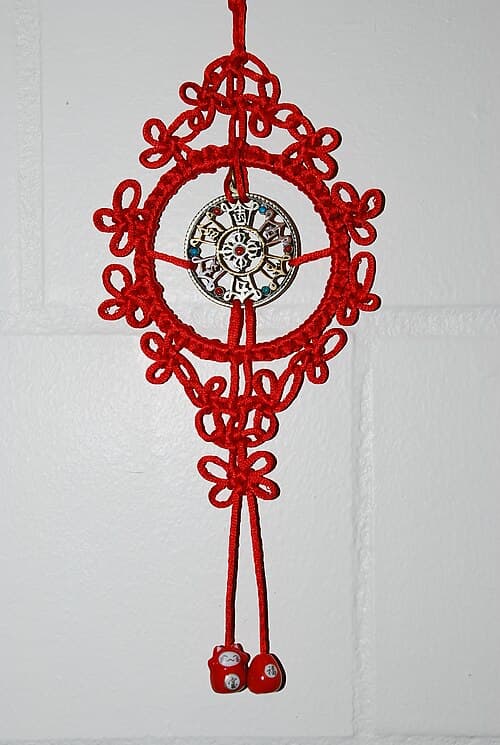
Chinese decorative knots are intricate single-cord creations representing unity, good fortune, and the endless continuity of blessings — each pattern carries its own specific meaning.

China
Goldfish have been symbols of wealth and abundance in China for over a thousand years, their gold color and fluid movement embodying the easy flow of prosperity.

China
The peach in Chinese mythology is the fruit of the immortals, ripening once every three thousand years in the garden of the Queen Mother of the West to grant eternal life.

