Colombian Tumbaga
Colombia (Muisca and other pre-Columbian civilizations)
The sacred gold-copper alloy of Colombia's pre-Columbian peoples — the metal behind the El Dorado legend and some of the most extraordinary goldwork in world history.
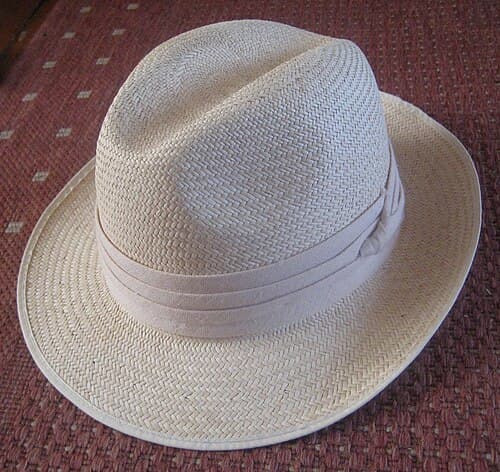
The world's finest straw hat — technically Ecuadorian, famously misnamed — a symbol of artisan excellence, trade's global reach, and working with grace under tropical sun.
The Panama hat is one of history's great geographical misattributions: this exquisitely crafted hat of toquilla straw is made in Ecuador — primarily in the towns of Montecristi on the coast and Cuenca in the highlands — and has been for over four centuries. The 'Panama' name stuck because the hats became internationally famous when they were sold to workers and dignitaries passing through Panama during the construction of the railroad and later the Canal, including President Theodore Roosevelt, who was photographed wearing one in 1906. The photograph went around the world and the hat's association with Panama became permanent.
The finest Montecristi Panama hats — superfinos — are among the most labor-intensive handmade objects on earth. A single superfino hat requires toquilla fiber that can only be harvested in the cool hours before dawn (heat makes the fiber brittle), then dried, bleached, and woven by a master craftsperson working in a cool, dimly lit environment for anywhere from one month to one year. The weave is so fine that a truly exceptional Montecristi superfino can be rolled into a tube and passed through a ring, then shake out perfectly when unrolled. These hats sell for thousands of dollars.
UNESCO recognized the toquilla straw weaving tradition of Ecuador as Intangible Cultural Heritage in 2012. As a luck charm, the Panama hat represents the rewards of extraordinary craft, the way that excellent work travels beyond its origins and reshapes the world's understanding of value, and the Ecuadorian quality of working beautifully and without complaint even when credit goes elsewhere.

The Ecuadorian Panama hat represents the quiet dignity of excellent craftsmanship that speaks for itself even when improperly credited. It symbolizes the rewards of patient, painstaking work — the superfino hat's extraordinary price validates centuries of artisan dedication. As a luck charm it brings the energy of quality recognized across global distances and labor honored with its true worth.
Wearing a genuine Ecuadorian Panama hat is itself the most meaningful use — it is a functional charm for protection from the sun's harsh energy while physically connecting you to one of the world's great craft traditions. Display a quality Montecristi in your workspace to invoke the energy of patient excellence and globally recognized quality. Give Panama hats as status gifts to people who appreciate the finest handmade objects.
The world record for the finest toquilla weave ever measured was achieved by a Montecristi master weaver named Simón Espinal, who produced a hat with 3,600 weaves per square inch — so fine it was nearly translucent and took over a year to complete. This achievement, at the extreme edge of what human fingers can accomplish, is considered one of the world's greatest craft accomplishments.
Look for certification from the Junta Nacional de Defensa del Artesano or purchase from established Ecuadorian hat importers. Genuine Montecristi hats come with documentation of origin. The quality of the weave (count the weaves per inch), the uniformity of the pattern, and the flexibility of the hat are physical indicators. Mass-produced hats from China or other locations can look similar at low quality levels.
Store a genuine toquilla straw hat in its original box or a hat-shaped stand — never crushed or folded except for specifically designed rollable versions. Keep it away from moisture, which can permanently warp the shape. If it becomes damp, reshape it while damp and let it dry in shape. Clean with a soft, slightly damp cloth. Treat it like the fine craft object it is.
The name 'Panama hat' has been in use for over 150 years and is embedded in the global trade nomenclature and legal classification of goods. Ecuador has pursued recognition through UNESCO and through quality certification programs rather than renaming — a pragmatic approach that maintains market recognition while asserting proper cultural credit. Ecuador's solution has been to tout the origin story rather than fight the name.
Colombia (Muisca and other pre-Columbian civilizations)
The sacred gold-copper alloy of Colombia's pre-Columbian peoples — the metal behind the El Dorado legend and some of the most extraordinary goldwork in world history.
Peru (Chimú and Inca civilization)
The iconic ceremonial sacrificial knife of ancient Andean civilization, now a symbol of Peruvian identity and good fortune.
Argentina (Pampas region)
The iconic facón of the Argentine gaucho — a large sheath knife symbolizing autonomy, courage, and the free life of the Pampas horseman.