

30
Protection
✡️
Star of David
Israel
The six-pointed star that became Judaism's most recognized symbol, now carried as both identity marker and protective charm.
4.8Learn more →

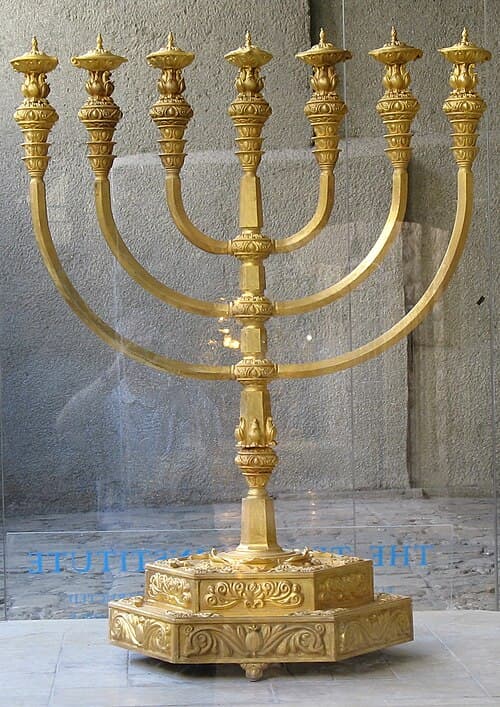
The seven-branched candelabrum, Judaism's oldest symbol of divine light and the endurance of faith against darkness.
The seven-branched menorah (from the Hebrew for 'lamp') is among the oldest and most historically documented symbols in Judaism — it was the central sacred object of the Tabernacle built by Moses in the wilderness and later of Solomon's Temple and the Second Temple in Jerusalem. Its seven branches correspond to the seven days of creation, the seven known planets of the ancient world, and the divine light that illuminates all wisdom. When the Roman army destroyed the Second Temple in 70 CE, the Arch of Titus in Rome depicts Roman soldiers carrying the great Temple menorah in their triumphal procession — an image that has haunted Jewish memory ever since and made the menorah's eventual return one of the unfulfilled longings of Jewish historical consciousness.
The Hanukkah menorah (technically called a chanukiah) has nine branches — eight for the eight nights of the miracle of the oil plus one shamash (helper) branch — and is distinct from the Temple menorah, though both share the name and the symbolism of light persisting against all odds. The Hanukkah story — a small amount of oil lasting eight days when it should have lasted one — is itself a legend of impossible persistence, and lighting the chanukiah publicly fulfills the commandment of 'publicizing the miracle,' making the menorah an act of declaration: our light cannot be extinguished.
The State of Israel adopted the seven-branched menorah as its official state emblem, explicitly connecting the modern state to the ancient Temple tradition and expressing continuity with thousands of years of Jewish civilization. Menorah jewelry and miniatures are among the most universally recognized Jewish symbols, worn and displayed across all Jewish communities worldwide.
Divine light that cannot be extinguished, the persistence of faith and culture against overwhelming historical odds, and the creation principle embodied in seven days/branches. The menorah says: even in the deepest darkness, this light endures.
Light a chanukiah (Hanukkah menorah) for eight nights placing it where it can be seen, fulfilling the commandment of publicizing the miracle. Wear a menorah pendant as a Jewish identity and light symbol. Display a decorative seven-branched menorah in the home year-round as a symbol of divine illumination and cultural continuity.
The famous Arch of Titus menorah relief in Rome shows the Temple menorah with a specific octagonal base design. In 2019, archaeologists found a fragment of Temple-period stone carving at Jerusalem's Western Wall that may depict the Temple menorah in the same form — potentially the earliest contemporary image of the original sacred object.
A menorah has seven branches and represents the Temple candelabrum. A chanukiah (Hanukkah menorah) has nine branches — eight for the eight nights of Hanukkah plus one shamash. In everyday usage 'menorah' is often used for both, but technically they are distinct objects with different ritual functions.
When Israel declared independence in 1948, the founders chose the menorah as the state emblem because it is Judaism's oldest continuously documented symbol, appears in ancient Jewish art and coinage, and represents the continuity of Jewish civilization from the Temple period to the modern state. The olive branches flanking it are from Zechariah's prophetic vision.
Its fate is unknown. After the Temple's destruction in 70 CE the menorah was taken to Rome, depicted in the Arch of Titus procession. Some historical accounts suggest it went to Carthage, then to Constantinople, and eventually disappeared. The Vatican has historically denied possessing it, and its location remains one of the great mysteries of ancient history.
Israel
The six-pointed star that became Judaism's most recognized symbol, now carried as both identity marker and protective charm.

Israel
The Hebrew word for 'life' worn as the most personal and meaningful of all Jewish lucky charms.

Israel
A scroll of Torah verses in a decorative case affixed to doorposts, transforming Jewish homes into sanctuaries.

