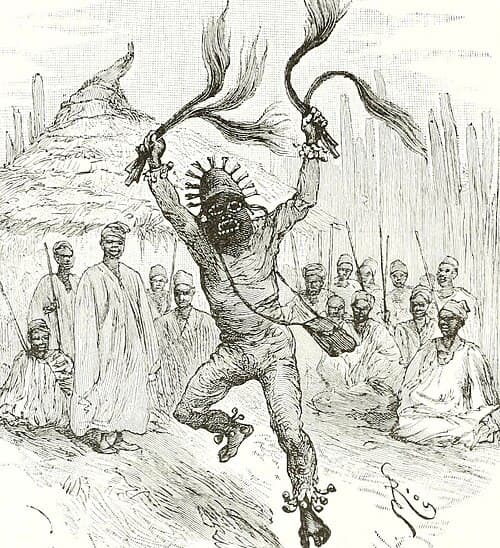
Puerto Rican Vejigante Mask
Puerto Rico (Ponce and Loíza)
The magnificent multi-horned papier-mâché mask of Puerto Rican Carnival tradition — a figure who chases away evil while embodying the island's joyful, syncretic spirit.
The spectacular mas' costume and mask of Trinidad's Carnival — the greatest show on earth, where transformation is both art and liberation.
Trinidad's Carnival — 'the Greatest Show on Earth' — is a two-day explosion of color, music, dance, and spectacular costume that fills the streets of Port of Spain every year before Ash Wednesday. The tradition evolved from the enslaved Africans of Trinidad who transformed the planters' pre-Lenten balls into their own massive celebration, taking to the streets after emancipation in 1838 with costumes that mocked their former masters and honored their own African traditions. What emerged was one of the most creative, politically charged, and joyfully overwhelming celebrations in the world.
The mas' costume (from masquerade) has grown over centuries into an extraordinary art form — from elaborate wire-bending and hand-sewing to today's feathered bikini-and-glitter presentations — and is designed annually by mas' bands whose themes, political content, and aesthetic ambition are subjects of serious cultural discussion. The traditional Carnival characters — the Midnight Robber with his tall hat and rhetoric, the Jab Jab covered in mud and chains representing the enslaved made free, the Moko Jumbie on stilts, the Blue Devil — each carry specific meanings about freedom, history, and the supernatural.
A Trinidadian Carnival mask or costume element as a charm carries the energy of radical liberation through joy, of transformation through performance, and of the West Indian understanding that play is not trivial but is one of humanity's most powerful responses to suffering.

The Trinidadian Carnival Mask traces its origins to Trinidad and Tobago, where it has been revered for generations as a powerful symbol of good fortune and positive energy. Historical records and oral traditions suggest that early versions of this charm appeared centuries ago, when communities in Trinidad and Tobago first began attributing supernatural qualities to objects drawn from their natural and spiritual environment.
Over time, the Trinidadian Carnival Mask evolved from a regional folk object into a widely recognized talisman. Traders, travelers, and migrants carried it across borders, introducing it to new cultures that often adopted and adapted it to fit their own belief systems. Today it is found in trinidad and tobago and beyond, each culture adding its own layer of meaning and ritual to the charm's enduring legacy.
In its homeland of Trinidad and Tobago, the Trinidadian Carnival Mask occupies a revered place in both daily life and ceremonial practice. It is not merely decorative — it is woven into the fabric of cultural identity, appearing in celebrations, rites of passage, and household traditions that have been passed down through generations.
Beyond Trinidad and Tobago, the Trinidadian Carnival Mask has gained recognition in trinidad and tobago and other regions, where it is valued for its symbolic connection to universal good luck. Scholars of material culture and anthropologists note that charms like the Trinidadian Carnival Mask serve a dual psychological function: they provide a tangible focus for hope and intention, and they connect their owners to a living cultural tradition that transcends individual experience.
To get the most from your Trinidadian Carnival Mask, keep it in a place where you will see it daily — on a desk, nightstand, or near your front entrance. Physical proximity reinforces the intention behind the charm and serves as a regular reminder of your goals.
Traditional practice recommends handling the charm with clean hands and respectful intention. Many practitioners in Trinidad and Tobago advise setting a clear purpose when you first acquire the charm: hold it, state your wish or goal silently or aloud, and then place it in its chosen position. Periodically cleansing the charm — by passing it through incense smoke, placing it under moonlight, or simply wiping it with a clean cloth — is believed to refresh its energy.
If the charm is meant to be worn (as jewelry or a carried token), keep it close to your body throughout the day. If it is a household object, place it in the area of your home most associated with its purpose — for example, near a workspace for success charms, or by the bed for love and health charms.
The Trinidadian Carnival mask represents liberation through transformation, the power of collective joy to overcome historical trauma, and the West Indian philosophical conviction that the greatest art emerges from the deepest pain. It embodies 'playing mas' — the ritual of temporarily becoming something other than your everyday self as a path to freedom. As a charm it brings the energy of radical joy as liberation.
Display a Carnival mask or feathered headpiece in your creative space as an invitation to transformation and joyful self-expression. If you play mas', understand that you are participating in a sacred tradition of liberation as well as a party. Use Carnival imagery to remind yourself that transformation through joy is a serious spiritual technology, not mere frivolity.
The steel pan — the only acoustic instrument invented in the 20th century — was developed in Trinidad from discarded oil drums in the 1930s and 40s. This invention, which produces music of extraordinary beauty from industrial waste, is considered the ultimate expression of the Trinidadian Carnival spirit: transforming the materials of oppression into instruments of beauty and freedom.
Trinidadian Carnival is understood as a time of profound social reversal where normal hierarchies are suspended, costumes allow anyone to become anything, and the street belongs to everyone equally. Scholars of Caribbean culture describe it as 'the festival of the people defeating the festival of the masters' — a permanent reversal of colonial power through cultural creativity and collective joy.
The Midnight Robber delivers elaborate rhetorical speeches mocking authority. The Jab Jab (devil) represents enslaved people reclaiming their supposed demonization. The Moko Jumbie on stilts sees from the elevated perspective of the spirits. Pierrot Grenade is a clown figure mocking colonial education systems. Each character carries political and spiritual meaning developed over generations of creative cultural resistance.
Trinidad's Carnival welcomes international participants who respect the tradition's cultural meaning. Register with a mas' band several months in advance (bands sell out early). Learn about the tradition's history before attending. Consider supporting Trinidadian artisans and mas' designers rather than costume rental companies. Understand that playing mas' is a cultural participation, not just a costume party.
The Trinidadian Carnival Mask originates from Trinidad and Tobago, where it has been used as a general charm for centuries. Its influence has since spread to trinidad and tobago and many other regions worldwide.
Display a Carnival mask or feathered headpiece in your creative space as an invitation to transformation and joyful self-expression. If you play mas', understand that you are participating in a sacred tradition of liberation as well as a party. Use Carnival imagery to remind yourself that transformation through joy is a serious spiritual technology, not mere frivolity. For best results, set a clear intention when you first acquire the charm and keep it in a prominent, respectful location.
Yes, giving a Trinidadian Carnival Mask as a gift is considered a generous and meaningful gesture in most traditions. In Trinidad and Tobago, gifted charms are often believed to carry even stronger energy than those purchased for oneself, because they come with the goodwill and intention of the giver.
Many practitioners recommend periodically cleansing your Trinidadian Carnival Mask to refresh its energy. Common methods include passing it through incense smoke, placing it in moonlight overnight, rinsing it under clean water (if the material allows), or simply wiping it down with a clean cloth while setting a fresh intention.
While the Trinidadian Carnival Mask originated in the cultural traditions of Trinidad and Tobago, it is not exclusive to any single religion. It has been adopted and adapted by people of many faiths and backgrounds, each bringing their own interpretation to its symbolism and use.
Puerto Rico (Ponce and Loíza)
The magnificent multi-horned papier-mâché mask of Puerto Rican Carnival tradition — a figure who chases away evil while embodying the island's joyful, syncretic spirit.
Jamaica
Jamaica's national bird — the streamertail hummingbird — a symbol of joy, agility, and the vibrant natural spirit of the Caribbean island.
Haiti (Haitian Vodou tradition)
Sacred geometric symbols drawn in cornmeal or flour to invoke specific Lwa (spirits) in Haitian Vodou ceremonies.