
60
Love
💍
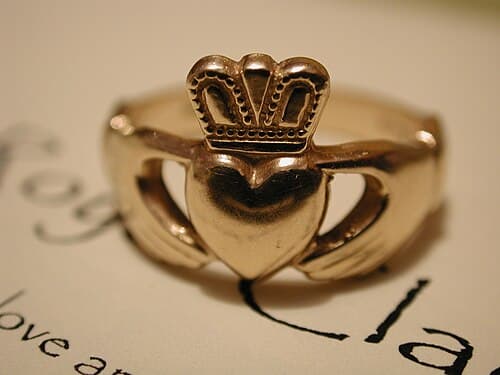
Claddagh Ring
Ireland
The Irish ring of hands, heart, and crown declaring love, loyalty, and friendship.
4.8Learn more →


The ancient triple spiral of the Celts, encoding the threefold nature of reality.
The triskele — also called the triskelion — is one of the oldest symbols found in European sacred art, appearing at Newgrange in Ireland in engravings dated to approximately 3200 BCE, making it older than Stonehenge and the Egyptian pyramids. This triple spiral, in which three interlocked spirals emanate from a single centre, represents the fundamental Celtic understanding of reality as threefold: past, present, future; land, sea, sky; birth, life, death; and countless other triadic structures that the Celts identified in the natural and spiritual world.
The spiral itself was the most important Celtic sacred symbol before Christianity, representing movement, growth, and the cyclical nature of time. The three-fold version intensified this meaning: where a single spiral suggested one cycle, the triskele suggested the interconnection of all cycles, the way in which each phase of existence feeds into and generates the next. Druids used the symbol to represent the triple goddess and the divine triad of the natural world.
In modern Irish culture the triskele appears on government documents, sporting emblems, and jewellery, carrying both its ancient sacred resonance and a contemporary identity of Celtic heritage. The symbol is also prominent in Breton (French Celtic) culture, where it appears on regional flags and craft work, and has been adopted more broadly as a general symbol of Celtic identity throughout the diaspora.
The Triskele traces its origins to Ireland, where it has been revered for generations as a powerful symbol of good fortune and positive energy. Historical records and oral traditions suggest that early versions of this charm appeared centuries ago, when communities in Ireland first began attributing supernatural qualities to objects drawn from their natural and spiritual environment.
Over time, the Triskele evolved from a regional folk object into a widely recognized talisman. Traders, travelers, and migrants carried it across borders, introducing it to new cultures that often adopted and adapted it to fit their own belief systems. Today it is found in ireland, france, spain and beyond, each culture adding its own layer of meaning and ritual to the charm's enduring legacy.
In its homeland of Ireland, the Triskele occupies a revered place in both daily life and ceremonial practice. It is not merely decorative — it is woven into the fabric of cultural identity, appearing in celebrations, rites of passage, and household traditions that have been passed down through generations.
Beyond Ireland, the Triskele has gained recognition in ireland, france, spain and other regions, where it is valued for its symbolic connection to universal good luck. Scholars of material culture and anthropologists note that charms like the Triskele serve a dual psychological function: they provide a tangible focus for hope and intention, and they connect their owners to a living cultural tradition that transcends individual experience.
To get the most from your Triskele, keep it in a place where you will see it daily — on a desk, nightstand, or near your front entrance. Physical proximity reinforces the intention behind the charm and serves as a regular reminder of your goals.
Traditional practice recommends handling the charm with clean hands and respectful intention. Many practitioners in Ireland advise setting a clear purpose when you first acquire the charm: hold it, state your wish or goal silently or aloud, and then place it in its chosen position. Periodically cleansing the charm — by passing it through incense smoke, placing it under moonlight, or simply wiping it with a clean cloth — is believed to refresh its energy.
If the charm is meant to be worn (as jewelry or a carried token), keep it close to your body throughout the day. If it is a household object, place it in the area of your home most associated with its purpose — for example, near a workspace for success charms, or by the bed for love and health charms.
The triskele represents the continuous motion of life, the interconnectedness of all phases of existence, and the power that emerges when three forces work in harmony. It suggests that what appears to be opposition — beginning and ending, life and death, growth and decay — is actually a continuous creative cycle. Wearing or displaying a triskele invites this dynamic balance into your life.
Wear a triskele pendant or ring as a protective amulet and a reminder of life's cyclical nature. The symbol is particularly meaningful during times of transition — new beginnings, completions, or transformations — when awareness of cycles is most needed. Meditate on the three spirals as representing three aspects of your current life situation seeking balance.
The enormous carved triskele at Newgrange in County Meath, Ireland, is positioned so that on the winter solstice, sunlight travels 19 metres through the entrance passage and illuminates the triple spiral carving for exactly 17 minutes. This astronomical precision suggests the triskele was deeply connected to solar calendar knowledge.
They are the same symbol called by different names. 'Triskele' is the more Anglicised term used in Celtic contexts; 'triskelion' is the more classical Greek-derived academic term. Both refer to the triple spiral or triple-leg design.
Yes — the Isle of Man's flag features a triskelion of three armoured legs, which is a different artistic interpretation of the three-fold symbol rather than the Celtic spiral version. Both draw on the same tradition of threefold symbolism.
The triskele is widely embraced beyond Celtic heritage communities as a symbol of balance and life cycles. Its extremely ancient origins predate any specific ethnic identity. It is generally used respectfully as a spiritual and philosophical symbol.
The Triskele originates from Ireland, where it has been used as a general charm for centuries. Its influence has since spread to ireland, france, spain and many other regions worldwide.
Wear a triskele pendant or ring as a protective amulet and a reminder of life's cyclical nature. The symbol is particularly meaningful during times of transition — new beginnings, completions, or transformations — when awareness of cycles is most needed. Meditate on the three spirals as representing three aspects of your current life situation seeking balance. For best results, set a clear intention when you first acquire the charm and keep it in a prominent, respectful location.
Yes, giving a Triskele as a gift is considered a generous and meaningful gesture in most traditions. In Ireland, gifted charms are often believed to carry even stronger energy than those purchased for oneself, because they come with the goodwill and intention of the giver.
Many practitioners recommend periodically cleansing your Triskele to refresh its energy. Common methods include passing it through incense smoke, placing it in moonlight overnight, rinsing it under clean water (if the material allows), or simply wiping it down with a clean cloth while setting a fresh intention.
While the Triskele originated in the cultural traditions of Ireland, it is not exclusive to any single religion. It has been adopted and adapted by people of many faiths and backgrounds, each bringing their own interpretation to its symbolism and use.


