

252
Protection
🔩
Nkondi Nail Figure
Congo
Kongo power figure bristling with nails that activate its protective power and bind agreements between parties.
4.7Learn more →


Ceremonial mask used across Africa to embody spirits, invoke divine forces, and transform the masked dancer into a sacred intermediary.
Across sub-Saharan Africa, the ceremonial mask is perhaps the most immediately powerful object in indigenous spiritual life. Unlike decorative masks, African ceremonial masks are not 'worn' in the ordinary sense — the masked dancer does not put on a mask but is transformed into a different being. The mask combined with its associated costume, specific movements, music, and ritual context creates a temporary vessel through which an ancestor spirit, nature force, or divine being can manifest in the human world. This is why masks are treated with extraordinary reverence — indeed, the 'mask' as a spiritual entity exists between ceremonies in the bush, shrine, or sacred house where only initiates may go.
Mask traditions vary enormously across the continent. The Poro and Sande societies of Sierra Leone, Liberia, and Guinea use masks in initiation ceremonies that usher young people into adulthood. The Yoruba Egungun mask brings ancestor spirits back to counsel the living. The Dogon of Mali use the Kanaga mask in funeral ceremonies that release the deceased's spirit to the next world. The Kongo Nkisi mask concentrates spiritual power (nkisi) for healing and protection. Each tradition has its own pantheon of mask spirits, its own initiation requirements for masked dancers, and its own protocols for when and how masks appear.
As decorative and spiritual objects in homes and collections, African masks carry a complex heritage. Ideally, masks displayed outside their original context should be understood as windows into the extraordinary diversity and sophistication of African spiritual thinking. Displayed with knowledge and respect, they continue to carry a presence — many people report feeling 'watched' by masks they display, which traditional understanding would attribute to residual spiritual charge in the object.
Manifestation of ancestral or divine presence, transformation of the human vessel, initiation into community, protection of society through spiritual intervention, and the boundary between ordinary and sacred reality.
Display masks with awareness of their original function — facing outward to project protective energy, or inward to invite ancestral wisdom into a space. Research the specific type of mask and its original meaning before displaying. Avoid using ceremonial masks as costume without understanding their context.
Pablo Picasso's exposure to African masks in 1907 at the Trocadéro museum in Paris directly inspired the radical shift in European art that led to Cubism. Picasso himself said that looking at these masks was a 'revelation' that changed everything about how he thought about the human figure — a profound irony, given that the masks were often displayed without credit to the cultures that created them.
This depends on the tradition. Protective guardian masks are often placed facing outward (toward the door or exterior) to deflect negative energy. Ancestor masks that invite wisdom and guidance may face inward toward the household. When in doubt, placing a mask above and facing the main gathering space of a home is a neutral, respectful choice.
Authentic ceremonial masks typically show evidence of use: traces of paint, oil, or ritual substances; wear patterns consistent with being worn; sometimes attached organic materials. Reproduction masks are usually symmetrically perfect with uniform paint and no signs of use. Provenance documentation from trusted dealers or auction houses helps authenticate older pieces.
When done with knowledge, respect, and ideally a direct relationship with the culture of origin (purchasing from artisans, understanding the tradition), display is generally considered acceptable. The most respectful approach includes informational labeling, ensuring the piece was ethically sourced, and treating it as the sacred art it is rather than mere decoration.
Congo
Kongo power figure bristling with nails that activate its protective power and bind agreements between parties.
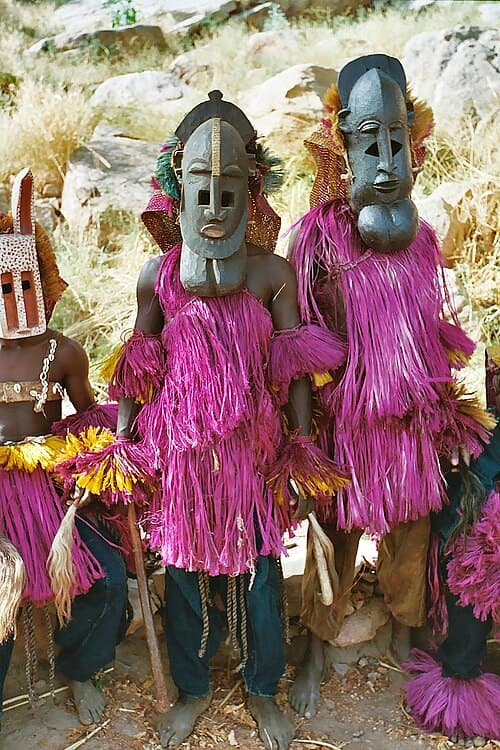
Mali
The cross-shaped Dogon mask used in Dama funeral ceremonies to guide the souls of the dead to their resting place.

Liberia
The powerful Poro society mask of the Dan and related peoples — used for social justice, healing, and initiation.

