

447
Success
🟠
Carnelian
India
The bold orange stone of vitality and creative courage, carried as a charm for motivation, artistic inspiration, and the passionate pursuit of action.
4.7Learn more →

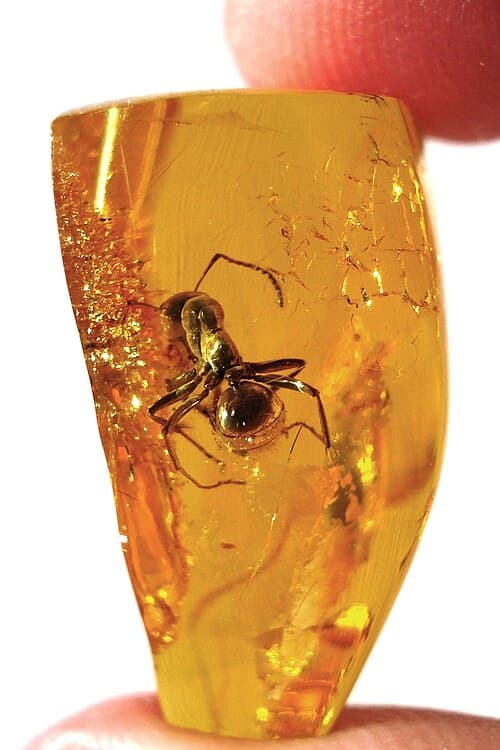
Ancient tree resin turned to golden stone over millions of years, carried as a charm of healing warmth, timeless wisdom, and the sun's preserved light.
Amber is not technically a mineral but fossilised tree resin — typically from ancient pine-like trees of the Eocene epoch, 34–56 million years ago. The Baltic region (Lithuania, Latvia, Poland, Russia's Kaliningrad enclave) produces over 80% of the world's amber, with the most ancient sea-washed deposits accumulating on Baltic beaches after winter storms. Dominican Republic produces much younger (15–45 million year old) amber that frequently contains spectacular insect inclusions; Myanmar produces the oldest true amber, some specimens containing feathered dinosaur remains.
Amber's human story begins at least 130,000 years ago with Neanderthals who apparently collected it for its beauty. Baltic amber was traded throughout prehistoric Europe in routes that linked the Baltic to the Mediterranean — Tutankhamun's tomb contained Baltic amber, as did prehistoric Swiss lake villages. The Greeks called amber 'elektron' — their word for the sun — because of its golden colour and because rubbing it produces static electricity (the origin of the word 'electricity'). In Chinese tradition, amber was believed to be the petrified soul of a tiger, making it a charm of ferocious protective vitality.
Amber is primarily a healing charm in contemporary crystal traditions — its ancient warmth, solar energy, and the millennia of life it has witnessed make it particularly effective for soothing chronic pain, supporting emotional processing, and bringing the comfort of deep time to those who feel overwhelmed by the urgency of the present.
Ancient healing warmth, the sun's preserved light, comfort of deep time, the wisdom of patient endurance, and the golden vitality that persists across millions of years.
Wear amber against the skin — it warms to body temperature and releases its comforting energy through the skin. Place on areas of chronic pain or inflammation (amber's static electricity is sometimes cited for this effect). Keep on a bedside table to bring the comfort of deep time into sleep and dreams.
Jurassic Park brought amber to global consciousness through the idea of mosquitoes preserved in amber containing dinosaur DNA. While this is scientifically implausible (DNA degrades far too rapidly), amber inclusions are scientifically priceless: a 2016 specimen of Burmese amber contained a complete feathered dinosaur tail, providing the first direct evidence of dinosaur plumage.
The salt water test: dissolve 1 cup of salt in 1 cup of water. Genuine amber floats in this saturated solution; most plastics and resins sink. The static test: rub vigorously with cloth — genuine amber attracts small pieces of paper. Heated genuine amber smells of pine resin; plastic smells chemical.
No — amber teething necklaces pose serious choking and strangulation hazards. Major paediatric medical authorities worldwide advise against their use. The purported teething benefits are not scientifically supported. Use amber as a charm for adults, not as jewellery for infants.
Copal is young fossilised resin — typically under 1 million years old — and is often sold as amber. It has similar appearance but is softer, more susceptible to solvents, and less valuable. True Baltic amber is 34–56 million years old. Both have sacred and healing uses in different traditions; neither is definitively superior as a charm.
India
The bold orange stone of vitality and creative courage, carried as a charm for motivation, artistic inspiration, and the passionate pursuit of action.

Brazil
The golden abundance crystal, known as the Merchant's Stone, carried to attract wealth, success, and the warm energy of solar prosperity.

Australia
A sacred art form encoding Dreamtime stories and ancestral wisdom as a talisman of connection and guidance.

