
193
Wealth
🌴
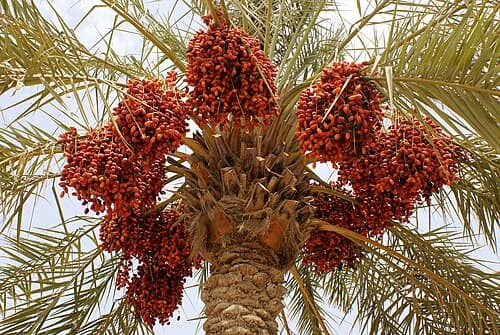
Date Palm
Middle East
The tree of life of the desert, symbol of abundance in arid lands and the most generous of all Arabic trees.
4.5Learn more →

A symbol of ancient Mesopotamian abundance — Iraq once had 30 million date palms and was the world's largest date exporter.
The date palm on Iraq's national emblem and in its cultural imagination is not merely decorative — it represents the living legacy of the world's oldest agricultural civilization, Mesopotamia, where the cultivation of date palms began at least 7,000 years ago in the fertile lands between the Tigris and Euphrates rivers. At its peak in the 1950s, Iraq had an estimated 30 million date palms producing some of the world's finest dates and accounting for 80% of global date exports. The date palm was the backbone of Iraqi rural economy, cultural life, and identity, with 600+ varieties of Iraqi dates each having distinct characteristics, seasons, and culinary uses.
The successive catastrophes of the late 20th and early 21st centuries — the Iran-Iraq War (1980-1988), the Gulf War (1991), the international sanctions that followed, and the 2003 invasion — devastated Iraq's palm groves through direct military damage, lack of maintenance, salinization of soils, and economic collapse. Today Iraq has approximately 9 million palms — a 70% reduction from the 1950s peak, representing one of the world's great agricultural catastrophes. Iraqi farmers and international organizations are working to restore the groves, but it takes decades for a new palm to reach peak productivity.
An Iraqi palm tree charm carries the weight of Mesopotamia's extraordinary ancient civilization — the civilization that invented writing, the wheel, systematic law, and organized religion — alongside the specific grief and hope of a people working to restore what has been lost.
The Iraqi Palm Tree traces its origins to Iraq, where it has been revered for generations as a powerful symbol of prosperity and abundance. Historical records and oral traditions suggest that early versions of this charm appeared centuries ago, when communities in Iraq first began attributing supernatural qualities to objects drawn from their natural and spiritual environment.
Over time, the Iraqi Palm Tree evolved from a regional folk object into a widely recognized talisman. Traders, travelers, and migrants carried it across borders, introducing it to new cultures that often adopted and adapted it to fit their own belief systems. Today it is found in iraq and beyond, each culture adding its own layer of meaning and ritual to the charm's enduring legacy.
In its homeland of Iraq, the Iraqi Palm Tree occupies a revered place in both daily life and ceremonial practice. It is not merely decorative — it is woven into the fabric of cultural identity, appearing in celebrations, rites of passage, and household traditions that have been passed down through generations.
Beyond Iraq, the Iraqi Palm Tree has gained recognition in iraq and other regions, where it is valued for its symbolic connection to financial prosperity. Scholars of material culture and anthropologists note that charms like the Iraqi Palm Tree serve a dual psychological function: they provide a tangible focus for hope and intention, and they connect their owners to a living cultural tradition that transcends individual experience.
To get the most from your Iraqi Palm Tree, keep it in a place where you will see it daily — on a desk, nightstand, or near your front entrance. Physical proximity reinforces the intention behind the charm and serves as a regular reminder of your goals.
Traditional practice recommends handling the charm with clean hands and respectful intention. Many practitioners in Iraq advise setting a clear purpose when you first acquire the charm: hold it, state your wish or goal silently or aloud, and then place it in its chosen position. Periodically cleansing the charm — by passing it through incense smoke, placing it under moonlight, or simply wiping it with a clean cloth — is believed to refresh its energy.
If the charm is meant to be worn (as jewelry or a carried token), keep it close to your body throughout the day. If it is a household object, place it in the area of your home most associated with its purpose — for example, near a workspace for success charms, or by the bed for love and health charms.
The resilience of ancient roots, the connection to the world's oldest agricultural tradition, and the hope of restoration after catastrophic loss. The Iraqi palm says: we were here first, and we will grow again.
Display as a tribute to Mesopotamian civilization and Iraqi cultural heritage. Gift to Iraqis as an acknowledgment of their culture's extraordinary historical depth. Carry as a charm for anyone working on long-term restoration, rebuilding, or recovery projects that require patience measured in decades.
The word 'paradise' comes from the Old Persian word 'pairidaeza' meaning a walled garden or orchard — and the original paradise gardens of ancient Persia and Mesopotamia featured date palms as their central trees. The date palm's association with paradise, abundance, and divine provision runs through the oldest stories humanity has told itself.
Iraq's date palm groves were devastated by multiple overlapping disasters: the Iran-Iraq War destroyed coastal and southern groves; the Gulf War damaged infrastructure and irrigation systems; UN sanctions (1990-2003) prevented maintenance and replanting; the 2003 invasion caused direct damage; and chronic water mismanagement and soil salinization have compounded the losses.
Iraq historically produced exceptional date varieties including Medjool, Halawi, Zahdi, and Barhi among many others. Iraqi dates were prized for their size, sweetness, and complexity of flavor. Some varieties were used fresh while others were dried or pressed into syrup (dibis). The diversity of Iraqi date palm varieties represents a genetic heritage of enormous agricultural importance.
Slowly. The Iraqi government and international agricultural organizations have been working to restore groves through replanting programs, irrigation rehabilitation, and soil remediation. Progress is complicated by water scarcity (the Tigris and Euphrates are at record low levels), political instability, and the enormous scale of loss. Recovery is measured in decades, not years.
The Iraqi Palm Tree originates from Iraq, where it has been used as a wealth charm for centuries. Its influence has since spread to iraq and many other regions worldwide.
Display as a tribute to Mesopotamian civilization and Iraqi cultural heritage. Gift to Iraqis as an acknowledgment of their culture's extraordinary historical depth. Carry as a charm for anyone working on long-term restoration, rebuilding, or recovery projects that require patience measured in decades. For best results, set a clear intention when you first acquire the charm and keep it in a prominent, respectful location.
Yes, giving a Iraqi Palm Tree as a gift is considered a generous and meaningful gesture in most traditions. In Iraq, gifted charms are often believed to carry even stronger energy than those purchased for oneself, because they come with the goodwill and intention of the giver.
Many practitioners recommend periodically cleansing your Iraqi Palm Tree to refresh its energy. Common methods include passing it through incense smoke, placing it in moonlight overnight, rinsing it under clean water (if the material allows), or simply wiping it down with a clean cloth while setting a fresh intention.
While the Iraqi Palm Tree originated in the cultural traditions of Iraq, it is not exclusive to any single religion. It has been adopted and adapted by people of many faiths and backgrounds, each bringing their own interpretation to its symbolism and use.
Middle East
The tree of life of the desert, symbol of abundance in arid lands and the most generous of all Arabic trees.

Saudi Arabia / UAE / Qatar / Kuwait
The iconic long-spouted Arabic coffee pot, a symbol of Gulf hospitality, generosity, and the sacred social ritual of coffee.

Iran
The winged divine figure of Zoroastrian Iran, symbol of good thoughts, good words, and good deeds.

