

12
Wealth
🎋
Lucky Bamboo
China
Lucky Bamboo is a feng shui staple believed to bring good fortune, prosperity, and positive energy when placed in the home or office.
4.5Learn more →


The Money Tree is a feng shui plant believed to generate positive energy and financial luck, its coin-shaped leaves symbolizing wealth growing steadily from roots of patience.
The Money Tree (Pachira aquatica) carries an origin story that perfectly encodes its symbolic meaning. According to a widely told legend, a poor Taiwanese farmer prayed for good fortune and found an unusual plant growing in his field. He cultivated it, sold multiple plants grown from its seeds, and became wealthy. He called it the 'money tree' and its braided trunk form — the result of a practice begun in Taiwan in the 1980s where five stems are braided together while young — became the standard form associated with luck and wealth.
The braided trunk of the money tree encodes significant symbolism. Five trunks braided together represent the five feng shui elements (wood, fire, earth, metal, water) held in unity and mutual support. Five is also associated with the five virtues of Confucianism and the five directions (north, south, east, west, and center). The braid itself, like Chinese knotting, represents the binding together of fortune in a form that cannot be easily undone. The tree's palmate leaves (each leaf consisting of five to seven leaflets on a single stem) resemble an open hand receiving money.
In feng shui practice, the Money Tree is valued for its ability to generate fresh, active yang energy through its growth — unlike static charm objects, a living, growing plant continuously creates new energy. The tree is considered most powerful when placed in the wealth corner (southeast sector of the home or room per the bagua map) or on a business desk. The more vigorously the plant grows, the stronger the wealth energy it generates is considered to be.
Steady accumulation of wealth through patient nurturing, the five elements aligned in mutual support of prosperity, and the living evidence that fortune can grow from humble origins.
Place in the southeast (wealth) corner of your home or the left-back corner of your office desktop. Keep the soil moderately moist but well-drained; overwatering kills both the plant and its feng shui efficacy. Tie the trunk with a red ribbon or hang small gold coin charms from the branches. Wipe dust from the leaves regularly to keep the plant's energy clear and active.
The braided Money Tree was first developed commercially in Taiwan around 1985 by a truck driver named Liu who began braiding the stems as an experiment, sold them at local markets, and within a decade had sparked a global houseplant industry now worth hundreds of millions of dollars annually.
No. Lucky Bamboo (Dracaena sanderiana) and Money Tree (Pachira aquatica) are completely different plants from different families. Lucky Bamboo grows in water and has bamboo-like stems; Money Tree grows in soil, develops a braided woody trunk, and produces large palmate leaves. Both are feng shui wealth plants but with different symbolism and care requirements.
A dying money tree is not interpreted as a wealth curse, but rather as a care signal. Diagnose the issue (usually overwatering, too much direct sun, or root rot) and address it. If the tree cannot be saved, replace it promptly — allowing the dead tree to remain in the wealth corner is considered stagnating to financial energy.
Most feng shui practitioners advise against bedroom placement for the Money Tree, as its active yang energy and association with financial activity can disrupt the yin, restful energy needed for sleep. The living room, office, or entrance hall are preferred. If bedroom placement is unavoidable, keep it small and ensure good ventilation.
China
Lucky Bamboo is a feng shui staple believed to bring good fortune, prosperity, and positive energy when placed in the home or office.

China
Goldfish have been symbols of wealth and abundance in China for over a thousand years, their gold color and fluid movement embodying the easy flow of prosperity.
China
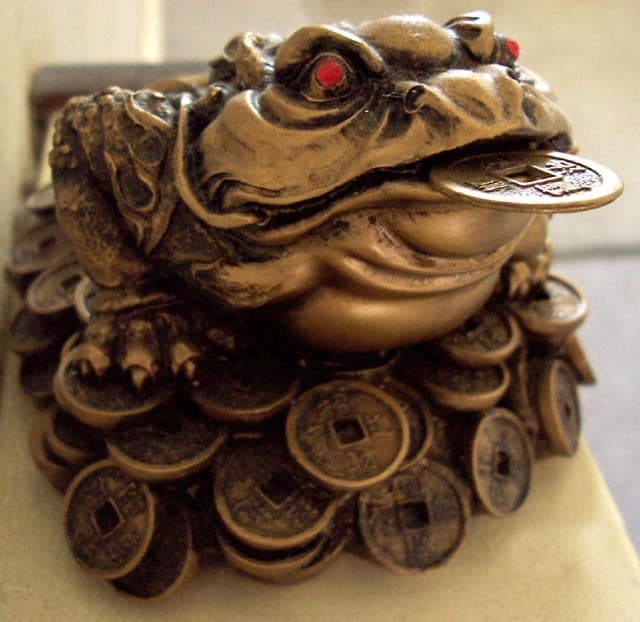
The three-legged toad sitting on coins with a coin in its mouth is one of feng shui's most potent wealth activators, said to attract money and prevent it from leaving.

China
The Laughing Buddha — the round, joyful, sack-carrying monk — is China's most beloved symbol of happiness, wealth, and the simple abundance that comes from contentment.

