
24
Wealth
🐸
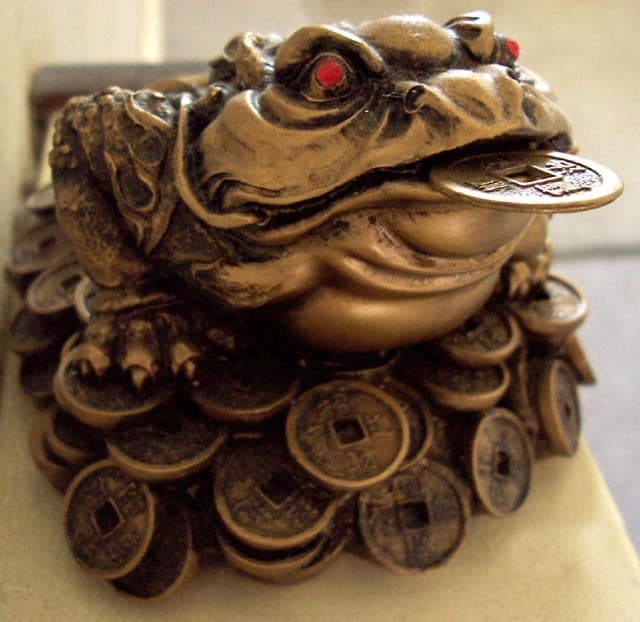
Money Frog (Jin Chan)
China
The three-legged toad sitting on coins with a coin in its mouth is one of feng shui's most potent wealth activators, said to attract money and prevent it from leaving.
4.6Learn more →


The Laughing Buddha — the round, joyful, sack-carrying monk — is China's most beloved symbol of happiness, wealth, and the simple abundance that comes from contentment.
The Laughing Buddha is not Siddhartha Gautama, the historical Buddha, but rather a representation of Budai (or Hotei in Japanese), a real Chinese Buddhist monk who lived during the Later Liang dynasty around 900 CE. Budai was known for wandering from village to village with an enormous cloth sack (his name literally means 'cloth sack'), handing out gifts to children from the inexhaustible supply within. His laughter was legendary — he laughed at everything, finding joy in the simplest moments — and his enormous belly was considered the physical manifestation of his boundless contentment and the generosity that flows naturally from a mind at peace.
Budai came to be seen in Chinese folk religion as an incarnation of Maitreya, the future Buddha who will appear at the end of times to restore harmony to the world. In this reading, his laughter is not merely personal but cosmic: the laughter of someone who knows how the story ends, who sees beyond present suffering to the inevitable triumph of good. Rubbing his belly is believed to transfer this philosophical luck — not just material wealth but the deeper fortune of contentment and the wisdom to recognize abundance when it exists.
In practical feng shui, the Laughing Buddha is one of the most versatile wealth activators. Different poses carry different specializations: a Buddha holding a gold ingot invites financial wealth; one holding a fan blesses everyone in the household; one holding a string of prayer beads brings spiritual insight and protection; one surrounded by children blesses family happiness and fertility. The sack itself is said to hold all the world's sorrows, which Budai collected from people he met on his travels — making the charm both a wealth magnet and a spiritual vacuum cleaner.
Contentment as the root of abundance, the wealth that flows from genuine happiness, protection from sorrow, generosity as the creator of prosperity, and the wisdom of cosmic joy.
Place the Laughing Buddha in a prominent position in the living room or entrance hall, at eye level or above. He should never be placed on the floor, in the bathroom, or in the bedroom. Rub his belly regularly with the intention of receiving his blessings. Position him facing the front door so he greets incoming energy. Clean the figurine with a soft cloth and respectful attention.
In Chinese restaurants worldwide, the Laughing Buddha figurine near the cash register is so ubiquitous that many people assume he is a mandatory business talisman — and in many Chinese communities, opening a business without one is genuinely considered a risk not worth taking.
No — rubbing the belly is the central traditional ritual associated with the charm and is considered an act of respectful engagement, not irreverence. The entire point of the figurine is this tactile blessing ritual. The only disrespectful actions are placing him on the floor, in the bathroom, or treating him carelessly.
For financial wealth, choose one holding a gold ingot or a sack. For family happiness, choose one surrounded by children. For wisdom and protection, choose one with a fan or prayer beads. For travel luck, choose one holding a fan above his head. For general good fortune, the classic pot-bellied seated pose is sufficient.
Yes. Unlike some feng shui items that lose power when duplicated, multiple Laughing Buddhas each bring their own specific blessings. Many practitioners have one at the entrance for general fortune, one at the business desk for wealth, and one in the family room for happiness. Each is treated as a distinct and complete blessing.
China
The three-legged toad sitting on coins with a coin in its mouth is one of feng shui's most potent wealth activators, said to attract money and prevent it from leaving.
China
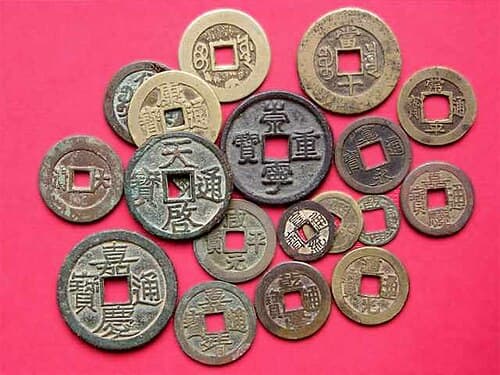
Ancient Chinese coins with square holes, tied in groups of three with red string, are powerful feng shui wealth activators connecting the circular heavens with the square earth.

China
Pixiu is a mythical Chinese creature with a dragon's head, horse's body, and lion's feet that eats gold but cannot excrete it — the ultimate symbol of wealth accumulation.

China
The Wu Lou bottle gourd is China's most important health and longevity charm, carried by the Eight Immortals and believed to contain the elixir of immortal life.

