

122
Wealth
🦁
Pixiu
China
Pixiu is a mythical Chinese creature with a dragon's head, horse's body, and lion's feet that eats gold but cannot excrete it — the ultimate symbol of wealth accumulation.
4.7Learn more →

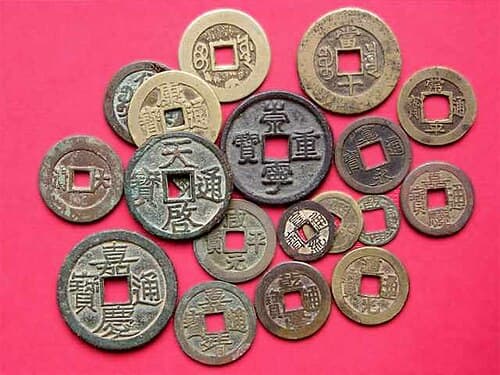
Ancient Chinese coins with square holes, tied in groups of three with red string, are powerful feng shui wealth activators connecting the circular heavens with the square earth.
Chinese I-Ching coins — round bronze coins with square holes used as currency from the Qin dynasty onward — carry profound cosmological symbolism in addition to their monetary function. The circular outer form represents heaven; the square inner hole represents earth; the coin itself is thus a miniature model of the universe in which the human realm exists between heaven and earth. Tying such coins together was understood not as mere decoration but as a ritual act of connecting these three realms — heaven, earth, and humanity — in the specific context of wealth generation.
The traditional arrangement of three coins bound together with red thread creates what feng shui practitioners call a 'wealth bridge.' Three is the number of yang vitality in Chinese numerology, and red is the activating color of fire and good fortune. The yang energy of three odd-numbered coins bound in auspicious red creates a self-contained energetic unit that, when placed correctly, continues to generate wealth-attracting vibrations indefinitely. Six coins (two groups of three) doubles the energy; nine coins (three groups of three) creates the most powerful configuration — nine being the number of completion and eternal fortune.
The specific dynasty from which the coins originate is considered important by serious practitioners. Coins from the reigns of great emperors — particularly the Qianlong Emperor of the Qing dynasty, under whose reign China was the world's wealthiest nation — are considered especially potent. Reproductions are widely available and considered energetically valid as long as they replicate the correct inscriptions (the emperor's reign name on the yang/positive face, a decorative pattern on the yin/negative face).
Wealth circulating between heaven and earth through the human realm, the yang vitality of gathered fortune, and the cosmic alignment that allows abundance to flow unobstructed.
Tie three coins together with red thread through the holes, yang face (with four Chinese characters) upward. Place under a doormat (inside, near the entrance), in a wallet, in the cash register, or in the wealth corner of your home. Attach to financial documents or a business card holder. In feng shui, six or nine coins placed in a horizontal row in the wealth area are among the most classic activators.
During the Qing dynasty, the Qianlong Emperor's reign lasted 60 years and coincided with China's greatest territorial and economic expansion — making Qianlong coins the single most replicated feng shui wealth charm in history, with hundreds of millions of reproduction coins now in circulation worldwide.
The yang face — with four Chinese characters (the emperor's reign title) — should face upward. This activates the heaven energy of the coin. The yin face with decorative patterns faces down toward the earth. In a wallet, the yang face should face the direction you carry your cards or cash.
Feng shui tradition specifies ancient-style Chinese coins with the square hole as the correct form for this charm. Modern coins can be used as general prosperity tokens, but they lack the specific cosmological symbolism (circle/heaven, square/earth) that makes the ancient coin format uniquely powerful for this purpose.
Three (one yang cycle) for personal use; six (double yang) for business; nine (completion) for the most powerful home placement. The number four is avoided (sounds like 'death' in Mandarin), as are even numbers in general for this specifically yang-energy charm.
China
Pixiu is a mythical Chinese creature with a dragon's head, horse's body, and lion's feet that eats gold but cannot excrete it — the ultimate symbol of wealth accumulation.

China
The Laughing Buddha — the round, joyful, sack-carrying monk — is China's most beloved symbol of happiness, wealth, and the simple abundance that comes from contentment.

China
The gold sycee ingot — the boat-shaped gold and silver currency of imperial China — is the most direct and universally recognized symbol of accumulated financial wealth in the Chinese tradition.
China
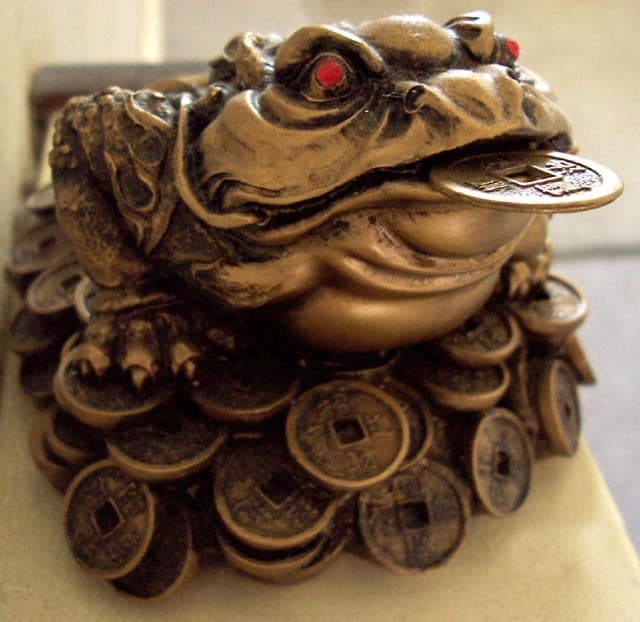
The three-legged toad sitting on coins with a coin in its mouth is one of feng shui's most potent wealth activators, said to attract money and prevent it from leaving.

