
211
Protection
⚔️
Yemeni Jambiya
Yemen
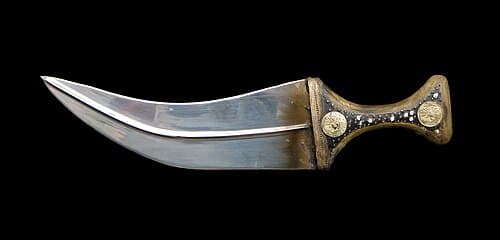
The curved ceremonial dagger of Yemen, worn by men as a symbol of honor, manhood, and tribal identity.
4.3Learn more →

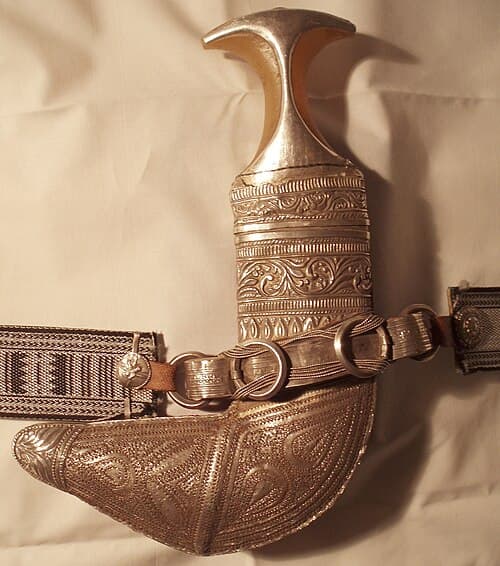
The curved ceremonial dagger of Oman, so central to national identity it appears on the national emblem.
The khanjar is the short, curved dagger that is the most iconic symbol of Omani national identity — it appears on the national emblem of Oman (alongside two crossed khanjars and a belt), is worn by Omani men at formal occasions and national celebrations, and its image appears on currency, stamps, buildings, and government documents throughout the Sultanate. The khanjar's characteristic form — a sharply curved double-edged blade in an ornate silver or gold scabbard — evolved over centuries of Omani craftsmanship, with regional variations (particularly between coastal and interior styles) encoding geographic and tribal identity in the blade's curvature, handle material, and scabbard decoration.
For an Omani man, wearing a khanjar is not merely decorative — it is a statement of identity, cultural pride, and social standing. The quality of a man's khanjar signals his family's heritage and prosperity: handles made from rhinoceros horn (now illegal) were historically the most prized; today alternative materials include silver, ebony, camel bone, and wood. The silver scabbard's decoration — intricate geometric engraving using techniques developed by Omani silversmiths over centuries — can represent hundreds of hours of skilled work. An heirloom khanjar might be worth hundreds of thousands of dollars.
Beyond its ceremonial role, the khanjar represents the Omani philosophy of the warrior at peace — strength available but not deployed, dignity maintained through the display of power rather than its exercise. Oman's historical reputation as a trading nation and diplomatic actor alongside a well-armed population created a culture where visible readiness meant less fighting, not more.
Dignity, courage, and the strength that establishes peace through its visible presence. The khanjar says: I am capable of defense, and therefore no defense is needed. It is the amulet of deterrence and honor.
Display a khanjar as a statement of cultural pride and dignity. Gift to Omani friends or admirers of Omani culture at important occasions. Carry a miniature khanjar charm when entering situations requiring assertion of dignity and boundaries. Display as art honoring the extraordinary craft of Omani silversmiths.
Oman is the only country in the world where a weapon — the khanjar — is the central element of the national emblem. Unlike the Saudi flag's sword, the Omani emblem depicts two crossed khanjars prominently as the primary heraldic device, making Oman's national identity inseparably tied to this specific weapon form.
Both are curved daggers, but the Omani khanjar typically has a sharper, more acute curve and a distinctive J-shape; the Yemeni jambiya has a more symmetric curve and is worn differently (horizontally at the front of the body). Both are ceremonial weapons of cultural identity but with distinct regional forms reflecting their different craft traditions.
Yes. Omani men wear khanjars at national celebrations, formal occasions, weddings, and official government functions. Sultan Qaboos and his successor Sultan Haitham regularly wear khanjars in official photographs. For Omani men, wearing the khanjar is a culturally correct and honored form of dress, not merely historical costume.
Rhinoceros horn handles were historically the most prestigious material for khanjar handles — the horn's unique texture, rarity, and hardness made it both aesthetically distinctive and enormously expensive. International bans on rhinoceros horn trade have eliminated new horn handles, but antique examples remain legal to own and extremely valuable, driving up prices for historic khanjars significantly.
Yemen
The curved ceremonial dagger of Yemen, worn by men as a symbol of honor, manhood, and tribal identity.

Saudi Arabia
The curved Saudi sabre from the Kingdom's flag, a symbol of justice, courage, and the unified Arabian nation.

UAE / Saudi Arabia / Qatar
The sacred hunting bird of the Arabian Peninsula, a symbol of power, precision, and the noble Bedouin tradition of falconry.

