
209
Protection
🗡️
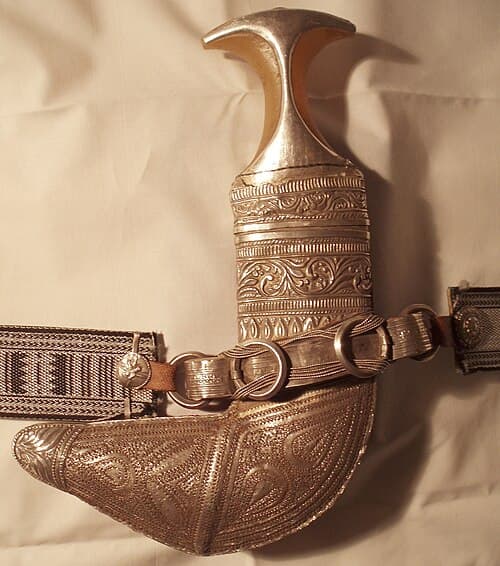
Omani Khanjar Dagger
Oman
The curved ceremonial dagger of Oman, so central to national identity it appears on the national emblem.
4.5Learn more →

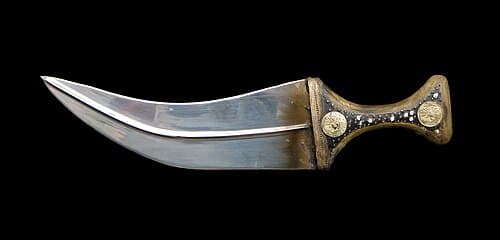
The curved ceremonial dagger of Yemen, worn by men as a symbol of honor, manhood, and tribal identity.
The jambiya is the short curved dagger worn by Yemeni men in a distinctive front-of-body position, secured in an elaborate fabric belt, and it is among the most culturally significant objects in Yemeni society — simultaneously a weapon, a piece of jewelry, a status symbol, and an identity document encoding the wearer's tribal origins and social standing. Unlike many ceremonial weapons in other cultures, the jambiya remains in daily use in Yemen and is worn by men of all ages, from teenage boys receiving their first dagger at a rite of passage to elderly tribal leaders bearing heirloom blades centuries old. The jambiya is so central to Yemeni masculinity that the word 'rajul' (man) and the jambiya are inseparably linked in Yemeni idiom.
The jambiya's blade is traditionally made by hereditary craftsmen (janbiyah-makers) whose families have practiced the trade for generations. The handle material is the primary indicator of status — a grading system from the most humble (buffalo horn or cow horn) to middle-class (oryx or ibex horn) to wealthy (exotic wood inlaid with silver) to the most elite (rhinoceros horn, now illegal, the 'saifani' category) creates a visible hierarchy of status immediately readable by other Yemenis. The fabric belt (maazer) is itself often an artwork of Yemeni weaving.
The practice of carrying the jambiya continues even through Yemen's current devastating civil war — it remains a symbol of Yemeni identity and dignity in the most difficult circumstances, an object that says: whatever else has been taken from us, this we carry.
Masculine honor, tribal identity, the dignity that must be defended and the strength that enables defense. The jambiya is the external declaration of the internal code of honor (sharaf) that governs Yemeni tribal life.
Display a jambiya as an artwork honoring Yemeni cultural heritage. Gift to Yemeni friends as a recognition of their cultural identity. Carry a miniature jambiya charm as a symbol of personal honor and the courage to defend what is sacred. Use as a meditation object when cultivating inner strength.
Yemen's demand for rhinoceros horn handles for premium jambiya daggers contributed significantly to rhinoceros poaching in Africa during the late 20th century — Yemeni buyers were one of the primary global markets for illegal rhino horn. International conservation agreements and education campaigns have reduced (though not eliminated) the trade, making antique saifani handles even more valuable.
The age varies by tribe and family, but the receipt of a first jambiya is typically associated with puberty and the transition to young manhood — often between ages 14-18. It is a rite of passage ceremony marking the beginning of adult male status and the responsibilities that come with it in Yemeni tribal society.
While the jambiya is primarily ceremonial in contemporary Yemen, it remains a functional weapon. In tribal disputes, drawing the jambiya can signal escalation of conflict, and there are traditional rules governing when and how it may be drawn. In serious inter-tribal disputes it may be used, though firearms have largely replaced daggers in actual combat.
The curve of the blade, the shape of the hilt, the style of the belt (maazer), and the decorative elements of the scabbard all encode regional and tribal origin. An experienced Yemeni can identify a man's general region of origin from these details, making the jambiya a wearable identity document readable by those who know the code.
Oman
The curved ceremonial dagger of Oman, so central to national identity it appears on the national emblem.

Saudi Arabia
The curved Saudi sabre from the Kingdom's flag, a symbol of justice, courage, and the unified Arabian nation.

UAE / Saudi Arabia / Qatar
The sacred hunting bird of the Arabian Peninsula, a symbol of power, precision, and the noble Bedouin tradition of falconry.

