

51
Protection
🔵
Turkish Nazar
Turkey
Turkey's iconic blue glass evil eye bead — the nazar boncuğu — protecting against the destructive gaze of envy.
4.9Learn more →

The ancient Persian eye charm — cheshm nazar — protecting against envy with the same blue eye tradition spanning from Iran to Greece.
The Persian cheshm nazar (eye of the gaze/evil eye) is the Iranian version of the widespread Mediterranean and Middle Eastern evil eye protection tradition. In Persian culture, the evil eye (chashm zakhm, literally 'wound of the eye') is taken seriously across all social levels — a jealous or admiring gaze can genuinely harm what it falls upon. Babies, beautiful women, prosperous businesses, and treasured possessions all require protection.
Persian evil eye protection uses blue beads, mirror work, and the specific form of the eye charm — but distinctively adds the use of rue (esfand) burned on hot coals as a smoke purification against evil eye energy. The crackling sound of rue seeds popping is believed to 'pop' the evil eye's power. This aromatic smoke purification distinguishes Persian practice from purely visual Turkish and Greek methods, adding a sensory layer to the protection.
Persian cheshm nazar charms appear in classical literature from Rumi to Hafez — the evil eye as a poetic motif of envy's destructive power appears throughout Persian poetry's most celebrated works. This literary embedding makes the charm part of Persian high culture as well as folk practice.
Protection from jealousy and the gaze of envy, the ancient understanding that intense attention transmits energy, and the Persian tradition of multi-sensory protection through sight and smoke.
Burn esfand (rue seeds) over hot coals while passing the smoke over yourself, family members, and new possessions to clear evil eye energy — a traditional Persian purification. Display a cheshm nazar bead in your home and business. When feeling watched or envied, burn a small amount of rue as protective incense.
The Persian esfand burning ritual is performed at major life transitions and before important events across Iranian culture — secular Iranians who describe themselves as non-superstitious often still burn esfand as a cultural reflex. The ritual has been documented continuously since pre-Islamic Zoroastrian Persian practice, making it over 2,500 years old.
Persian practice adds rue burning (esfand) as a cleansing smoke element that Turkish tradition does not emphasize. Both use blue glass beads. Persian tradition also uses mirror work — embedded mirrors in decorative objects — to reflect harmful gazes.
Evil eye protection is cross-cultural and anyone can use it. The Persian version's rue-burning addition is a beautiful ritual that works for anyone willing to engage with its sensory dimensions. The blue bead alone is universally effective.
Above the front door and in main entertainment areas where guests gather are most important. Any space that receives many visitors or attracts potential envy (a beautiful garden, a successful home office) benefits from cheshm nazar protection.
Turkey
Turkey's iconic blue glass evil eye bead — the nazar boncuğu — protecting against the destructive gaze of envy.
Greece
Greece's ancient blue eye amulet — the mati — protecting against the evil eye's harm since antiquity.
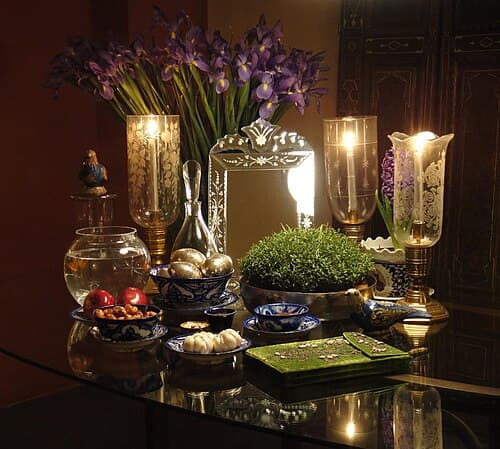
Iran
The seven-S Nowruz table — Iran's ancient New Year blessing ritual arranging seven symbolic items to invite spring's full abundance.

