

427
Health
חי
Israeli Chai Symbol
Israel
The Hebrew word for 'life' worn as the most personal and meaningful of all Jewish lucky charms.
4.7Learn more →


A fruit overflowing with seeds like righteous deeds, a Jewish symbol of abundance, wisdom, and the high holidays.
The pomegranate holds a unique place in Jewish religious symbolism as one of the 'seven species' of fruits specifically associated with the Land of Israel in the Torah (Deuteronomy 8:8), making it both a symbol of the sacred land and of divine abundance. The fruit's most celebrated characteristic — that each pomegranate contains exactly 613 seeds, corresponding to the 613 commandments (mitzvot) of Jewish law — is actually a charming Jewish legend rather than botanical fact, but the symbolic resonance is profound: to eat a pomegranate is to consume the mitzvot, to internalize divine instruction in a tangible, delicious, embodied way.
During the Jewish New Year (Rosh Hashanah), the pomegranate takes center stage as one of the symbolic foods eaten at the holiday table. Families eat pomegranate seeds while saying: 'May our merits be as numerous as the seeds of a pomegranate.' This blessing transforms the act of eating into an act of aspiration — each seed consumed is a hope for a righteous and merit-filled new year. The pomegranate thus marks sacred time as well as sacred space, connecting the eater to both the Land of Israel and to the annual cycle of Jewish self-examination and renewal.
As a decorative and jewelry motif, pomegranates appear throughout Jewish art and architecture — silver Torah finials (rimonim, the Hebrew word for pomegranates) are shaped like the fruit, decorated Temple pillars bore pomegranate motifs, and pomegranate pendants are popular Rosh Hashanah gifts. Their ruby-red interior and crown-like calyx have made them perennial favorites of Jewish artists across centuries and cultures.
Divine abundance, the fullness of righteous deeds, connection to the sacred Land of Israel, and the aspiration to fill the coming year with merit as full as a pomegranate is full of seeds.
Eat pomegranate seeds on Rosh Hashanah with the traditional blessing for a year full of merits. Display pomegranate artwork or charms in a home throughout the High Holiday season. Gift pomegranate jewelry as a Rosh Hashanah gift wishing the recipient a sweet and full new year. Keep as a desk ornament throughout the year as a reminder of abundance.
The word 'rimon' (pomegranate) in Hebrew shares its root with the name 'Rimmon,' and the pomegranate was so beloved that ancient Jewish coins bore its image. The silver finials on Torah scroll cases are called 'rimonim' specifically because they are pomegranate-shaped, making every Torah scroll literally crowned with this sacred fruit.
No — pomegranates typically have between 200 and 1,400 seeds depending on the variety and individual fruit. The 613-seed belief is a beloved Jewish folk tradition that aligns the fruit's abundance with the number of commandments in Jewish law, but it is symbolic rather than botanical.
The pomegranate is sacred across many cultures — in Ancient Greek mythology, Persephone's eating of pomegranate seeds bound her to the underworld for half the year, explaining the seasons. In Chinese tradition it symbolizes fertility. In Persian culture it represents fertility and abundance. In Christianity it appears in Renaissance paintings as a symbol of resurrection.
Rimonim are the ornamental finials placed on the tops of the wooden handles (etz chaim) of a Torah scroll. The word means pomegranate in Hebrew, and the finials are typically pomegranate-shaped, often elaborately crafted in silver with bells that ring as the Torah is carried through the synagogue — an auditory as well as visual honor.
Israel
The Hebrew word for 'life' worn as the most personal and meaningful of all Jewish lucky charms.
Israel
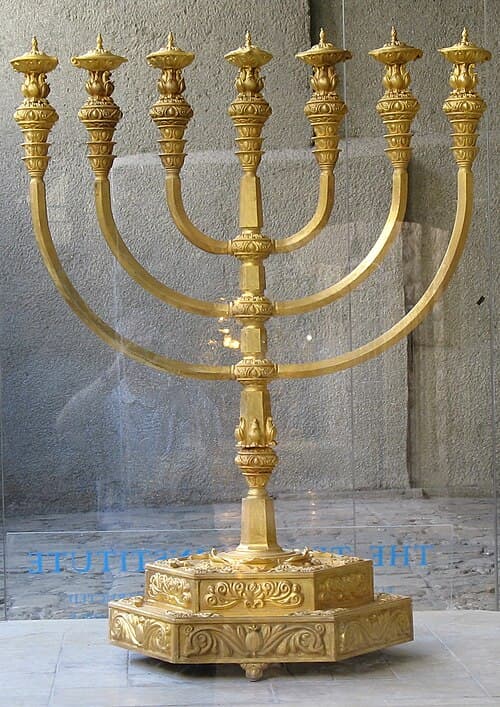
The seven-branched candelabrum, Judaism's oldest symbol of divine light and the endurance of faith against darkness.

Israel
The six-pointed star that became Judaism's most recognized symbol, now carried as both identity marker and protective charm.

