

426
Protection
📋
Mezuzah
Israel
A scroll of Torah verses in a decorative case affixed to doorposts, transforming Jewish homes into sanctuaries.
4.7Learn more →


A crimson thread tied seven times around the left wrist after visiting Rachel's Tomb, believed to ward off the evil eye.
The red Kabbalah string is one of modern popular culture's most recognized Jewish mystical practices — a thin red woolen thread tied seven times around the left wrist and knotted, believed to protect the wearer against the evil eye, misfortune, and negative energy. The practice is rooted in Jewish mystical (Kabbalistic) tradition and specifically connected to the biblical Rachel, wife of Jacob and mother of Joseph, whose tomb near Bethlehem is considered one of Judaism's most sacred sites. Red wool from Rachel's Tomb is believed to absorb her protective blessing and transfer it to whoever wears a strand.
The left wrist is specifically chosen in Kabbalistic thought because the left side is associated with receiving — the left hand receives energy from the universe while the right hand gives it out. Placing the protective string on the receiving wrist creates a shield at the point of vulnerability, where outside energies enter the body's energy field. The color red connects to the concept of 'dam' (blood), life force, and the ancient biblical use of red thread in protective contexts — most notably the red cord hung in Rahab's window in the Book of Joshua that marked her house for protection.
While traditional Kabbalists and Orthodox Jews have practiced variations of this custom for centuries, it entered global popular culture in the early 2000s when celebrities including Madonna, Demi Moore, and Britney Spears were photographed wearing the red string during their study of Kabbalah. This exposure made it the world's most recognized Jewish mystical amulet among non-Jewish populations, and the Philip Berg Kabbalah Centre commercialized a version that spread globally.
Protection from the evil eye and negative energy, connection to the blessing of Rachel the matriarch, and the cultivation of good fortune through alignment with Kabbalistic protective practice.
Have a friend or family member tie the string around your left wrist with seven knots while you recite a blessing or intention. The string should remain on until it naturally breaks or falls off on its own — removing it deliberately is believed to break its protection. Receive one tied by someone who loves you for maximum protective power.
The tradition of using red thread as protection against the evil eye appears in many non-Jewish cultures across the Middle East, Europe, and Asia — red threads tied around babies' wrists appear in Hindu, Chinese, and various folk European traditions — suggesting the red protective cord is a deeply cross-cultural human protective instinct that predates any specific religious system.
Rachel is the biblical matriarch whose tomb near Bethlehem has been a Jewish pilgrimage site for millennia. She is especially associated with intercession for children and protection of travelers, derived from Jeremiah 31:15 where 'Rachel weeps for her children.' Red wool wound around her tomb absorbs her intercessory blessing.
It has genuine roots in Kabbalistic tradition, though its specific forms have varied over centuries and the commercialized version popularized by the Kabbalah Centre is a modern adaptation. Traditional Kabbalists and Orthodox Jews have worn red strings for protection, though the exact practice and its theological legitimacy are debated within Jewish communities.
Traditional practice says a broken string has done its protective work — it absorbed whatever negative energy was directed at you and broke in the process. You can replace it with a new string. Removing the string deliberately is generally discouraged as it is believed to interrupt the protective connection.
Israel
A scroll of Torah verses in a decorative case affixed to doorposts, transforming Jewish homes into sanctuaries.
Israel
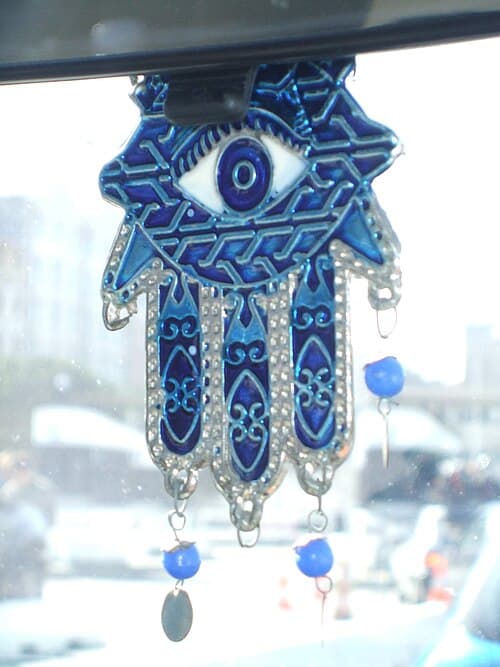
The Jewish version of the Hamsa hand, inscribed with Hebrew prayers and the Shema to protect against the evil eye.

Israel
The six-pointed star that became Judaism's most recognized symbol, now carried as both identity marker and protective charm.

