
5
Protection
🖐️
Hamsa Hand
Middle East
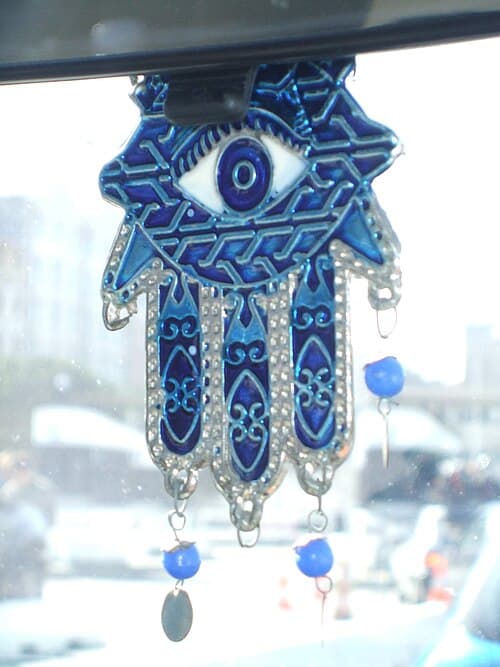
An open palm amulet warding off the evil eye across Middle Eastern and North African cultures.
4.9Learn more →

The Jewish version of the Hamsa hand, inscribed with Hebrew prayers and the Shema to protect against the evil eye.
The Hamsah — the specifically Jewish version of the Hamsa hand — is distinguished from its pan-regional cousins by the Hebrew textual and symbolic elements it incorporates: Hebrew prayers such as the Shema or Psalm 121, the Star of David, or the Hebrew word 'mazal' (luck/blessing) typically decorate the palm alongside or instead of the central eye. Jewish Hamsahs often bear the phrase 'b'ezrat Hashem' (with God's help) or other Hebrew expressions of blessing, making the palm literally inscribed with divine words — combining the protective power of the hand form with the specific efficacy of Hebrew sacred language.
In Sephardic Jewish tradition (Jews with roots in Spain, Portugal, and the Mediterranean), the Hamsah is an ancient and central protective object, having been used alongside the evil eye bead and the red thread as the three pillars of Jewish home protection for many centuries. Sephardic Jewish women were expert makers of Hamsah amulets, creating elaborate versions in silver with coral inlay for bridal chambers, newly furnished homes, and above infant cradles. The craft of Hamsah-making in communities like those of Morocco, Tunisia, Yemen, and the Balkans developed into distinctive regional styles that are now being rediscovered and celebrated by contemporary Jewish artists.
The Hamsah also holds an important place in the emerging discourse around Mizrahi and Sephardic Jewish identity — as Ashkenazi (Eastern European) Jewish culture dominated mid-20th century Jewish institutional life, the specifically Middle Eastern and Mediterranean traditions of Sephardic Jewry were somewhat marginalized. The Hamsah's global recognition has become part of a broader reclaiming of Sephardic Jewish cultural depth and sophistication.
Divine protection through the combined power of sacred Hebrew language and the universal hand-form, specifically protective against the evil eye and all forms of negative spiritual energy.
Hang in a home's main entrance with fingers pointing downward to invite divine blessing. Place near a newborn's crib for protection during the vulnerable early months. Wear as a pendant or hang in a vehicle. Gift at Jewish life cycle events — weddings, bar and bat mitzvahs, new home dedications.
Some of the most elaborate Jewish Hamsah amulets ever made were produced in Yemen, where Jewish silversmiths developed extraordinary filigree techniques combining the hand form with Hebrew calligraphy and complex geometric patterning. Yemenite Jewish silver Hamsahs are now recognized as masterworks of world jewelry art.
Jewish Hamsahs typically include Hebrew text (prayers, blessings, or divine names), Hebrew letters, or specifically Jewish symbols like the Star of David, Menorah, or fish. Arabic Hamsas may include Arabic calligraphy or Islamic symbols. Both share the core open-palm protective form and evil eye deflection function.
Its acceptance varies. The Hamsah has deep roots in Sephardic and Mizrahi Jewish communities where it is considered a legitimate protective tradition. Some Orthodox Ashkenazi authorities are skeptical of amulet use in general, while Sephardic Halachic authorities generally permit it. It is widely used across denominations without controversy.
Yemenite Jewish silversmiths developed extraordinary filigree techniques over many centuries of relative isolation from other Jewish communities. Their Hamsah amulets are considered among the finest examples of the form, combining Hebrew calligraphy with Islamic geometric patterns in an utterly unique cultural synthesis that reflects Yemen's distinctive religious plurality.
Middle East
An open palm amulet warding off the evil eye across Middle Eastern and North African cultures.

Israel
A crimson thread tied seven times around the left wrist after visiting Rachel's Tomb, believed to ward off the evil eye.

Israel
The six-pointed star that became Judaism's most recognized symbol, now carried as both identity marker and protective charm.

