

1
Protection
👁️
Evil Eye (Middle East)
Middle East
A blue glass bead charm that reflects the envious gaze before it can cause harm.
4.8Learn more →

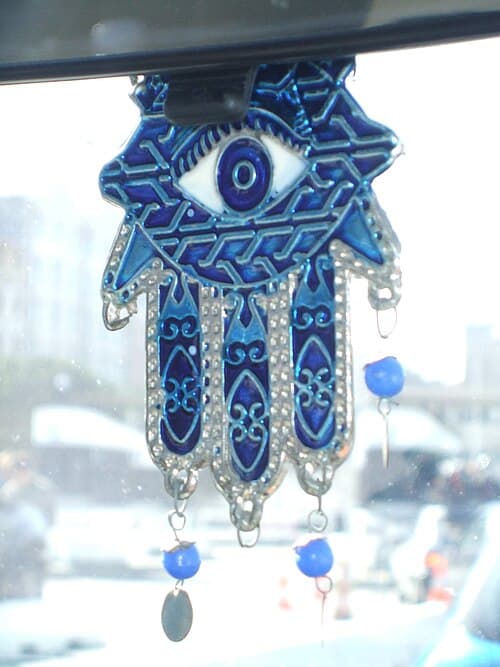
An open palm amulet warding off the evil eye across Middle Eastern and North African cultures.
The Hamsa Hand is one of the most universally recognized protective symbols in the Middle East and North Africa, appearing across Jewish, Islamic, and other traditions for thousands of years. Shaped like an open right hand with an eye depicted in the center of the palm, this amulet is believed to deflect the malevolent gaze of envy and ill intention, acting as a shield between its bearer and harm. The word 'hamsa' itself comes from the Arabic and Hebrew word for five, referring to the five fingers of the hand.
Across cultures it carries distinct meanings — in Jewish tradition it is associated with the five books of the Torah and the hand of God, while in Islamic tradition it is linked to the Five Pillars of Islam and the hand of Fatima, daughter of the Prophet Muhammad. In North Africa, particularly in Morocco and Tunisia, the symbol is embedded in architecture, jewelry, and everyday objects as a universal guardian against misfortune.
The Hamsa transcends religious boundaries to function as a cultural touchstone of the region, a shared visual language of protection that unites communities despite theological differences. Artisans craft it from silver, gold, ceramic, and embroidered fabric, each medium carrying its own regional tradition and aesthetic sensibility.
Protection from the evil eye, good fortune, and divine blessing. The five fingers represent the five senses and the call to use them to praise God. The eye in the center is a counter-amulet that reflects malicious stares back to their source.
Hang a Hamsa with the fingers pointing downward over doorways to invite blessings into a home, or with fingers pointing upward over windows to block negative energy from entering. Wear as a pendant, bracelet, or earring for personal protection throughout the day. Place on a car dashboard or office desk for ongoing shielding.
Archaeological evidence of open-hand protective symbols has been found in ancient Carthage (modern Tunisia) and Mesopotamia dating back over 3,000 years, suggesting the Hamsa's protective symbolism predates both Islam and Judaism in the region.
They refer to the same symbol. 'Hamsa' is the broader regional term used across Jewish and Islamic cultures, while 'Hand of Fatima' (Khamsa or Yad Fatima) is the specifically Islamic name honoring Fatima bint Muhammad. Both depict the same open-palm amulet with protective intent.
Fingers pointing downward are said to invite good luck and abundance into your life, while fingers pointing upward ward off evil and negative energy. Both orientations are considered protective — the choice is a matter of personal preference and cultural tradition.
Yes. The Hamsa has pre-religious roots and is widely considered a cultural rather than strictly religious symbol. Many people wear it purely for its protective folklore significance or as an appreciation of Middle Eastern artistic tradition.
Middle East
A blue glass bead charm that reflects the envious gaze before it can cause harm.
Middle East / North Africa
The sacred open palm named for the Prophet Muhammad's daughter, a cornerstone of Islamic protective symbolism.
Israel
The Jewish version of the Hamsa hand, inscribed with Hebrew prayers and the Shema to protect against the evil eye.

