

34
Success
🐘
Ganesha Figurine
India
The elephant-headed Hindu deity Ganesha is the remover of obstacles and the lord of new beginnings.
4.9Learn more →


The sacred conch shell is blown at auspicious moments to purify the atmosphere and invoke divine blessing across Hindu and Buddhist traditions.
The shankha (conch shell) is one of the most important ritual objects in Hindu worship, appearing in the right hand of Vishnu and the hands of many other deities as a symbol of primordial sound, victory, and the origin of existence. The spiral form of the conch mirrors the spiral structure of the cosmos in Hindu cosmology, and when blown, the resonant sound it produces is believed to purify the environment of negative energies and invite divine presences. The sound of the shankha is said to be so purifying that even the dust stirred by its vibration can sanctify whatever it touches.
In temple worship, the conch is blown at the beginning of puja (worship ceremony), during the waving of the sacred lamp (aarti), and at auspicious moments like sunrise and sunset. The sound drives away evil spirits, negative energies, and disease-causing entities according to traditional belief. Scientific measurements have found that the acoustic frequency produced by a blown conch shell is highly consistent at approximately 432 Hz, a frequency that some researchers associate with calming neurological effects.
The dakshinavarti shankha (right-spiraling conch) is especially rare and prized as a talisman, as most conch shells spiral to the left. A right-spiraling conch is considered to be directly associated with Vishnu and Lakshmi and is placed on home altars as a vessel for holding sacred water. Simply keeping a shankha in the home is believed to prevent the entry of negative forces. In Buddhist traditions across Southeast Asia, the conch is one of the Eight Auspicious Symbols, used in ritual contexts to proclaim the dharma across the world.
Primordial sound, purification, victory over evil, the call of the divine, and Vishnu's direct blessing. The right-spiraling variety specifically attracts Lakshmi's prosperity.
Blow the conch shell at the beginning and end of morning prayers to purify the space. Fill a dakshinavarti shankha with water and sprinkle the water in all directions of a new home or business as a purification rite. Keep the shell on a red cloth on the altar. Clean with pure water monthly.
The conch shell appears on the flag of Kerala state in India, in the coat of arms of several South Asian institutions, and in the royal regalia of Thailand and Cambodia — indicating its importance as a symbol of legitimate authority and divine sanction across the entire region.
Any conch shell can be used ritually, but the most sacred is the dakshinavarti (right-spiraling) shankha, which is rare and commands high prices. Regular conch shells spiral counterclockwise; right-spiraling ones are found in roughly 1 in 10,000 specimens.
Traditionally, the head of the household or the priest blows the shankha during rituals. There are no strict prohibitions against others blowing it, though it should be treated with respect and not blown carelessly or for entertainment.
The dakshinavarti shankha filled with water represents the blessed waters of all sacred rivers simultaneously, according to the Skanda Purana. This water, called shankha jal, is used for sprinkling on devotees and offerings as a powerful purifying agent.
India
The elephant-headed Hindu deity Ganesha is the remover of obstacles and the lord of new beginnings.

India
The pot filled with sacred water and crowned with a coconut and mango leaves represents the universe and invites the gods to reside within.
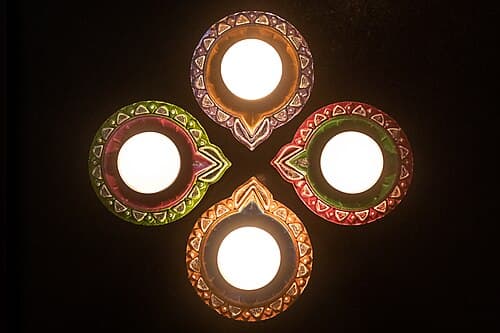
India
The clay oil lamp is the most fundamental symbol of the dispelling of darkness and the inviting of divine light into one's life.

India
Rising pure from muddy water, the lotus is the universal symbol of spiritual awakening and untouched beauty across Asia.

