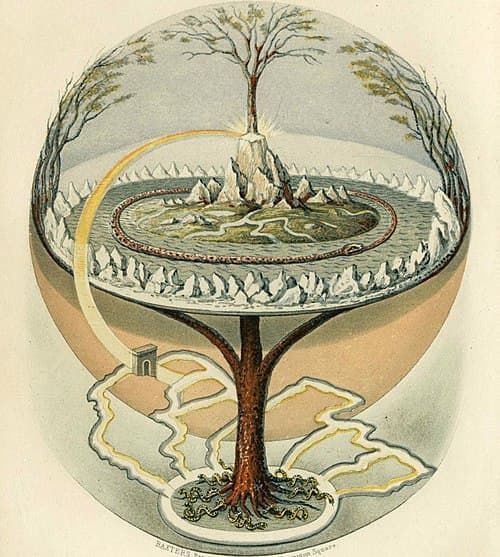
Tree of Life
Ancient Mesopotamia / Multiple traditions
The Tree of Life is a universal symbol found in nearly every major world culture, representing the interconnection of all life, ancestral roots, and the continuous cycle of growth and renewal.
The spiral is one of humanity's oldest sacred symbols, found in Neolithic art worldwide, representing the cycles of life, evolution, growth, and the journey inward to the center of the self.
Carved into the great Neolithic passage tomb of Newgrange in Ireland over five thousand years ago, painted on the rocks of Malta's prehistoric temples, and spiraling through the indigenous art of the Americas, Australia, and Polynesia, the spiral is humanity's oldest recurring sacred symbol. It predates writing, organized religion, and recorded history. Its ubiquity suggests that something in the spiral speaks directly to a fundamental human perception of how the world works — how galaxies spin, how shells grow, how storms form, how DNA coils.
In Celtic tradition, the triple spiral (triskelion) found at Newgrange is associated with the triple goddess, the cycles of life-death-rebirth, and the movements of the sun. In Japanese art, the spiral (tomoe) appears on Shinto shrines and samurai armor. In ancient Greek culture, spiral motifs decorated temples and pottery as symbols of eternity. Native American cultures used spirals to represent water, migration paths, and spiritual journeys.
As a charm, the spiral is used when seeking guidance through change, when navigating a difficult transition, or when one wants to align with the natural rhythms of the universe. It reminds us that growth rarely moves in a straight line — it cycles back to familiar territory at a higher level, each revolution expanding the circle of our understanding.

Growth, evolution, cycles of life, the journey inward, natural rhythms, and the ever-expanding self.
Wear a spiral charm during periods of transition or personal growth to align with the natural flow of change. Trace spiral patterns during meditation to induce a contemplative state. Place spiral art or carvings in spaces dedicated to creativity and personal development.
The Fibonacci spiral — found in sunflower seeds, nautilus shells, pine cones, and galaxies — is mathematically the same proportion as the golden spiral, suggesting that the spiral is not just a human symbol but a fundamental pattern embedded in the structure of the universe itself.
In some traditions yes — a clockwise spiral is associated with drawing energy in and attracting, while a counterclockwise spiral is used for releasing and letting go. In most everyday charm use, the distinction is not critical.
A spiral moves outward from a center point continuously. A labyrinth is a specific type of winding path with a single route to the center and back. Both are used for contemplative journeying, but a labyrinth is more associated with ritual walking meditation.
Yes. Because the spiral echoes the coiling double helix of DNA, some practitioners use it specifically in healing work, particularly for cellular renewal and recovery from illness.
Ancient Mesopotamia / Multiple traditions
The Tree of Life is a universal symbol found in nearly every major world culture, representing the interconnection of all life, ancestral roots, and the continuous cycle of growth and renewal.
Ancient India / 17th-Century Europe
The infinity symbol — a horizontal figure eight — represents endless possibility, eternal love, and the boundless nature of the universe.
Ancient Crete / Greece
The labyrinth is an ancient walking meditation symbol found worldwide, representing the journey inward to the center of the self and the winding path of spiritual growth.