

461
Protection
🐱
Cat's Eye Stone
Sri Lanka
The luminous chatoyant gem of acute perception, worn as a charm of sharp intuition, protection from the evil eye, and the mysterious wisdom of the night.
4.6Learn more →

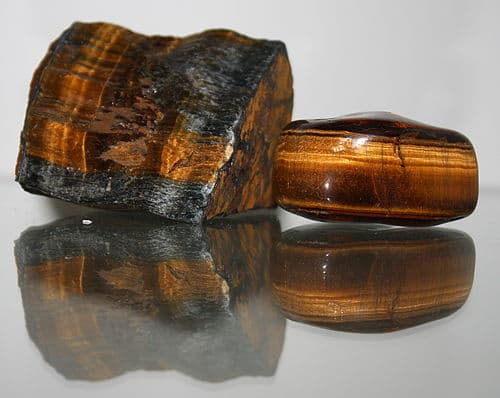
The chatoyant golden-brown stone of courage and discernment, worn as a charm for sharp perception, confident action, and the focused power of the predator's gaze.
Tiger's eye is a metamorphic gemstone formed when crocidolite (blue asbestos) fibres are replaced by silica and iron oxide during a geological process called pseudomorphism. The resulting stone — golden brown with silky parallel fibres — displays a stunning optical effect called chatoyancy or 'cat's eye effect': a band of light that moves across the surface as the stone is turned, like a predator's eye tracking movement. South Africa's Northern Cape produces the finest specimens, with Western Australia also a significant source.
Ancient Roman soldiers carried tiger's eye into battle carved into amulets shaped as eyes, believing the stone conferred the vision of the tiger — the ability to see danger clearly and act with swift, decisive power. Egyptian craftsmen carved it into the eyes of deity statues, connecting it to the all-seeing Ra and to divine sight that perceives truth behind illusion. Across Asian traditions, tiger's eye was placed in homes to detect the approach of deceivers and thieves.
In metaphysical work, tiger's eye bridges the gap between solar plexus power (action, will, confidence) and the earth's grounding stability — it encourages bold action from a grounded, centred place rather than reckless impulsivity. It is the stone of the entrepreneur who knows when to strike and when to wait; of the athlete who reads the game before making the move; of anyone who needs the courage of conviction combined with the wisdom of discernment.
The Tiger's Eye traces its origins to South Africa, where it has been revered for generations as a powerful symbol of achievement and ambition. Historical records and oral traditions suggest that early versions of this charm appeared centuries ago, when communities in South Africa first began attributing supernatural qualities to objects drawn from their natural and spiritual environment.
Over time, the Tiger's Eye evolved from a regional folk object into a widely recognized talisman. Traders, travelers, and migrants carried it across borders, introducing it to new cultures that often adopted and adapted it to fit their own belief systems. Today it is found in south africa, australia, india and beyond, each culture adding its own layer of meaning and ritual to the charm's enduring legacy.
In its homeland of South Africa, the Tiger's Eye occupies a revered place in both daily life and ceremonial practice. It is not merely decorative — it is woven into the fabric of cultural identity, appearing in celebrations, rites of passage, and household traditions that have been passed down through generations.
Beyond South Africa, the Tiger's Eye has gained recognition in south africa, australia, india and other regions, where it is valued for its symbolic connection to personal achievement. Scholars of material culture and anthropologists note that charms like the Tiger's Eye serve a dual psychological function: they provide a tangible focus for hope and intention, and they connect their owners to a living cultural tradition that transcends individual experience.
To get the most from your Tiger's Eye, keep it in a place where you will see it daily — on a desk, nightstand, or near your front entrance. Physical proximity reinforces the intention behind the charm and serves as a regular reminder of your goals.
Traditional practice recommends handling the charm with clean hands and respectful intention. Many practitioners in South Africa advise setting a clear purpose when you first acquire the charm: hold it, state your wish or goal silently or aloud, and then place it in its chosen position. Periodically cleansing the charm — by passing it through incense smoke, placing it under moonlight, or simply wiping it with a clean cloth — is believed to refresh its energy.
If the charm is meant to be worn (as jewelry or a carried token), keep it close to your body throughout the day. If it is a household object, place it in the area of your home most associated with its purpose — for example, near a workspace for success charms, or by the bed for love and health charms.
Courage, clear-sighted discernment, grounded confidence, the power to act decisively at the right moment, and protection against deception.
Wear as a pendant or carry in the dominant hand pocket when entering situations requiring sharp judgment. Place on the desk during decision-making processes. Carry during job interviews, negotiations, or any situation where you need to project confident authority while remaining perceptive.
The formation of tiger's eye involves one of geology's most complete transformations: the original blue crocidolite fibres are almost entirely replaced by quartz, yet the parallel alignment of the original fibres is perfectly preserved in the quartz matrix — an architectural memory of the original stone etched into an entirely different mineral.
Yes — the original asbestos fibres in tiger's eye are completely replaced by quartz during its formation, making the finished stone perfectly safe to handle and wear. Do not sand or drill tiger's eye without protective equipment, as this could release silica dust.
All three are varieties of the same stone. Tiger's eye is golden-brown; hawk's eye (falconite) retains the original blue-grey colour; bull's eye (ox eye) is red-brown, caused by additional iron oxidation. Each is thought to have a slightly different energetic emphasis.
Its grounding quality can calm anxiety that stems from overthinking or feeling unmoored. It is particularly helpful for 'action anxiety' — the fear of taking a necessary step. It encourages the holder to move from thought into confident, grounded action.
The Tiger's Eye originates from South Africa, where it has been used as a success charm for centuries. Its influence has since spread to south africa, australia, india and many other regions worldwide.
Wear as a pendant or carry in the dominant hand pocket when entering situations requiring sharp judgment. Place on the desk during decision-making processes. Carry during job interviews, negotiations, or any situation where you need to project confident authority while remaining perceptive. For best results, set a clear intention when you first acquire the charm and keep it in a prominent, respectful location.
Yes, giving a Tiger's Eye as a gift is considered a generous and meaningful gesture in most traditions. In South Africa, gifted charms are often believed to carry even stronger energy than those purchased for oneself, because they come with the goodwill and intention of the giver.
Many practitioners recommend periodically cleansing your Tiger's Eye to refresh its energy. Common methods include passing it through incense smoke, placing it in moonlight overnight, rinsing it under clean water (if the material allows), or simply wiping it down with a clean cloth while setting a fresh intention.
While the Tiger's Eye originated in the cultural traditions of South Africa, it is not exclusive to any single religion. It has been adopted and adapted by people of many faiths and backgrounds, each bringing their own interpretation to its symbolism and use.
Sri Lanka
The luminous chatoyant gem of acute perception, worn as a charm of sharp intuition, protection from the evil eye, and the mysterious wisdom of the night.

Brazil
The golden abundance crystal, known as the Merchant's Stone, carried to attract wealth, success, and the warm energy of solar prosperity.

Spain
The golden metallic mineral of abundance and confidence, carried as a charm to attract wealth, repel negative energy, and activate the solar will to succeed.

