
15
Protection
🕉️
Om Symbol
India
The primordial sound of the universe, Om is the most sacred symbol in Hinduism, Buddhism, and Jainism.
4.9Learn more →


Sacred geometric diagrams functioning as visual mantras, yantras concentrate divine energy into a specific intention.
A yantra is a sacred geometric diagram used in Hindu and Tantric traditions as a focus for meditation, worship, and the concentration of specific divine energies. The word derives from the Sanskrit root 'yam' (to control or bind) and 'tra' (instrument), making a yantra literally an instrument for controlling or harnessing a specific energy. While a mantra is a sound formula and a mudra is a physical gesture, the yantra is the visual dimension of the same spiritual technology — all three working together in full Tantric practice.
The Sri Yantra is the most celebrated of all yantras, depicting the cosmos in a complex interlocking arrangement of nine triangles, of which five point downward (representing Shakti, the feminine principle) and four point upward (representing Shiva, the masculine principle). Together they generate 43 smaller triangles that encode the complete structure of the cosmos, surrounded by two circles of lotus petals and enclosed in a square representing the earth. Simply gazing at the Sri Yantra in meditation is believed to activate deep states of altered consciousness and attract the energies of abundance, beauty, and harmony.
Different yantras are dedicated to different deities and serve different purposes: the Ganesha yantra removes obstacles, the Lakshmi yantra attracts wealth, the Saraswati yantra enhances learning and creativity, the Sudarshana yantra offers protection. Each yantra is typically inscribed on copper, gold, or silver plate, consecrated through specific rituals, and then placed on an altar or in a specific location according to the purpose it serves. The geometry itself is considered a living, functioning form — not merely a symbol but an active device.
The Yantra traces its origins to India, where it has been revered for generations as a powerful symbol of prosperity and abundance. Historical records and oral traditions suggest that early versions of this charm appeared centuries ago, when communities in India first began attributing supernatural qualities to objects drawn from their natural and spiritual environment.
Over time, the Yantra evolved from a regional folk object into a widely recognized talisman. Traders, travelers, and migrants carried it across borders, introducing it to new cultures that often adopted and adapted it to fit their own belief systems. Today it is found in india, nepal, sri lanka and beyond, each culture adding its own layer of meaning and ritual to the charm's enduring legacy.
In its homeland of India, the Yantra occupies a revered place in both daily life and ceremonial practice. It is not merely decorative — it is woven into the fabric of cultural identity, appearing in celebrations, rites of passage, and household traditions that have been passed down through generations.
Beyond India, the Yantra has gained recognition in india, nepal, sri lanka and other regions, where it is valued for its symbolic connection to financial prosperity. Scholars of material culture and anthropologists note that charms like the Yantra serve a dual psychological function: they provide a tangible focus for hope and intention, and they connect their owners to a living cultural tradition that transcends individual experience.
To get the most from your Yantra, keep it in a place where you will see it daily — on a desk, nightstand, or near your front entrance. Physical proximity reinforces the intention behind the charm and serves as a regular reminder of your goals.
Traditional practice recommends handling the charm with clean hands and respectful intention. Many practitioners in India advise setting a clear purpose when you first acquire the charm: hold it, state your wish or goal silently or aloud, and then place it in its chosen position. Periodically cleansing the charm — by passing it through incense smoke, placing it under moonlight, or simply wiping it with a clean cloth — is believed to refresh its energy.
If the charm is meant to be worn (as jewelry or a carried token), keep it close to your body throughout the day. If it is a household object, place it in the area of your home most associated with its purpose — for example, near a workspace for success charms, or by the bed for love and health charms.
Concentration and activation of divine energy for a specific purpose. Each yantra is a complete energetic technology encoded in visual geometry.
Place the appropriate yantra on a clean altar facing east or north. Cleanse it with milk, honey, and water during consecration. Light a ghee lamp and offer flowers. Gaze at the central point (bindu) of the yantra during meditation, allowing the geometry to draw the mind inward. Recite the associated mantra 108 times.
The Sri Yantra has been the subject of serious mathematical analysis: when three-dimensionally projected, it becomes a perfect pyramid whose apex angle exactly matches that of the Great Pyramid of Giza, a coincidence that has fascinated both mathematicians and mystics.
A yantra becomes fully effective only after proper consecration (prana pratishtha), which requires specific rituals, mantras, and materials. A mass-produced yantra without consecration functions as a reminder and focus for personal practice but is not considered a fully activated talisman. Ideally, seek a yantra consecrated by a qualified practitioner.
The Shri Yantra (or Sri Chakra) is universally considered the supreme yantra for wealth and abundance, as it embodies the energy of the goddess Tripura Sundari (Lalita), who governs all forms of prosperity. The Kubera Yantra is used specifically for material wealth, and the Lakshmi Yantra for both wealth and good fortune.
The prayer room or meditation space facing east is ideal. For wealth yantras, the north corner (associated with Kubera, the god of wealth) is recommended. Place yantras at eye level or above, never on the floor. Ensure the space remains clean and well-lit.
The Yantra originates from India, where it has been used as a wealth charm for centuries. Its influence has since spread to india, nepal, sri lanka and many other regions worldwide.
Place the appropriate yantra on a clean altar facing east or north. Cleanse it with milk, honey, and water during consecration. Light a ghee lamp and offer flowers. Gaze at the central point (bindu) of the yantra during meditation, allowing the geometry to draw the mind inward. Recite the associated mantra 108 times. For best results, set a clear intention when you first acquire the charm and keep it in a prominent, respectful location.
Yes, giving a Yantra as a gift is considered a generous and meaningful gesture in most traditions. In India, gifted charms are often believed to carry even stronger energy than those purchased for oneself, because they come with the goodwill and intention of the giver.
Many practitioners recommend periodically cleansing your Yantra to refresh its energy. Common methods include passing it through incense smoke, placing it in moonlight overnight, rinsing it under clean water (if the material allows), or simply wiping it down with a clean cloth while setting a fresh intention.
While the Yantra originated in the cultural traditions of India, it is not exclusive to any single religion. It has been adopted and adapted by people of many faiths and backgrounds, each bringing their own interpretation to its symbolism and use.
India
The primordial sound of the universe, Om is the most sacred symbol in Hinduism, Buddhism, and Jainism.

India
Seeds of the Elaeocarpus ganitrus tree, rudraksha beads are the tears of Shiva — the most potent Hindu spiritual talisman.
India
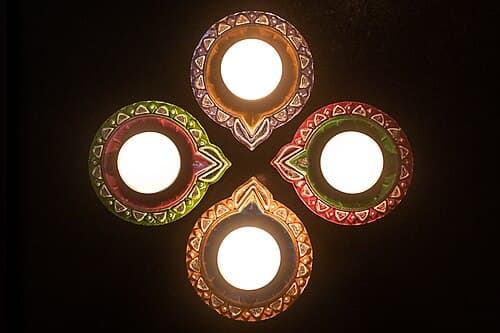
The clay oil lamp is the most fundamental symbol of the dispelling of darkness and the inviting of divine light into one's life.

India
A string of 108 prayer beads used for mantra repetition, mala beads align the practitioner's energy with divine intention through meditative counting.

