
5
Protection
🖐️
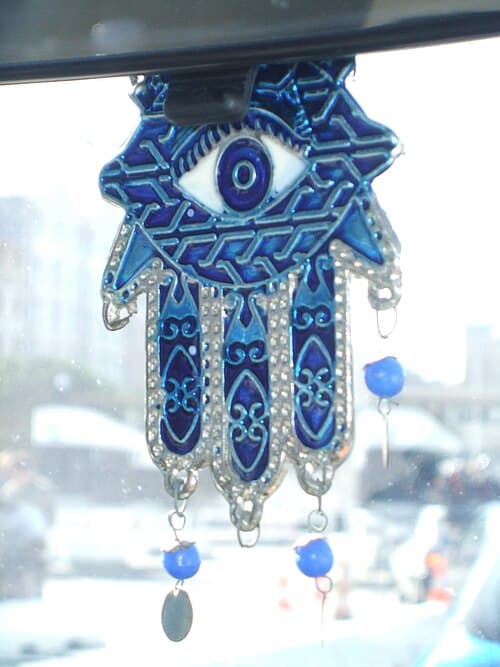
Hamsa Hand
Middle East
An open palm amulet warding off the evil eye across Middle Eastern and North African cultures.
4.9Learn more →

From St. Christopher medals to Thai amulets, discover the lucky charms that travelers have relied on for centuries — and which ones to pack on your next trip.
Traveling has always been one of humanity's most exhilarating — and most dangerous — activities. Long before GPS, airport security, and travel insurance, people relied on lucky charms to protect them on the road, the sea, and eventually the sky. Many of these traditions survive today, not as museum curiosities but as living practices used by millions of modern travelers worldwide.
The St. Christopher medal is the single most widely carried travel charm in the Western world. According to Catholic tradition, St. Christopher was a giant who carried travelers across a dangerous river. One day he carried a small child who grew impossibly heavy — the child revealed himself as Christ, carrying the weight of the world. Since then, St. Christopher has been the patron saint of travelers.
Millions of Christians and non-Christians alike clip St. Christopher medals to their car visors, wear them as pendants, or tuck them into luggage. The practice is so widespread that even after the Vatican removed Christopher from the universal calendar of saints in 1969, devotion to his medal actually increased.
Best for: Road trips, long-distance driving, any journey where personal safety is a concern.
In Thailand, Phra Kruang — sacred Buddhist amulets blessed by monks — are worn by an estimated 90% of Thai men and a growing number of travelers from other countries. These small tablets, encased in waterproof housings and worn around the neck, are believed to offer protection against accidents, violence, and misfortune.
Some amulets are mass-produced and affordable; others, blessed by particularly revered monks, can sell for tens of thousands of dollars at auction. Thai taxi drivers universally display them on their dashboards, and Thai airlines have been known to bless new aircraft with monastic ceremonies that include placing amulets aboard.
Best for: Southeast Asian travel, general spiritual protection, collecting meaningful cultural artifacts.
The Hamsa hand — an open palm with an eye at its center — is the premier travel protection charm across the Middle East, North Africa, and the Mediterranean. Jewish, Muslim, and Christian traditions all embrace it, making it one of the few protective symbols that transcend religious boundaries entirely.
Travelers in Morocco, Turkey, Israel, Greece, and Tunisia frequently purchase Hamsa pendants or keychains as both souvenirs and genuine protective objects. The eye at the center wards off the evil eye — particularly relevant for travelers, who are often objects of attention and envy in unfamiliar places.
Best for: Mediterranean and Middle Eastern travel, protection against envy and negative attention.
In Norse mythology, the acorn was sacred to Thor, god of thunder and protector of travelers. Vikings carried acorns during sea voyages to invoke Thor's protection against storms. The tradition persisted in Scandinavia and Britain for centuries — acorns were placed on windowsills to protect homes from lightning, and carried in pockets during journeys.
The acorn's symbolism of resilience (a mighty oak grows from a tiny seed) makes it an appealing modern travel charm for anyone embarking on a journey of personal growth or adventure.
Best for: Outdoor adventures, sea travel, journeys into the unknown.
Indigenous peoples of the American Southwest, particularly the Navajo and Zuni, have regarded turquoise as a supreme protective stone for travelers for over a thousand years. Apache warriors attached turquoise to their bows and later to their horses' bridles to ensure safe passage. The stone's sky-blue color connected it to the protective powers of the heavens.
In Persian tradition, turquoise (called firuzeh, meaning "victory") was similarly used as a traveler's talisman, set into rings and horse trappings. The stone was believed to change color to warn its owner of approaching danger.
Best for: Road trips through the American Southwest, horseback adventures, any journey through arid or mountainous terrain.
The Cornicello — the red horn charm ubiquitous in Southern Italy — and its companion gesture, the Mano Cornuta, have protected Italian travelers for millennia. Originally a phallic fertility symbol, the horn evolved into a general protector against the malocchio (evil eye) and misfortune. Italian-Americans frequently hang cornicelli from their rearview mirrors, continuing a tradition that dates back to the Roman Empire.
Best for: Mediterranean travel, protection against jealousy and the evil eye, road safety.
Omamori are silk-wrapped amulets sold at Shinto shrines and Buddhist temples throughout Japan. Specific types exist for virtually every purpose, including kotsu anzen (traffic safety) omamori — one of the best-selling varieties. Japanese drivers purchase new traffic safety omamori annually and attach them to their keychains or rearview mirrors.
The tradition is so deeply embedded in Japanese culture that major automotive companies, including Toyota, have been known to distribute omamori to employees during new model launches.
Best for: Japanese travel, safe driving, a meaningful cultural souvenir.
While not tied to any single cultural tradition, the compass rose has emerged as a modern traveler's charm that combines nautical heritage with universal symbolism. Sailors, pilots, and explorers have used compass rose imagery for centuries to represent safe navigation and the hope of returning home. Modern travelers wear compass rose pendants or carry them as keychain charms.
Best for: Any journey, especially sea and air travel, or for someone who travels frequently.
The most effective travel charm is one that resonates personally. Consider these factors:
Every civilization in human history has developed travel protection charms. The details vary — a medal in Rome, an amulet in Bangkok, a turquoise stone in Arizona — but the underlying impulse is identical: the recognition that leaving the safety of home is inherently risky, and the hope that something small and meaningful can tip the odds in your favor. Whether you approach these charms with spiritual conviction or simply enjoy the ritual and the history, carrying one on your next journey connects you to the deepest and most universal of human traditions.
Middle East
An open palm amulet warding off the evil eye across Middle Eastern and North African cultures.

Japan
Omamori are sacred Japanese amulets sold at Shinto shrines and Buddhist temples, offering specific divine blessings for love, safety, success, health, or any of dozens of specialized needs.

Italy
The twisted red horn amulet of southern Italy that deflects the evil eye.

Iran
The ancient sky-stone of the world's oldest cultures, worn as a charm of protection, communication, and the sacred turquoise bridge between earth and heaven.

Middle East
A blue glass bead charm that reflects the envious gaze before it can cause harm.
Can a rabbit's foot really improve your luck? Surprising research from psychology and neuroscience reveals that lucky charms work — just not the way most people think.
Over time, lucky charms are believed to absorb negative energy and lose their potency. Learn the most respected cleansing and charging methods from traditions worldwide.
Every month of the year is associated with a gemstone believed to bring special fortune to those born under its influence. Discover the history and meaning behind all 12 birthstones.