1
Protection
👁️
Evil Eye (Middle East)
Middle East
A blue glass bead charm that reflects the envious gaze before it can cause harm.
4.8Learn more →

The belief that an envious gaze can cause harm exists in virtually every culture on earth. Discover the history, science, and global traditions of evil eye protection.
If you could identify one belief shared by virtually every culture in human history, it would not be a specific religion, moral code, or creation myth. It would be the evil eye — the conviction that a look of envy, admiration, or ill will can bring misfortune, illness, or death to its target. And if you could identify one protective object that transcends all cultural boundaries, it would be the amulet designed to deflect that gaze.
The evil eye belief is documented in ancient Sumerian texts from 3,000 BCE, in Egyptian papyri, in the Hebrew Bible, in the Quran, in Greek philosophy, in Roman law, in medieval European church records, and in the oral traditions of Indigenous peoples across Africa, Asia, and the Americas. No other superstition comes close to this level of cross-cultural universality.
The earliest written references to the evil eye appear in Sumerian cuneiform texts dating to approximately 3,000 BCE. The Sumerians called it "ig-hul" (evil eye) and developed incantations and amulets to counteract it. The belief was inherited by the Babylonians, Assyrians, and Egyptians, each of whom developed their own protective traditions.
In ancient Egypt, the Eye of Horus (Wadjet) served a dual purpose: it was a healing symbol and a counter-amulet against the evil eye. The eye's stylized form — with its distinctive teardrop marking — became the template for protective eye symbols across the Mediterranean for millennia.
Ancient Greece formalized the evil eye concept. The philosopher Plutarch offered a quasi-scientific explanation, suggesting that the eyes emitted rays of energy that could, when powered by envy, cause physical harm. Pliny the Elder documented evil eye beliefs across the Roman Empire. Greek and Roman households routinely displayed eye-shaped amulets, phallic symbols (fascinus), and grotesque figures (gorgoneion) to deflect envious gazes.
The iconic cobalt blue glass evil eye bead — known as Nazar in Turkish — emerged from the glassmaking traditions of ancient Egypt and later flourished in Anatolia (modern Turkey). Blue was chosen for specific reasons: it was the color of the sky and therefore associated with divine protection, and blue-eyed people were considered especially potent givers of the evil eye in brown-eyed Mediterranean populations, making a blue amulet the ideal symbolic counter.
The layered glass technique used to create the concentric circles of the Nazar bead — dark blue outer ring, white ring, light blue iris, and black pupil — has remained virtually unchanged for over 2,000 years. The town of Gorece near Izmir, Turkey, has been producing evil eye beads continuously for centuries and remains the world's primary source.
Today, the Nazar bead is Turkey's most recognized cultural export, appearing on everything from jewelry and keychains to airplane tail fins (Turkish Airlines features a Nazar-inspired livery) and the facades of five-star hotels.
Middle East and North Africa: The evil eye is called "ayn al-hasud" (eye of the envier) in Arabic and is explicitly acknowledged in Islamic scripture. The Quran references "the evil of the envier" (Surah Al-Falaq 113:5). Protection methods include reciting specific Quranic verses (Ayat al-Kursi), wearing the Hamsa hand, burning incense, and applying kohl around children's eyes.
Mediterranean Europe: In Italy, the evil eye is called "malocchio," and protection includes the cornicello (a twisted horn-shaped pendant) and the mano cornuta (a hand gesture with extended index and little fingers). Greek tradition uses the mati (blue eye bead) and a ritual called xematiasma, in which olive oil is dropped into water to diagnose and cure the evil eye.
South Asia: In India, the evil eye is "drishti" or "nazar" and is one of the most commonly feared sources of misfortune. Newborn babies are considered extremely vulnerable — a black dot of kohl is applied to the baby's forehead or foot to make it appear less perfect and therefore less likely to attract envy. Lemons and green chillies hung at doorways are believed to absorb evil eye energy.
Latin America: The concept of "mal de ojo" is widespread across Central and South America, blending indigenous and Spanish colonial beliefs. Children are considered most at risk. Traditional remedies include passing an egg over the afflicted person's body to absorb the negative energy, then cracking it into a glass of water to "read" the results.
East Africa: In Ethiopia and the Horn of Africa, the "buda" (evil eye) is associated with specific social groups — historically, metalworkers and potters were believed to possess the power. Protection involves wearing silver amulets, burning specific herbs, and the intervention of religious leaders.
Why is the evil eye so universal? Psychologists offer several complementary explanations:
Social monitoring: In small-scale societies (which characterized most of human history), monitoring others' envy was essential for social survival. The evil eye belief system creates a socially sanctioned framework for acknowledging envy, managing it, and protecting against its consequences.
Anxiety management: The evil eye provides an explanation for otherwise inexplicable misfortune — a healthy child suddenly falling ill, a thriving business suddenly failing. Having an explanation, even a supernatural one, is psychologically preferable to randomness. It also provides a protective response (wearing an amulet), which restores a sense of control.
Modesty enforcement: The evil eye tradition implicitly discourages conspicuous display of success. If flaunting your wealth attracts envious gazes that cause harm, there is a strong social incentive to remain modest — a norm that benefits community cohesion.
In recent decades, the evil eye has undergone a remarkable transformation from folk amulet to high fashion accessory. Luxury brands including Gucci, Dolce & Gabbana, and Cartier have featured evil eye motifs in their collections. Celebrities from Gigi Hadid to Meghan Markle have been photographed wearing evil eye jewelry. The symbol has appeared on fashion runways in New York, Paris, and Milan.
This mainstreaming has sparked debate. Some cultural commentators welcome the global appreciation of a beautiful and historically significant symbol. Others express concern about cultural appropriation — the reduction of a deeply meaningful protective tradition to a decorative trend divorced from its spiritual context.
For those who wish to engage with the tradition authentically, the following practices are widely recommended across cultures:
The evil eye amulet is, in every meaningful sense, humanity's amulet — the one protective symbol that unites Jew and Muslim, European and Asian, ancient and modern, superstitious and secular. Its five-thousand-year persistence is not evidence of ignorance. It is evidence that the human need for protection against the unknown is as fundamental as the need for food, shelter, and love. And as long as that need exists, the blue glass eye will continue to watch over us.
Middle East
A blue glass bead charm that reflects the envious gaze before it can cause harm.
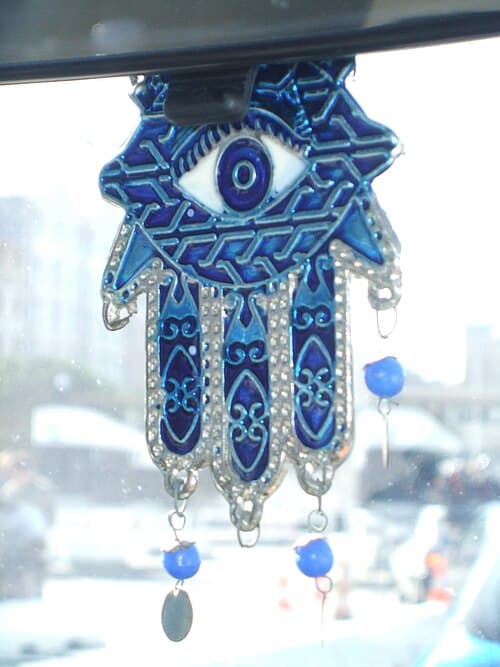
Middle East
An open palm amulet warding off the evil eye across Middle Eastern and North African cultures.
Middle East / North Africa
The sacred open palm named for the Prophet Muhammad's daughter, a cornerstone of Islamic protective symbolism.

Italy
The twisted red horn amulet of southern Italy that deflects the evil eye.
A protection charm bundle — sometimes called a mojo bag, medicine pouch, or gris-gris — is one of the most personal and powerful protective tools you can create. Here is how to make one that works.
The hamsa is one of the world's oldest protective symbols, revered across three Abrahamic religions and pre-dating all three. Discover the rich history and cross-cultural significance of the hand that protects.
The dreamcatcher is one of the most widely sold Native American-inspired objects in the world. But its true origins, meanings, and proper use are far richer and more specific than most people know.