

13
Success
🪲
Scarab Beetle
Egypt
The sacred Egyptian beetle of Khepri, symbol of transformation, rebirth, and the rising sun.
4.6Learn more →


The ancient Egyptian key of life, a symbol of immortality and the union of masculine and feminine forces.
The Ankh is perhaps the most recognized symbol of ancient Egyptian civilization — a cross with a loop at the top that the Egyptians called 'the key of life' or 'the breath of life.' It appears in hieroglyphic writing as the word for 'life' and was carried by nearly every Egyptian deity in artwork, held in their hands like a scepter of divine authority. The shape is believed by many scholars to represent the union of the masculine and feminine — the loop symbolizing the sun rising above the horizon, or alternately, a sandal strap, or the combination of the symbols of Osiris and Isis.
The Ankh was not merely a symbol — it was a tool. In tomb paintings, gods are shown holding the Ankh to the nostrils of pharaohs, literally breathing life into them. It was believed that holding or wearing an Ankh connected the bearer to the life-force of the gods themselves, offering protection from death and the promise of eternal existence beyond the mortal realm. Mirrors and hand mirrors in ancient Egypt were often fashioned in the shape of the Ankh, suggesting a connection to the concept of the soul's reflection.
In modern times the Ankh has experienced a powerful cultural revival, adopted by New Age spiritualists, Afrocentric scholars, and Egyptian heritage communities as a symbol of African philosophical achievement and the deep wisdom of ancient civilizations. It bridges the ancient and modern as few symbols can, carrying 5,000 years of meaning into contemporary discourse about life, death, and what lies beyond.
Eternal life, the union of opposites, and the divine power of creation and sustenance. The Ankh represents both the mortal life we live and the immortal life that follows, making it a symbol of complete existence.
Wear as a pendant over the throat or heart chakra for maximum life-energy benefit. Place an Ankh in your bedroom to encourage health and vitality. Meditate with an Ankh in hand when contemplating major life questions or seeking connection to a larger sense of purpose.
The Coptic Christian cross, used by Egypt's ancient Christian community, evolved directly from the Ankh — early Egyptian Christians adapted the symbol to represent Christ's crucifixion while retaining its deep-rooted associations with eternal life, one of the most remarkable examples of symbol continuity in religious history.
Scholars debate this. Common interpretations include a sandal strap seen from above, the union of the oval womb symbol (Isis) with the cross symbol (Osiris), the sun rising above the horizon, or a stylized depiction of a knot. Most agree the loop represents the feminine and the cross the masculine principle.
The Ankh is widely worn across cultures as a symbol of life and spirituality. Egyptian and Kemetic practitioners consider it sacred to their heritage, while others wear it more broadly as a life symbol. Approaching it with genuine respect for its origins is generally considered appropriate.
Yes, though the Ankh as jewelry was more common in elite and royal contexts. Commoners were more likely to use Ankh imagery in home shrines and on amulets. Elaborate Ankh pendants in gold and precious stones have been found in royal tombs including that of Tutankhamun.
Egypt
The sacred Egyptian beetle of Khepri, symbol of transformation, rebirth, and the rising sun.

Egypt
The sacred eye of the falcon god, a powerful amulet of healing, protection, and royal authority.
Egypt
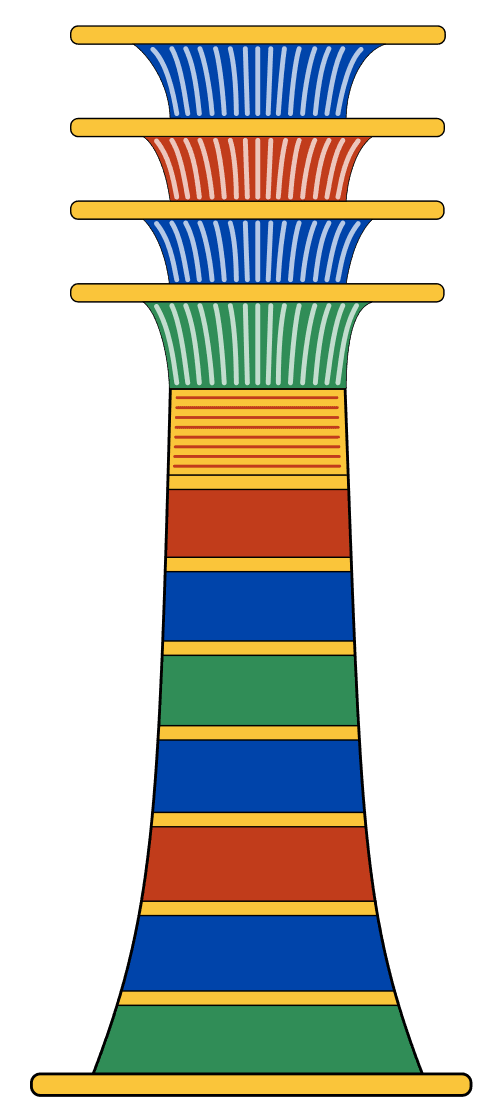
The ancient Egyptian symbol of stability, endurance, and the spine of the god Osiris.

