
458
General
🌈
Opal
Australia
The rainbow-fire stone of magic and possibility, carried as a charm for amplifying imagination, embracing the full spectrum of emotion, and attracting the unexpected blessings of change.
4.8Learn more →

The rainbow-fire gemstone of the Australian outback, worn as a charm for creativity, spontaneity, and the full spectrum of possibility.
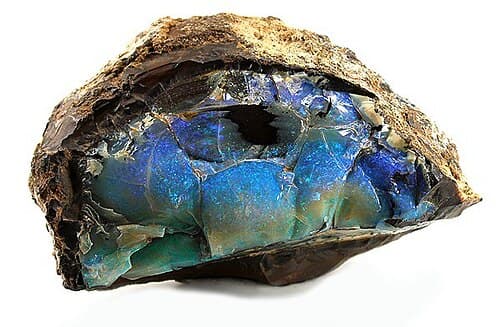
Australia produces roughly 95% of the world's precious opal, with the Lightning Ridge black opal and the Coober Pedy white opal representing the two great poles of this extraordinary gemstone. Formed 100 million years ago when silica-rich water seeped into voids left by ancient sea creatures, opal's play-of-colour — the shifting fire of red, green, gold, and violet — is caused by diffraction of light through its unique silica sphere structure. No two opals display the same pattern, making each stone a truly singular object and a natural symbol of individuality.
Ancient Romans called opal opalus and considered it the most precious of all gems, believing it contained the fire of rubies, the sea-green of emeralds, and the blue of sapphires all in one. They saw it as the stone of hope, carrying the full spectrum of possibility. Aboriginal Australians have their own creation stories for opal — in one Dreaming narrative, the Creator descended to Earth on a rainbow, and where his foot touched the ground, the stones began to sparkle with all the colours of the sky.
Wearing Australian opal as a charm is believed to amplify whatever emotion or intention the wearer holds most strongly, making it a powerful stone for creative endeavours and emotional honesty. It is traditionally associated with artists, writers, and visionaries. It also encourages the wearer to embrace change rather than resist it, reflecting the gemstone's own refusal to be pinned to a single colour.
The Australian Opal traces its origins to Australia, where it has been revered for generations as a powerful symbol of good fortune and positive energy. Historical records and oral traditions suggest that early versions of this charm appeared centuries ago, when communities in Australia first began attributing supernatural qualities to objects drawn from their natural and spiritual environment.
Over time, the Australian Opal evolved from a regional folk object into a widely recognized talisman. Traders, travelers, and migrants carried it across borders, introducing it to new cultures that often adopted and adapted it to fit their own belief systems. Today it is found in australia and beyond, each culture adding its own layer of meaning and ritual to the charm's enduring legacy.
In its homeland of Australia, the Australian Opal occupies a revered place in both daily life and ceremonial practice. It is not merely decorative — it is woven into the fabric of cultural identity, appearing in celebrations, rites of passage, and household traditions that have been passed down through generations.
Beyond Australia, the Australian Opal has gained recognition in australia and other regions, where it is valued for its symbolic connection to universal good luck. Scholars of material culture and anthropologists note that charms like the Australian Opal serve a dual psychological function: they provide a tangible focus for hope and intention, and they connect their owners to a living cultural tradition that transcends individual experience.
To get the most from your Australian Opal, keep it in a place where you will see it daily — on a desk, nightstand, or near your front entrance. Physical proximity reinforces the intention behind the charm and serves as a regular reminder of your goals.
Traditional practice recommends handling the charm with clean hands and respectful intention. Many practitioners in Australia advise setting a clear purpose when you first acquire the charm: hold it, state your wish or goal silently or aloud, and then place it in its chosen position. Periodically cleansing the charm — by passing it through incense smoke, placing it under moonlight, or simply wiping it with a clean cloth — is believed to refresh its energy.
If the charm is meant to be worn (as jewelry or a carried token), keep it close to your body throughout the day. If it is a household object, place it in the area of your home most associated with its purpose — for example, near a workspace for success charms, or by the bed for love and health charms.
Creative amplification, emotional authenticity, embracing the full spectrum of experience, and the iridescent magic of possibility.
Wear as a pendant over the heart or carry loose in a small pouch. When beginning a creative project, hold the opal and allow your eyes to trace the shifting colours — this activates the imaginative mind. Avoid wearing during arguments, as opal can amplify strong emotions including difficult ones.
The world's most valuable opal, the 'Olympic Australis,' was found in 1956 at Coober Pedy and weighs 17,000 carats (3.4 kg). It remains the largest and most valuable gem-quality opal ever found, currently valued at over AUD 2.5 million.
This superstition was popularised in the 19th century by a novel (Sir Walter Scott's Anne of Geierstein) and has no basis in gemological or metaphysical tradition. In most ancient cultures, opal was considered extraordinarily lucky.
Opals contain water (up to 21%) and can crack if they dry out. Store them away from heat and direct sunlight, and avoid ultrasonic cleaners. Wipe gently with a soft damp cloth rather than submerging.
Black opals from Lightning Ridge are considered the most energetically potent due to the contrast between the dark body tone and the vivid colour play — this contrast symbolises light arising from darkness.
The Australian Opal originates from Australia, where it has been used as a general charm for centuries. Its influence has since spread to australia and many other regions worldwide.
Wear as a pendant over the heart or carry loose in a small pouch. When beginning a creative project, hold the opal and allow your eyes to trace the shifting colours — this activates the imaginative mind. Avoid wearing during arguments, as opal can amplify strong emotions including difficult ones. For best results, set a clear intention when you first acquire the charm and keep it in a prominent, respectful location.
Yes, giving a Australian Opal as a gift is considered a generous and meaningful gesture in most traditions. In Australia, gifted charms are often believed to carry even stronger energy than those purchased for oneself, because they come with the goodwill and intention of the giver.
Many practitioners recommend periodically cleansing your Australian Opal to refresh its energy. Common methods include passing it through incense smoke, placing it in moonlight overnight, rinsing it under clean water (if the material allows), or simply wiping it down with a clean cloth while setting a fresh intention.
While the Australian Opal originated in the cultural traditions of Australia, it is not exclusive to any single religion. It has been adopted and adapted by people of many faiths and backgrounds, each bringing their own interpretation to its symbolism and use.
Australia
The rainbow-fire stone of magic and possibility, carried as a charm for amplifying imagination, embracing the full spectrum of emotion, and attracting the unexpected blessings of change.

Sri Lanka
The ethereal stone of the feminine divine, worn as a charm of intuition, emotional balance, new beginnings, and the luminous mystery of lunar cycles.

Canada
The stone of magic and transformation, carried as a charm for psychic protection, the awakening of hidden gifts, and the luminous mystery of the Northern Lights made stone.

