
293
General
💎
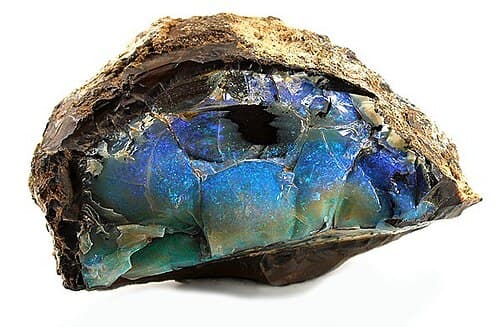
Australian Opal
Australia
The rainbow-fire gemstone of the Australian outback, worn as a charm for creativity, spontaneity, and the full spectrum of possibility.
4.9Learn more →

The rainbow-fire stone of magic and possibility, carried as a charm for amplifying imagination, embracing the full spectrum of emotion, and attracting the unexpected blessings of change.
Opal is an amorphous hydrated silica that displays play-of-colour — an iridescent rainbow shift across its surface caused by the diffraction of light through microscopic spheres of silica stacked in a regular three-dimensional grid. The size and arrangement of the spheres determines which colours flash: small spheres produce violet and blue; larger spheres produce red and orange. No two opals display the same pattern, making each stone uniquely individual — a natural mirror for the uniqueness of its holder.
Australia dominates global opal production, but Ethiopia produces brilliant crystal opals that have entered the market relatively recently, and Mexico's fire opals — transparent orange stones with vivid colour — are prized in their own right. Ancient Rome valued opal above almost every other stone; the senator Nonius famously chose exile over surrendering his opal to Mark Antony. Arabic tradition held that opals fell from heaven in lightning flashes, carrying the fire of the sky within them.
Opal's metaphysical tradition involves amplification — it intensifies emotions, creativity, and the sense of possibilities available. This makes it a powerful charm but also one that requires the holder to be in a positive, stable emotional place, as it amplifies whatever energy is present. At its best, opal opens the holder to the full magical spectrum of experience, refuses to pin down a single identity, and attracts the kind of unexpected, shimmering good fortune that comes when you are genuinely open to surprise.
Creative amplification, the full spectrum of experience, openness to unexpected blessings, emotional depth, and the magical iridescence of a consciousness fully alive to possibility.
Wear when in a positive, creative, or celebratory state to amplify those energies. Place in creative spaces to enhance imaginative output. Use in manifestation practice when your intentions span multiple possibilities rather than a single specific goal. Avoid wearing during periods of heavy emotional turbulence.
Ethiopian opals are unusual in being 'hydrophane' — they can absorb water, temporarily losing their colour play, then regain it completely as they dry. This living quality — responding visibly to moisture — reinforces opal's connection to the element of water and the dynamic, changing nature of emotional life.
This superstition was manufactured by the diamond trade in the Victorian era following a misreading of a Sir Walter Scott novel. In every pre-Victorian culture that valued opal, it was considered extraordinarily lucky. The 'only for October' superstition has no historical basis.
Opals contain water (3–21%) and can crack in extreme heat or dryness. Store in a slightly humid environment, away from heat. Avoid ultrasonic cleaners, strong chemicals, and prolonged direct sunlight. Clean with a soft damp cloth only.
Solid opals are entirely natural opal. Doublets are a thin slice of opal glued to a dark backing to enhance colour play. Triplets add a transparent quartz dome on top. Solids are most valuable; doublets and triplets are affordable alternatives but should not be submerged in water.
Australia
The rainbow-fire gemstone of the Australian outback, worn as a charm for creativity, spontaneity, and the full spectrum of possibility.

Sri Lanka
The ethereal stone of the feminine divine, worn as a charm of intuition, emotional balance, new beginnings, and the luminous mystery of lunar cycles.

Canada
The stone of magic and transformation, carried as a charm for psychic protection, the awakening of hidden gifts, and the luminous mystery of the Northern Lights made stone.

