

381
General
👞
Serbian Opanak Shoe
Serbia
The curled-toe traditional Serbian shoe — a symbol of cultural identity, grounded tradition, and the blessing of walking one's own path.
4.1Learn more →

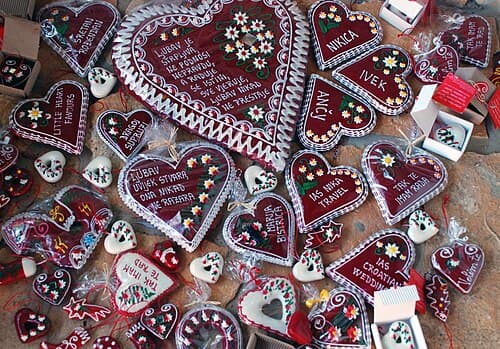
Croatia's iconic red gingerbread heart — a UNESCO-protected folk art object and the sweetest expression of Croatian love.
The Croatian licitar is a honey gingerbread cookie, glazed brilliant red and decorated with sugar icing, mirrors, and folk motifs. Heart-shaped licitars have been central to Croatian folk culture since the 17th century, given as love tokens at festivals, fairs, and pilgrimages. A young man who wanted to declare his feelings would give a girl a licitar heart; she would keep it displayed in her home as a token of his affection. The tradition continues at the Zagreb Christmas Market and folk festivals nationwide.
UNESCO inscribed the art of Croatian licitar-making on its Intangible Cultural Heritage list in 2010, recognizing the craft as an irreplaceable cultural expression. The Zagreb guild of licitar makers (licitari) has maintained continuous craft traditions since 1582 — one of Europe's oldest continuously operating craft guilds. Each licitar maker has their own family recipes and decorative vocabulary.
As a lucky charm, the licitar heart carries concentrated love energy in the most literal sense — it is made from sweetness (honey, spices) shaped into love (heart) and decorated with beauty (mirrors and flowers). The mirror at its center reflects the giver's face back to the recipient, creating a literal image of 'I see you.' Miniature ceramic or wooden licitar hearts serve as lasting talismans when the edible version isn't practical.
The Croatian Licitar Heart traces its origins to Croatia, where it has been revered for generations as a powerful symbol of romantic devotion and emotional connection. Historical records and oral traditions suggest that early versions of this charm appeared centuries ago, when communities in Croatia first began attributing supernatural qualities to objects drawn from their natural and spiritual environment.
Over time, the Croatian Licitar Heart evolved from a regional folk object into a widely recognized talisman. Traders, travelers, and migrants carried it across borders, introducing it to new cultures that often adopted and adapted it to fit their own belief systems. Today it is found in croatia and beyond, each culture adding its own layer of meaning and ritual to the charm's enduring legacy.
In its homeland of Croatia, the Croatian Licitar Heart occupies a revered place in both daily life and ceremonial practice. It is not merely decorative — it is woven into the fabric of cultural identity, appearing in celebrations, rites of passage, and household traditions that have been passed down through generations.
Beyond Croatia, the Croatian Licitar Heart has gained recognition in croatia and other regions, where it is valued for its symbolic connection to romantic fulfillment. Scholars of material culture and anthropologists note that charms like the Croatian Licitar Heart serve a dual psychological function: they provide a tangible focus for hope and intention, and they connect their owners to a living cultural tradition that transcends individual experience.
To get the most from your Croatian Licitar Heart, keep it in a place where you will see it daily — on a desk, nightstand, or near your front entrance. Physical proximity reinforces the intention behind the charm and serves as a regular reminder of your goals.
Traditional practice recommends handling the charm with clean hands and respectful intention. Many practitioners in Croatia advise setting a clear purpose when you first acquire the charm: hold it, state your wish or goal silently or aloud, and then place it in its chosen position. Periodically cleansing the charm — by passing it through incense smoke, placing it under moonlight, or simply wiping it with a clean cloth — is believed to refresh its energy.
If the charm is meant to be worn (as jewelry or a carried token), keep it close to your body throughout the day. If it is a household object, place it in the area of your home most associated with its purpose — for example, near a workspace for success charms, or by the bed for love and health charms.
Sweet love freely given, the recognition of being truly seen by another, folk art as love declaration, and the Croatian tradition of expressing feeling through beautiful craft.
Give a licitar heart charm to someone you love as a declaration of genuine feeling. Display one in the bedroom to sustain romantic energy. A licitar heart in the kitchen invites sweetness into all domestic life. When seeking love, keep a heart-shaped red object in your space as a love magnet.
The mirrored center of the Croatian licitar has a specific folk function: brides would hold a large licitar heart up so suitors could 'admire themselves' in the reflection. A suitor who could laugh at his reflection without vanity — appreciating the sweet absurdity — was considered marriage material.
Traditional licitars are edible but often preserved as keepsakes for years. The folk wisdom says: if someone gave it to you with love, keeping it preserves that love's energy. Eating it takes the love inside you literally.
A ceramic or wooden replica licitar maintains the cultural connection. A plain red heart works for the love energy generally. The licitar's specific power comes from its combination of sweetness (honey), folk art, and direct love declaration.
No — licitars are given between parents and children, between friends, and as general festival goodwill tokens. It is love in its broadest sense: the Croatian capacity for warm, generous human connection.
The Croatian Licitar Heart originates from Croatia, where it has been used as a love charm for centuries. Its influence has since spread to croatia and many other regions worldwide.
Give a licitar heart charm to someone you love as a declaration of genuine feeling. Display one in the bedroom to sustain romantic energy. A licitar heart in the kitchen invites sweetness into all domestic life. When seeking love, keep a heart-shaped red object in your space as a love magnet. For best results, set a clear intention when you first acquire the charm and keep it in a prominent, respectful location.
Yes, giving a Croatian Licitar Heart as a gift is considered a generous and meaningful gesture in most traditions. In Croatia, gifted charms are often believed to carry even stronger energy than those purchased for oneself, because they come with the goodwill and intention of the giver.
Many practitioners recommend periodically cleansing your Croatian Licitar Heart to refresh its energy. Common methods include passing it through incense smoke, placing it in moonlight overnight, rinsing it under clean water (if the material allows), or simply wiping it down with a clean cloth while setting a fresh intention.
While the Croatian Licitar Heart originated in the cultural traditions of Croatia, it is not exclusive to any single religion. It has been adopted and adapted by people of many faiths and backgrounds, each bringing their own interpretation to its symbolism and use.
Serbia
The curled-toe traditional Serbian shoe — a symbol of cultural identity, grounded tradition, and the blessing of walking one's own path.

Hungary
The beloved tulip of Hungarian folk art — a symbol of love, spring renewal, and the flowering of life's gifts.

Slovenia
The heart-shaped linden leaf of Slovenia — the sacred tree of the Slavic world symbolizing love, justice, and the village gathering place.

