
171
Protection
☸️
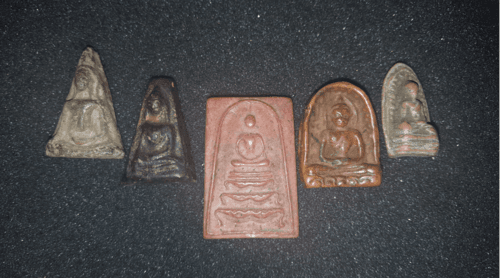
Thai Buddha Amulet
Thailand
Consecrated Buddha image amulets are Thailand's most serious sacred collectibles — worn for protection, luck, and spiritual merit.
4.8Learn more →

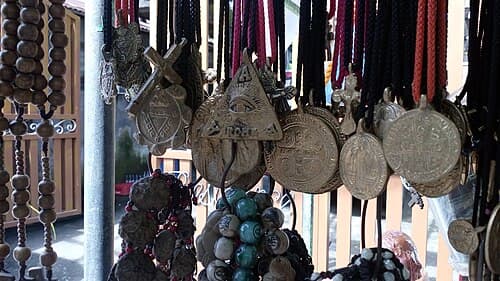
The mystical amulet of the Philippines provides supernatural protection and power, combining indigenous animism with Catholic imagery.
The anting-anting is the Filipino folk amulet, a tradition that represents one of the most distinctive syncretisms in world magical practice — combining pre-colonial Austronesian animism with Spanish Catholic imagery and Islam in the Muslim south to create a uniquely Filipino protective tradition. The word 'anting-anting' derives from the Tagalog word for 'ant' (repeated twice), suggesting something small but possessing extraordinary strength relative to its size. An anting-anting can be almost any object: a piece of wood with inscribed prayers, a fragment of cloth from a saint's garment, a small metal medallion depicting Catholic saints alongside indigenous symbols, or a naturally formed stone believed to have absorbed supernatural power.
The most powerful anting-anting in Philippine folk belief are believed to grant their bearers extraordinary powers: immunity from bullets and blades, superhuman strength, ability to become invisible, power to detect evil, and the capacity to charm others into helpfulness. The tradition has a rich history in Philippine resistance movements — many of the warriors who fought Spanish colonizers and later American forces were believed to carry powerful anting-anting that made them invulnerable. Historical accounts from Spanish and American military records describe enemies who seemed unconcerned with firearms and charged without apparent fear — behavior attributed to their faith in their anting-anting.
Obtaining an anting-anting requires more than purchasing it — the most powerful ones must be found in specific ways (during Holy Week, typically Good Friday, when the barriers between worlds are thinnest), inherited from a deceased practitioner, or gifted by supernatural beings. A found anting-anting carries more power than one deliberately acquired. The object must then be personally activated through a series of tests and rituals that confirm its authenticity and the wearer's qualification to benefit from it.
Supernatural protection from physical harm, accumulation of extraordinary personal power, and the concentrated spiritual heritage of both indigenous and adopted religious traditions.
Wear the anting-anting as a pendant or tucked inside clothing close to the skin. Traditional guidelines specify that the anting-anting must never be shown to others casually — its power is diminished by being treated as a curiosity. The object should be prayed over daily with the prayer specified when it was obtained. Activate during Holy Week.
During the Philippine-American War (1899-1902), American soldiers described Filipino fighters of the Pulahan sect charging machine gun positions with absolute calm, apparently unconcerned with bullets. The American military documented this phenomenon with puzzlement; the Filipino warriors attributed their invulnerability entirely to their anting-anting, which they believed made them bullet-proof.
Traditional tests include fire (a genuine anting-anting will not burn), water (it will float despite being heavier than water), and attempted blade damage (it will not be scratched). Most importantly, a genuine anting-anting allegedly makes itself known to its destined owner through unexplained events. Objects acquired through commercial channels are generally considered replicas rather than genuine anting-anting.
Very much so. The anting-anting tradition remains robust, particularly in rural areas and among certain communities. Albularyos (folk healers) continue to work with anting-anting, and specific regions — particularly Batangas and Cebu — maintain strong living traditions. Urban Filipinos often carry mass-produced saint medallions that function as everyday anting-anting equivalents.
Yes, though historically the most powerful invulnerability anting-anting were predominantly male objects due to their warrior context. Women's anting-anting traditionally focused on protection during childbirth, attraction of good partners, and healing power. Female practitioners (mananambals) have their own distinct anting-anting traditions that are considered equally powerful within their specific domains.
Thailand
Consecrated Buddha image amulets are Thailand's most serious sacred collectibles — worn for protection, luck, and spiritual merit.
Thailand
A rolled metal or bark scroll inscribed with sacred Pali or Khmer text, the Takrut is one of Southeast Asia's most potent protective talismans.
Thailand
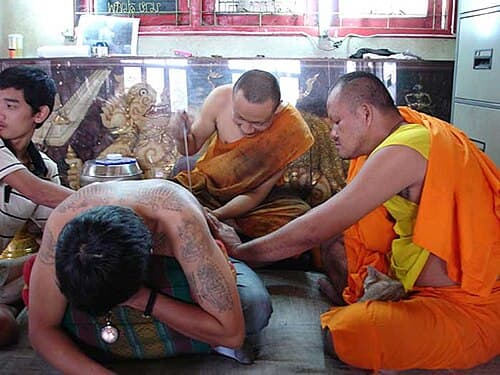
Sacred geometric tattoos blessed by monks carry the power of the inscribed formulas directly on the body as permanent living talismans.

Indonesia
The sacred wavy-bladed dagger of Java is both a masterwork of metallurgy and a living talisman possessing its own spirit and destiny.

