

176
Protection
🔱
Thai Palad Khik
Thailand
A sacred phallic amulet from Thailand believed to provide extraordinary luck, sexual power, and protection from harm.
4.3Learn more →

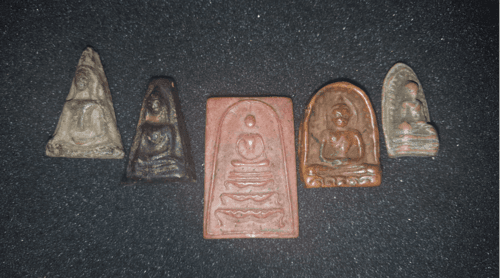
Consecrated Buddha image amulets are Thailand's most serious sacred collectibles — worn for protection, luck, and spiritual merit.
Thai Buddha amulets (Phra Khruang) represent one of the most sophisticated and highly developed amulet traditions in the world. These small Buddha-image pendants, typically made from a mixture of sacred materials including ashes of incense, old temples, and the remains of revered monks, pressed into a mold and fired, are then consecrated in elaborate rituals by senior monks. The amulet market in Thailand is enormous — amulets are traded, collected, and evaluated with the seriousness of fine art or investment-grade commodities, with particularly rare and potent pieces selling for hundreds of thousands of dollars.
The power (itthiret) of a Buddha amulet is believed to come from the sanctity of its makers, the quality of its sacred materials, and the precision of its consecration rituals. Wearing an amulet creates a continuous connection with the spiritual potency of the monk who blessed it, providing an ongoing field of protection around the wearer. Bulletproof vests, helmets, and military uniforms are all standard parts of Thai soldiers' equipment — but so is their collection of amulet necklaces, which are considered as practically important as physical armor.
Thai society has an elaborate taxonomy for evaluating amulets: the Somdej amulet (first created by Somdet Phra Phutthachan in the 19th century) is the most prestigious category; Phra Pidta (closed-eyes Buddha) amulets are worn for invulnerability and avoiding danger; Luang Phor Tuad amulets from Wat Chang Hai in southern Thailand are the most universally worn and are believed to specifically protect the wearer from drowning. Wearing multiple amulets is normal — many Thais wear five to fifteen amulets simultaneously, carefully selected for their complementary powers.
The Thai Buddha Amulet traces its origins to Thailand, where it has been revered for generations as a powerful symbol of safety and spiritual defense. Historical records and oral traditions suggest that early versions of this charm appeared centuries ago, when communities in Thailand first began attributing supernatural qualities to objects drawn from their natural and spiritual environment.
Over time, the Thai Buddha Amulet evolved from a regional folk object into a widely recognized talisman. Traders, travelers, and migrants carried it across borders, introducing it to new cultures that often adopted and adapted it to fit their own belief systems. Today it is found in thailand, cambodia, myanmar and beyond, each culture adding its own layer of meaning and ritual to the charm's enduring legacy.
In its homeland of Thailand, the Thai Buddha Amulet occupies a revered place in both daily life and ceremonial practice. It is not merely decorative — it is woven into the fabric of cultural identity, appearing in celebrations, rites of passage, and household traditions that have been passed down through generations.
Beyond Thailand, the Thai Buddha Amulet has gained recognition in thailand, cambodia, myanmar and other regions, where it is valued for its symbolic connection to spiritual guardianship. Scholars of material culture and anthropologists note that charms like the Thai Buddha Amulet serve a dual psychological function: they provide a tangible focus for hope and intention, and they connect their owners to a living cultural tradition that transcends individual experience.
To get the most from your Thai Buddha Amulet, keep it in a place where you will see it daily — on a desk, nightstand, or near your front entrance. Physical proximity reinforces the intention behind the charm and serves as a regular reminder of your goals.
Traditional practice recommends handling the charm with clean hands and respectful intention. Many practitioners in Thailand advise setting a clear purpose when you first acquire the charm: hold it, state your wish or goal silently or aloud, and then place it in its chosen position. Periodically cleansing the charm — by passing it through incense smoke, placing it under moonlight, or simply wiping it with a clean cloth — is believed to refresh its energy.
If the charm is meant to be worn (as jewelry or a carried token), keep it close to your body throughout the day. If it is a household object, place it in the area of your home most associated with its purpose — for example, near a workspace for success charms, or by the bed for love and health charms.
Protection from physical harm, spiritual merit from proximity to the Buddha's teachings, luck, and a continuous connection with the blessing power of revered monks.
Wear around the neck on a cord or chain, positioned at the heart or upper chest level, never below the waist. Keep amulets clean and treat them with respect. Avoid letting others touch your amulets without permission. Bring amulets to monks periodically for re-blessing. Never sell a genuinely sacred amulet — it should be passed on respectfully.
In 1988, a Thai soldier named Artit Sripat was reportedly shot at close range multiple times but survived without injury, attributing his survival entirely to his collection of Buddha amulets worn under his uniform. The Thai military subsequently conducted an unofficial investigation and credited the amulets in internal documentation — an extraordinary official acknowledgment of their protective power.
Genuine amulets show age-appropriate wear, the correct materials for their claimed provenance, and documentation of their origin temple and blessing ceremony. The Amulet Market at Tha Phra Chan in Bangkok employs expert evaluators. UV light examination, material testing, and provenance documentation are all used by serious collectors.
Many non-Buddhists wear Thai Buddha amulets with good results according to practitioners. The amulet's power is believed to activate for anyone who wears it with respectful intention, regardless of their own religious background. The key requirement is treating the amulet with proper respect, not following any specific Buddhist practices.
A damaged amulet should not be discarded in the trash. The correct action is to return it to a temple, where monks can properly retire it — usually by placing it in a specially designated repository for old sacred objects. Alternatively, it can be buried under a sacred tree or respectfully submerged in flowing water.
The Thai Buddha Amulet originates from Thailand, where it has been used as a protection charm for centuries. Its influence has since spread to thailand, cambodia, myanmar and many other regions worldwide.
Wear around the neck on a cord or chain, positioned at the heart or upper chest level, never below the waist. Keep amulets clean and treat them with respect. Avoid letting others touch your amulets without permission. Bring amulets to monks periodically for re-blessing. Never sell a genuinely sacred amulet — it should be passed on respectfully. For best results, set a clear intention when you first acquire the charm and keep it in a prominent, respectful location.
Yes, giving a Thai Buddha Amulet as a gift is considered a generous and meaningful gesture in most traditions. In Thailand, gifted charms are often believed to carry even stronger energy than those purchased for oneself, because they come with the goodwill and intention of the giver.
Many practitioners recommend periodically cleansing your Thai Buddha Amulet to refresh its energy. Common methods include passing it through incense smoke, placing it in moonlight overnight, rinsing it under clean water (if the material allows), or simply wiping it down with a clean cloth while setting a fresh intention.
While the Thai Buddha Amulet originated in the cultural traditions of Thailand, it is not exclusive to any single religion. It has been adopted and adapted by people of many faiths and backgrounds, each bringing their own interpretation to its symbolism and use.
Thailand
A sacred phallic amulet from Thailand believed to provide extraordinary luck, sexual power, and protection from harm.
Thailand
A rolled metal or bark scroll inscribed with sacred Pali or Khmer text, the Takrut is one of Southeast Asia's most potent protective talismans.
Thailand
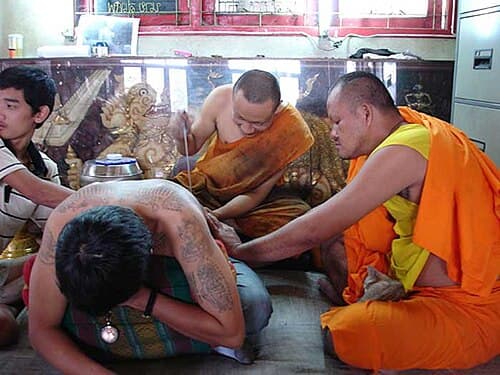
Sacred geometric tattoos blessed by monks carry the power of the inscribed formulas directly on the body as permanent living talismans.

Thailand
The four-faced Brahma deity is Thailand's most widely venerated Hindu god, granting wishes to all who pray with sincere hearts.

