
171
Protection
☸️
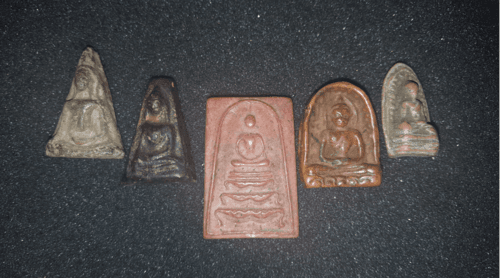
Thai Buddha Amulet
Thailand
Consecrated Buddha image amulets are Thailand's most serious sacred collectibles — worn for protection, luck, and spiritual merit.
4.8Learn more →


A sacred phallic amulet from Thailand believed to provide extraordinary luck, sexual power, and protection from harm.
The Palad Khik is one of the most distinctive and ancient amulets in Southeast Asian folk magic, a small phallic charm whose origins trace back to pre-Buddhist animist traditions of the region and to the Indian lingam cult that spread through the region during the first millennium CE. The name 'Palad Khik' roughly translates as 'surrogate penis' or 'honored surrogate', and its form is an explicit representation of male generative power — yet its use is entirely mainstream in Thai culture, worn by men, women, and children, tied to the waist belt or carried in the pocket as an all-purpose lucky charm.
The Palad Khik is typically made from sacred wood, bone, metal, or stone, carved with yantra (magical diagrams) and sacred script inscribed by monks or spirit priests. The act of consecration by a qualified practitioner is considered essential to activate the charm's power. Different materials and designs serve different purposes: Palad Khik made from the wood of trees struck by lightning are considered especially potent for protection; those made from holy wood from old temples provide general luck and prosperity; those inscribed with specific yantras for invulnerability are worn by soldiers and people in dangerous occupations.
Despite its explicitly sexual form, the Palad Khik is understood across all levels of Thai society primarily as a symbol of the generative life force — the same force that makes crops grow, businesses thrive, and human beings reproduce. Wearing it is no more erotic than wearing a cross is Christian worship; the symbol operates at the level of fundamental life energy. The charm's popularity has persisted through both Brahmanical and Theravada Buddhist periods in Thai history, surviving as a layer of animist folk practice underneath the official religion.
Life force, generative power, luck in gambling and commerce, protection from physical harm, and the vitality of the masculine principle applied to all endeavors.
Wear attached to a waist sash or belt cord, traditionally on the right side. Keep in the right trouser pocket for daily protection and luck. Monks are consulted for proper consecration. Traditional users avoid letting women step over the charm or handle it without care, though modern practitioners are less strict about this.
The Palad Khik is displayed openly in many Thai markets, sold alongside Buddha amulets and other sacred objects without any sense of contradiction. Large Palad Khik shrines exist throughout Thailand where people offer incense and flowers in return for winning lottery numbers — making the amulet simultaneously a fertility symbol and a gambling luck charm.
Yes. While it originates in pre-Buddhist animist practice, the Palad Khik has been fully integrated into Thai folk religion, which effortlessly combines Buddhism with older spirit beliefs. Monks bless Palad Khik routinely. The two traditions coexist without contradiction in the Thai religious worldview.
The inscriptions are typically passages from Pali Buddhist texts or Khmer magical scripts that provide specific protective powers: invulnerability from blades, attraction of luck, improvement of interpersonal relationships, and enhanced charisma. The specific text depends on the practitioner who consecrates the charm.
Yes. Women in Thailand carry Palad Khik for the same reasons as men — luck, protection, and business prosperity. The traditional cultural association of the charm with male virility has not prevented women from using it, as its practical luck-bringing function is understood to be gender-neutral.
Thailand
Consecrated Buddha image amulets are Thailand's most serious sacred collectibles — worn for protection, luck, and spiritual merit.
Thailand
A rolled metal or bark scroll inscribed with sacred Pali or Khmer text, the Takrut is one of Southeast Asia's most potent protective talismans.
Thailand
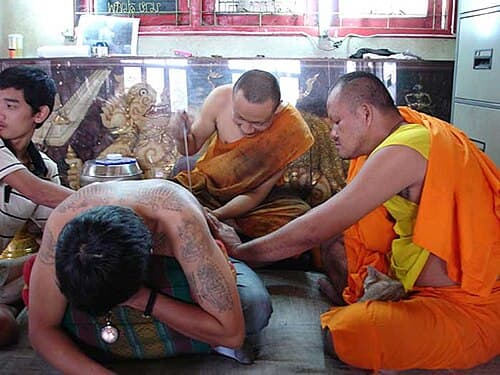
Sacred geometric tattoos blessed by monks carry the power of the inscribed formulas directly on the body as permanent living talismans.

Thailand
A miniature dwelling placed outside Thai homes and businesses to house the property's protective spirit and maintain good relations with the spirit world.

