

59
Protection
🔯
Bagua Mirror
China
The Bagua Mirror is feng shui's most powerful deflection tool — an octagonal mirror ringed with the eight trigrams of the I Ching, used exclusively for exterior protection.
4.4Learn more →


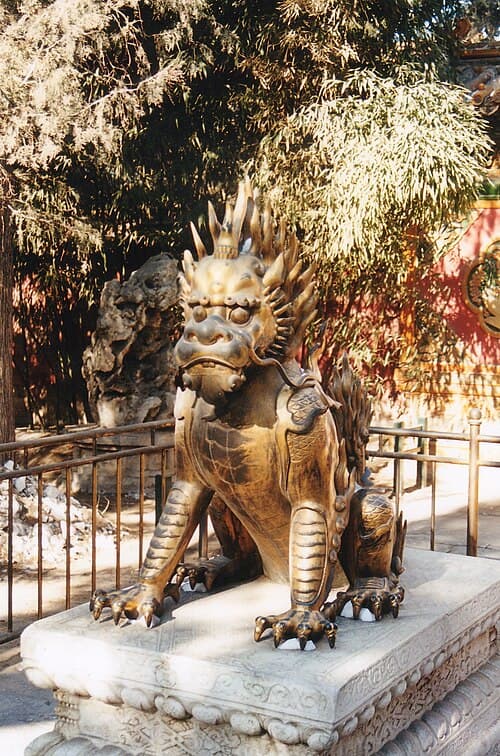
Fu Dogs — imperial stone lions that guard the gates of palaces, temples, and homes — are China's supreme protective talisman against evil, theft, and misfortune.
Fu Dogs — more accurately called Shi (stone lions) or Guardian Lions — are among the oldest and most architecturally significant protective charms in Chinese civilization. Their name 'Fu Dog' is a Western misnomer arising from confusion with the fo (Buddha) dogs kept in Buddhist temples, but the association stuck. Historically, these pairs of stone lions flanked the gates of Chinese imperial palaces, government buildings, aristocratic estates, and Buddhist temples for at least two thousand years. The earliest known examples date to the Han dynasty, and the tradition of using them as architectural guardians has never lapsed.
The lions are always deployed in pairs, with a male on the right side of the entrance (from inside looking out) holding or playing with a ball — representing the world, sovereignty, and the male principle — and a female on the left holding or playing with a cub — representing protection of offspring and the female principle. This gendered pairing is not merely decorative: it encodes an entire cosmological worldview in which proper cosmic order, with masculine and feminine principles in correct relationship, creates an impenetrable spiritual barrier against chaos and misfortune.
The Fu Dog's protective power operates on multiple levels simultaneously. Physically, their imposing size and fierce expressions served as deterrents to thieves and those who approached with ill intent. Spiritually, they are considered ferociously loyal guardians who serve the owner with absolute devotion, having no interest in the affairs of the world except as they affect the threshold they protect. Pairs of smaller Fu Dog figurines placed inside the home at the entrance replicate the power of the monumental outdoor versions in a domestic context.
Absolute protection of home and family, the repelling of evil intentions before they can cross the threshold, loyal guardianship, and the establishment of cosmic order within the protected space.
Place a pair of Fu Dogs at the main entrance of your home or business: male on the right (from inside looking out, the right of the door), female on the left. For indoor placement, position them flanking the interior side of the front door. Stone or ceramic versions are traditional; metal is also acceptable. Ensure they face outward toward the entrance. Clean and maintain them respectfully.
The largest pair of Fu Dogs in the world flank the entrance to the Forbidden City in Beijing. They were cast in bronze during the Ming dynasty and are estimated to weigh over two tons each, making them as much architectural statement as spiritual talisman.
Stone and ceramic are traditional and considered most energetically aligned with the earth element's protective quality. Metal (particularly bronze or brass) is also powerful. Avoid resin or plastic for outdoor placement as they degrade quickly; for indoor decorative use, the material is less critical than correct placement.
A single Fu Dog is considered incomplete and potentially unbalanced — like one half of a guard on duty. The paired nature of the charm is essential to its power. If space is extremely limited, a miniature pair is far preferable to a single large figurine.
They should always face outward, toward the street or the direction from which visitors (and potential threats) approach. Their job is to screen what enters, so they must face the approach direction. Facing them inward is considered to direct their protective energy against the household itself — which is counterproductive.
China
The Bagua Mirror is feng shui's most powerful deflection tool — an octagonal mirror ringed with the eight trigrams of the I Ching, used exclusively for exterior protection.

South Korea
Pujok are Korean shamanistic talismans made from yellow paper with red ink inscriptions, used for protection against evil spirits, illness, and misfortune in homes and on the body.
South Korea
The Haetae is Korea's mythological guardian lion that eats fire and prevents disaster, symbolizing justice, protection, and the fierce defense of those under its care.

Japan
Shisa are Okinawa's beloved lion-dog guardians, placed in pairs on rooftops and gates to ward off evil spirits and protect homes from disaster.

