

139
Protection
🦁
Fu Dogs (Guardian Lions)
China
Fu Dogs — imperial stone lions that guard the gates of palaces, temples, and homes — are China's supreme protective talisman against evil, theft, and misfortune.
4.6Learn more →


The Bagua Mirror is feng shui's most powerful deflection tool — an octagonal mirror ringed with the eight trigrams of the I Ching, used exclusively for exterior protection.
The Bagua (Pa Kua) Mirror is among the most powerful and also most strictly governed of all feng shui protective tools. An octagonal mirror with a small circular mirror at its center, surrounded by the eight trigrams of the I Ching and often a yin-yang symbol, the Bagua Mirror is not a general-purpose charm but a precision spiritual instrument designed to reflect and neutralize specifically threatening external energies called 'sha chi' (killing breath) or 'shar chi' (negative energy arrows).
The eight trigrams (ba gua) that ring the mirror are the fundamental building blocks of the I Ching, China's ancient divination text and cosmological encyclopedia. Each trigram consists of three lines, each either broken (yin) or unbroken (yang), creating eight possible combinations that correspond to the eight cardinal and inter-cardinal directions, eight family members, eight natural forces, and eight aspects of life. Arranging all eight trigrams around a mirror creates a complete map of the universe — a microcosm that, when properly oriented, can interact with and reorder the macrocosmic energies surrounding a building.
There are three types of Bagua Mirror, each with different power levels and appropriate uses. The flat mirror deflects moderate negative energy from directly opposite structures. The convex (outward-curved) mirror expands its view to address negative energy from multiple directions simultaneously and is considered more powerful. The concave (inward-curved) mirror absorbs and transforms negative energy and is considered so powerful that it should only be used by qualified feng shui masters — improper use is said to transform the cure into a weapon that sends the negative energy back to its source, potentially harming neighbors.
The Bagua Mirror traces its origins to China, where it has been revered for generations as a powerful symbol of safety and spiritual defense. Historical records and oral traditions suggest that early versions of this charm appeared centuries ago, when communities in China first began attributing supernatural qualities to objects drawn from their natural and spiritual environment.
Over time, the Bagua Mirror evolved from a regional folk object into a widely recognized talisman. Traders, travelers, and migrants carried it across borders, introducing it to new cultures that often adopted and adapted it to fit their own belief systems. Today it is found in china, taiwan, vietnam and beyond, each culture adding its own layer of meaning and ritual to the charm's enduring legacy.
In its homeland of China, the Bagua Mirror occupies a revered place in both daily life and ceremonial practice. It is not merely decorative — it is woven into the fabric of cultural identity, appearing in celebrations, rites of passage, and household traditions that have been passed down through generations.
Beyond China, the Bagua Mirror has gained recognition in china, taiwan, vietnam and other regions, where it is valued for its symbolic connection to spiritual guardianship. Scholars of material culture and anthropologists note that charms like the Bagua Mirror serve a dual psychological function: they provide a tangible focus for hope and intention, and they connect their owners to a living cultural tradition that transcends individual experience.
To get the most from your Bagua Mirror, keep it in a place where you will see it daily — on a desk, nightstand, or near your front entrance. Physical proximity reinforces the intention behind the charm and serves as a regular reminder of your goals.
Traditional practice recommends handling the charm with clean hands and respectful intention. Many practitioners in China advise setting a clear purpose when you first acquire the charm: hold it, state your wish or goal silently or aloud, and then place it in its chosen position. Periodically cleansing the charm — by passing it through incense smoke, placing it under moonlight, or simply wiping it with a clean cloth — is believed to refresh its energy.
If the charm is meant to be worn (as jewelry or a carried token), keep it close to your body throughout the day. If it is a household object, place it in the area of your home most associated with its purpose — for example, near a workspace for success charms, or by the bed for love and health charms.
The deflection of all external negative forces, the protection of the home's threshold from environmental harm, the ordering of cosmic energies through the I Ching's complete cosmological map.
Hang the Bagua Mirror outside above the main entrance, facing outward toward the source of sha chi (a T-junction road, a sharp roof corner pointing at your home, a tall building directly opposite). Never use indoors — the mirror's reflective power turned inward is considered harmful to the household. The flat mirror is appropriate for most situations; never use concave mirrors without professional guidance.
In Hong Kong's high-rise districts, the sight of Bagua Mirrors mounted on balconies facing specific buildings is common enough that real estate agents routinely factor 'Bagua mirror pressure' from neighboring buildings into property valuations — treating it as a genuine environmental consideration in negotiations.
No — this is the most important rule of Bagua Mirror use. The mirror is designed exclusively for outdoor use above the main entrance. Hanging it indoors is considered to direct its powerful deflecting energy against the household members themselves, which is both ineffective as protection and potentially harmful.
Sha chi (literally 'killing breath') refers to fast-moving negative energy generated by sharp angles, straight lines, dead ends, or imposing structures aimed directly at a building. A T-junction road pointed at your front door, a sharp corner of a neighboring building directed at your entrance, or a large tower casting a shadow directly across your home are all classic sha chi sources.
For protective outdoor use above a door, the later heaven (post-heaven) Bagua sequence is standard. Earlier heaven arrangement is used in more specialized circumstances, particularly for grave protection in Chinese geomancy (yin feng shui). For household protection, the later heaven arrangement on commercially available mirrors is correct.
The Bagua Mirror originates from China, where it has been used as a protection charm for centuries. Its influence has since spread to china, taiwan, vietnam and many other regions worldwide.
Hang the Bagua Mirror outside above the main entrance, facing outward toward the source of sha chi (a T-junction road, a sharp roof corner pointing at your home, a tall building directly opposite). Never use indoors — the mirror's reflective power turned inward is considered harmful to the household. The flat mirror is appropriate for most situations; never use concave mirrors without professional guidance. For best results, set a clear intention when you first acquire the charm and keep it in a prominent, respectful location.
Yes, giving a Bagua Mirror as a gift is considered a generous and meaningful gesture in most traditions. In China, gifted charms are often believed to carry even stronger energy than those purchased for oneself, because they come with the goodwill and intention of the giver.
Many practitioners recommend periodically cleansing your Bagua Mirror to refresh its energy. Common methods include passing it through incense smoke, placing it in moonlight overnight, rinsing it under clean water (if the material allows), or simply wiping it down with a clean cloth while setting a fresh intention.
While the Bagua Mirror originated in the cultural traditions of China, it is not exclusive to any single religion. It has been adopted and adapted by people of many faiths and backgrounds, each bringing their own interpretation to its symbolism and use.
China
Fu Dogs — imperial stone lions that guard the gates of palaces, temples, and homes — are China's supreme protective talisman against evil, theft, and misfortune.

China
Pixiu is a mythical Chinese creature with a dragon's head, horse's body, and lion's feet that eats gold but cannot excrete it — the ultimate symbol of wealth accumulation.

South Korea
Pujok are Korean shamanistic talismans made from yellow paper with red ink inscriptions, used for protection against evil spirits, illness, and misfortune in homes and on the body.
China
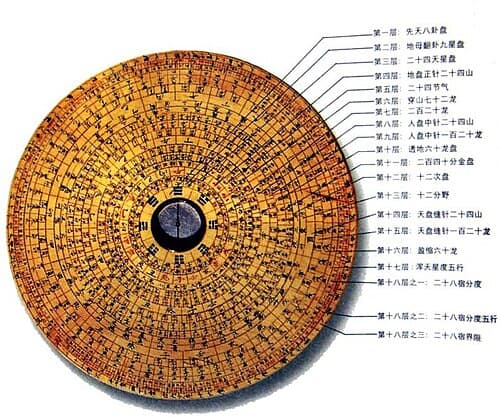
The Luopan feng shui compass is the master instrument of Chinese geomancy, used to align buildings, graves, and lives with the optimal energy flows of the cosmos.

