

59
Protection
🔯
Bagua Mirror
China
The Bagua Mirror is feng shui's most powerful deflection tool — an octagonal mirror ringed with the eight trigrams of the I Ching, used exclusively for exterior protection.
4.4Learn more →

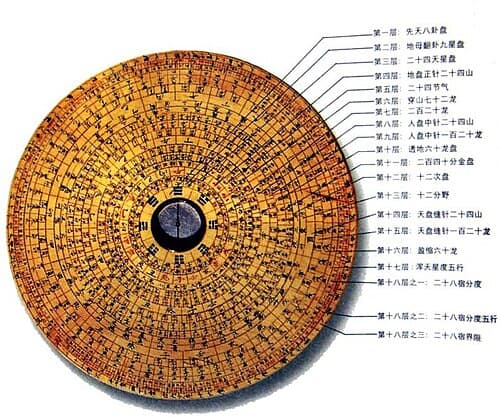
The Luopan feng shui compass is the master instrument of Chinese geomancy, used to align buildings, graves, and lives with the optimal energy flows of the cosmos.
The Luopan (Luo Pan, literally 'net plate' or 'encompassing plate') is the specialized compass used by feng shui masters to assess and harness the energies of any location. Unlike a navigational compass that merely indicates magnetic north, the Luopan is a complex instrument layered with concentric rings encoding the full cosmological knowledge of classical Chinese geomancy: the eight trigrams, the 64 hexagrams of the I Ching, the five elements, the 24 directions (each of 15 degrees), the 28 lunar mansions, the ten heavenly stems, and the twelve earthly branches among dozens of other layers in the most elaborate versions.
The magnetic compass was actually invented in China specifically for feng shui purposes before it was applied to navigation — the earliest recorded compass use in China (around 200 BCE to 200 CE) was for orienting buildings and tombs in alignment with favorable directions, not for seafaring. This fact positions the feng shui compass not as a derivative spiritual tool but as one of humanity's great original technological achievements, developed to answer the fundamental question of how to position oneself in alignment with the forces of heaven and earth.
As a decorative charm or gift, Luopan and compass-themed objects carry the energy of perfect orientation — the idea that the owner has found their correct alignment in life and is moving in the direction most harmoniously supported by cosmic forces. A feng shui compass given to someone beginning a new venture symbolizes the wish that they will be perfectly aligned with success, guided by wisdom rather than guesswork, and protected by their correct positioning within the forces of the universe.
The Feng Shui Compass traces its origins to China, where it has been revered for generations as a powerful symbol of achievement and ambition. Historical records and oral traditions suggest that early versions of this charm appeared centuries ago, when communities in China first began attributing supernatural qualities to objects drawn from their natural and spiritual environment.
Over time, the Feng Shui Compass evolved from a regional folk object into a widely recognized talisman. Traders, travelers, and migrants carried it across borders, introducing it to new cultures that often adopted and adapted it to fit their own belief systems. Today it is found in china, taiwan, vietnam and beyond, each culture adding its own layer of meaning and ritual to the charm's enduring legacy.
In its homeland of China, the Feng Shui Compass occupies a revered place in both daily life and ceremonial practice. It is not merely decorative — it is woven into the fabric of cultural identity, appearing in celebrations, rites of passage, and household traditions that have been passed down through generations.
Beyond China, the Feng Shui Compass has gained recognition in china, taiwan, vietnam and other regions, where it is valued for its symbolic connection to personal achievement. Scholars of material culture and anthropologists note that charms like the Feng Shui Compass serve a dual psychological function: they provide a tangible focus for hope and intention, and they connect their owners to a living cultural tradition that transcends individual experience.
To get the most from your Feng Shui Compass, keep it in a place where you will see it daily — on a desk, nightstand, or near your front entrance. Physical proximity reinforces the intention behind the charm and serves as a regular reminder of your goals.
Traditional practice recommends handling the charm with clean hands and respectful intention. Many practitioners in China advise setting a clear purpose when you first acquire the charm: hold it, state your wish or goal silently or aloud, and then place it in its chosen position. Periodically cleansing the charm — by passing it through incense smoke, placing it under moonlight, or simply wiping it with a clean cloth — is believed to refresh its energy.
If the charm is meant to be worn (as jewelry or a carried token), keep it close to your body throughout the day. If it is a household object, place it in the area of your home most associated with its purpose — for example, near a workspace for success charms, or by the bed for love and health charms.
Perfect alignment with cosmic forces, the wisdom to read one's environment before acting, the mastery of direction and timing that transforms effort into inevitable success.
For practical feng shui use, a Luopan is used with the guidance of a trained practitioner to assess the energy of a property. As a decorative charm, place a compass-themed object on a career desk or in the office as a symbol of purposeful direction. Gift a decorative Luopan to someone beginning a new career or business as a wish for perfect alignment. Avoid placing on the floor or in areas associated with waste.
The invention of the magnetic compass for feng shui purposes preceded its use in navigation by at least 400 years — China's imperial feng shui masters were the world's first people to systematically harness magnetic north, a discovery that eventually revolutionized global maritime exploration when the technology spread westward.
A regular compass can determine the eight basic directions (N, NE, E, SE, S, SW, W, NW), which is sufficient for basic feng shui bagua mapping of a home. A full Luopan's 24 directions and additional rings are necessary for professional and precision work. For personal home use, a regular compass is adequate.
Phone compass apps are generally accepted by modern feng shui practitioners for basic directional work. However, phones can be affected by metal furniture and electrical interference. For important decisions, use a physical compass away from metal objects, taking three readings to ensure consistency.
It depends on the aspect of life you are addressing. The south is associated with fame and recognition; the north with career; the east with health and family; the west with children and creativity; the southeast with wealth. However, the most important direction for any individual is their personal Kua number's most auspicious direction, calculated from their birth year.
The Feng Shui Compass originates from China, where it has been used as a success charm for centuries. Its influence has since spread to china, taiwan, vietnam and many other regions worldwide.
For practical feng shui use, a Luopan is used with the guidance of a trained practitioner to assess the energy of a property. As a decorative charm, place a compass-themed object on a career desk or in the office as a symbol of purposeful direction. Gift a decorative Luopan to someone beginning a new career or business as a wish for perfect alignment. Avoid placing on the floor or in areas associated with waste. For best results, set a clear intention when you first acquire the charm and keep it in a prominent, respectful location.
Yes, giving a Feng Shui Compass as a gift is considered a generous and meaningful gesture in most traditions. In China, gifted charms are often believed to carry even stronger energy than those purchased for oneself, because they come with the goodwill and intention of the giver.
Many practitioners recommend periodically cleansing your Feng Shui Compass to refresh its energy. Common methods include passing it through incense smoke, placing it in moonlight overnight, rinsing it under clean water (if the material allows), or simply wiping it down with a clean cloth while setting a fresh intention.
While the Feng Shui Compass originated in the cultural traditions of China, it is not exclusive to any single religion. It has been adopted and adapted by people of many faiths and backgrounds, each bringing their own interpretation to its symbolism and use.
China
The Bagua Mirror is feng shui's most powerful deflection tool — an octagonal mirror ringed with the eight trigrams of the I Ching, used exclusively for exterior protection.
China
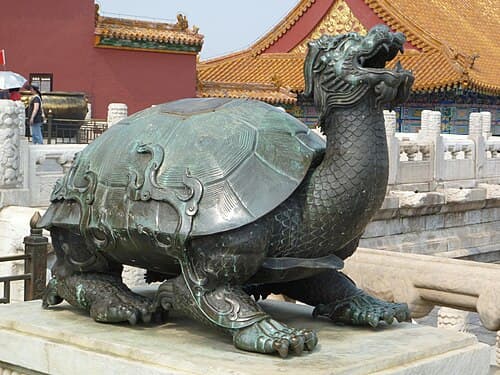
The Dragon Turtle combines the protective wisdom of the turtle with the powerful success energy of the dragon, creating one of feng shui's most potent talismans for career advancement.

China
The Ru Yi scepter — its name literally meaning 'as you wish' — is China's ultimate symbol of authority, fulfilled ambitions, and the power to make everything proceed according to one's will.

China
Pixiu is a mythical Chinese creature with a dragon's head, horse's body, and lion's feet that eats gold but cannot excrete it — the ultimate symbol of wealth accumulation.

