

22
Success
🐉
Dragon
China
The Chinese dragon is the supreme symbol of imperial power, auspicious fortune, and the dynamic yang energy that drives all achievement and transformation.
4.8Learn more →

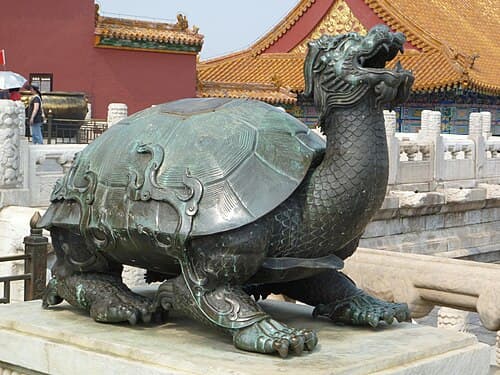
The Dragon Turtle combines the protective wisdom of the turtle with the powerful success energy of the dragon, creating one of feng shui's most potent talismans for career advancement.
The Dragon Turtle (Longui) is a composite mythological creature unique to Chinese cosmology: the body and shell of a turtle surmounted by the head of a dragon. This combination is not arbitrary — in Chinese tradition, the turtle (representing wisdom, longevity, and the steady accumulation of experience) and the dragon (representing power, authority, and the dynamic energy of achievement) are two of the four divine creatures, and their fusion creates a being of exceptional power that synthesizes their complementary qualities.
In classical Chinese cosmology, the Black Tortoise (Xuan Wu) is one of the four celestial guardians, ruling the north direction and associated with winter, water, and the deep wisdom of age. The dragon is associated with the east, spring, and ascending yang energy. By combining north and east in a single figure, the Dragon Turtle encompasses the full cycle from wisdom gained through experience to the energetic expression of that wisdom in achievement. It is particularly associated with career advancement that comes from genuine merit and accumulated expertise rather than luck alone.
The Dragon Turtle is typically depicted sitting on a bed of coins with a baby turtle on its back (representing the continuity of success through generations) and holding a coin in its mouth. In feng shui practice, it is placed facing the entrance of a room to receive incoming energy, or behind the desk of a professional or business owner, facing the person's back — the 'mountain support' position, where the Dragon Turtle's solid shell provides backing and protection against career setbacks.
The Dragon Turtle traces its origins to China, where it has been revered for generations as a powerful symbol of achievement and ambition. Historical records and oral traditions suggest that early versions of this charm appeared centuries ago, when communities in China first began attributing supernatural qualities to objects drawn from their natural and spiritual environment.
Over time, the Dragon Turtle evolved from a regional folk object into a widely recognized talisman. Traders, travelers, and migrants carried it across borders, introducing it to new cultures that often adopted and adapted it to fit their own belief systems. Today it is found in china, taiwan, vietnam and beyond, each culture adding its own layer of meaning and ritual to the charm's enduring legacy.
In its homeland of China, the Dragon Turtle occupies a revered place in both daily life and ceremonial practice. It is not merely decorative — it is woven into the fabric of cultural identity, appearing in celebrations, rites of passage, and household traditions that have been passed down through generations.
Beyond China, the Dragon Turtle has gained recognition in china, taiwan, vietnam and other regions, where it is valued for its symbolic connection to personal achievement. Scholars of material culture and anthropologists note that charms like the Dragon Turtle serve a dual psychological function: they provide a tangible focus for hope and intention, and they connect their owners to a living cultural tradition that transcends individual experience.
To get the most from your Dragon Turtle, keep it in a place where you will see it daily — on a desk, nightstand, or near your front entrance. Physical proximity reinforces the intention behind the charm and serves as a regular reminder of your goals.
Traditional practice recommends handling the charm with clean hands and respectful intention. Many practitioners in China advise setting a clear purpose when you first acquire the charm: hold it, state your wish or goal silently or aloud, and then place it in its chosen position. Periodically cleansing the charm — by passing it through incense smoke, placing it under moonlight, or simply wiping it with a clean cloth — is believed to refresh its energy.
If the charm is meant to be worn (as jewelry or a carried token), keep it close to your body throughout the day. If it is a household object, place it in the area of your home most associated with its purpose — for example, near a workspace for success charms, or by the bed for love and health charms.
Career advancement earned through wisdom and sustained effort, the solid support of ancient power behind one's ambitions, protection from backstabbing and workplace hostility, and the multi-generational continuity of family success.
Place the Dragon Turtle on your office desk behind you (between you and the wall, facing your direction) to provide career support. Alternatively, position it facing the entrance of your office. A Dragon Turtle with a small coin in its mouth should have the coin facing inward. Touch and stroke the shell regularly to activate the protective energy. Do not place in the bathroom or bedroom.
The Chinese myth of the Dragon Turtle includes one of the most architecturally significant legends in world history: the mythical ruler Yu the Great is said to have received a Dragon Turtle from the Yellow River whose shell was inscribed with the magic square — a 3x3 grid of numbers summing to 15 in every direction — which became the basis of the Luoshu, a foundational text of Chinese numerology, feng shui, and the I Ching.
Behind the desk in the north sector (career area) is the classic placement. The figurine should face toward you as you sit at your desk, providing the 'mountain support' energy — the feeling of having powerful backing. Alternatively, place it on your desk facing the entrance door to absorb and process incoming energies before they reach you.
The baby turtle represents the continuation of success through generations — the idea that the career and wealth built by the current generation will be inherited and extended by children and descendants. It specifically appeals to those who want to build lasting family enterprises rather than individual personal success.
Feng shui authorities differ on this. The 'mountain support' tradition places it facing you from behind your seat. Another school places it facing the door to screen incoming energy. Both are considered valid. The placement facing the person is more focused on personal career protection; the door-facing placement is more about controlling the energy entering the workspace.
The Dragon Turtle originates from China, where it has been used as a success charm for centuries. Its influence has since spread to china, taiwan, vietnam and many other regions worldwide.
Place the Dragon Turtle on your office desk behind you (between you and the wall, facing your direction) to provide career support. Alternatively, position it facing the entrance of your office. A Dragon Turtle with a small coin in its mouth should have the coin facing inward. Touch and stroke the shell regularly to activate the protective energy. Do not place in the bathroom or bedroom. For best results, set a clear intention when you first acquire the charm and keep it in a prominent, respectful location.
Yes, giving a Dragon Turtle as a gift is considered a generous and meaningful gesture in most traditions. In China, gifted charms are often believed to carry even stronger energy than those purchased for oneself, because they come with the goodwill and intention of the giver.
Many practitioners recommend periodically cleansing your Dragon Turtle to refresh its energy. Common methods include passing it through incense smoke, placing it in moonlight overnight, rinsing it under clean water (if the material allows), or simply wiping it down with a clean cloth while setting a fresh intention.
While the Dragon Turtle originated in the cultural traditions of China, it is not exclusive to any single religion. It has been adopted and adapted by people of many faiths and backgrounds, each bringing their own interpretation to its symbolism and use.
China
The Chinese dragon is the supreme symbol of imperial power, auspicious fortune, and the dynamic yang energy that drives all achievement and transformation.

China
Pixiu is a mythical Chinese creature with a dragon's head, horse's body, and lion's feet that eats gold but cannot excrete it — the ultimate symbol of wealth accumulation.

China
Fu Dogs — imperial stone lions that guard the gates of palaces, temples, and homes — are China's supreme protective talisman against evil, theft, and misfortune.

China
The Ru Yi scepter — its name literally meaning 'as you wish' — is China's ultimate symbol of authority, fulfilled ambitions, and the power to make everything proceed according to one's will.

