

268
Protection
🛡️
Swazi Shield
Eswatini
The cowhide warrior shield of Eswatini's umchwasho regiment — worn at the Incwala and Umhlanga ceremonies.
4.5Learn more →

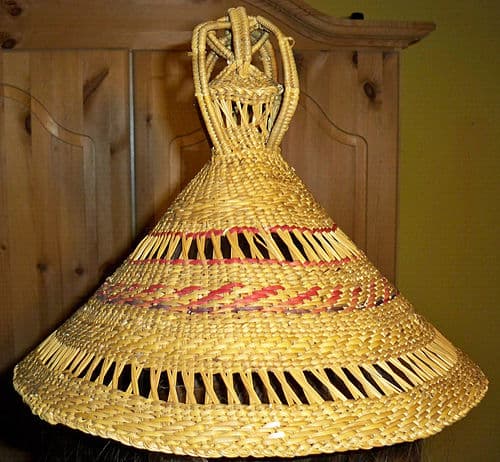
The iconic conical woven hat of Lesotho — national symbol of the mountain kingdom and its people.
The mokorotlo is the national symbol of Lesotho — a woven conical hat with a distinctive topknot, immediately recognizable as the centerpiece of the Lesotho national flag. Made from the local qiloane grass or from imported materials, the mokorotlo was traditionally associated with Basotho herdsmen who watched cattle and sheep on Lesotho's dramatic highland terrain. The hat provided practical protection from both sun and rain in a climate of extremes, while its distinctive conical form — inspired according to tradition by the shape of the qiloane (a flat-topped mountain peak characteristic of Lesotho's landscape) — became a powerful symbol of Basotho identity and connection to their mountain homeland.
The mokorotlo's presence on Lesotho's flag — one of very few national flags to feature a traditional African craft object as its primary symbol — reflects the depth of its connection to Basotho identity. When Lesotho revised its flag design in 2006 (replacing an earlier mokorotlo design with a more contemporary rendering), national debate about the change was intense, demonstrating how personally the Basotho people identify with this simple woven object. The hat is worn at national celebrations, royal ceremonies, and is given as a gift representing Lesotho identity to visitors and dignitaries.
As a lucky charm, the mokorotlo represents the wisdom of finding beauty and identity in the land itself — the hat's form echoes the mountain peaks of Lesotho, making it a portable embodiment of home, belonging, and the grounding power of one's place of origin. It is also associated with the hardy, practical resilience of the Basotho herders who first wore it in the demanding highland environment.
National and cultural identity, connection to one's homeland and its landscape, practical wisdom and resilience in challenging environments, and the pride of a small nation maintaining its distinct character.
Keep a miniature mokorotlo as a travel charm or home decoration to maintain connection to place of origin or cultural heritage. Gift one to someone traveling far from home as a symbol of rootedness and return. Use it as a meditation object when seeking groundedness and clarity about your own identity and values.
Lesotho is one of only three countries in the world (along with Vatican City and San Marino) that is entirely surrounded by another country — in this case, South Africa. This landlocked position within its powerful neighbor has made cultural distinctiveness a matter of political survival for Lesotho, which explains the exceptional symbolic importance of the mokorotlo as a marker of sovereign Basotho identity.
Traditional mokorotlo are woven from qiloane grass (Merxmuellera drakensbergensis) found in Lesotho's highlands. Modern versions may use imported reed, raffia, or synthetic materials. The traditional grass variety is preferred for ceremonial purposes, while commercial versions for the tourist market use whatever materials are available and affordable.
The topknot (the small protrusion at the apex of the cone) is said to represent the summit of the qiloane mountain peaks that inspired the hat's form. It also serves a practical function — providing a grip point for taking the hat off. In ceremonial contexts, the topknot may be decorated with specific colors or materials indicating the wearer's status.
The mokorotlo is worn by Basotho people wherever they live — within Lesotho and in the significant Basotho diaspora communities in South Africa (particularly in the Free State and on the Reef). It is worn specifically as a cultural identity marker outside Lesotho, where it immediately identifies the wearer as Basotho.
Eswatini
The cowhide warrior shield of Eswatini's umchwasho regiment — worn at the Incwala and Umhlanga ceremonies.

South Africa
The cowhide shield of Zulu warriors — a regimental identity marker and protective spiritual object.

South Africa
National flower of South Africa and symbol of resilience, diversity, and the beauty that grows from harsh conditions.

