

22
Success
🐉
Dragon
China
The Chinese dragon is the supreme symbol of imperial power, auspicious fortune, and the dynamic yang energy that drives all achievement and transformation.
4.8Learn more →


The three-legged crow of the sun is an ancient East Asian solar symbol representing the divine energy of achievement, the connection between heaven and earth, and the unstoppable power of solar vitality.
The Samjogo (삼족오, Three-Legged Crow) is one of the most ancient and powerful symbols in East Asian cosmology — a mythological crow said to inhabit the sun, its three legs representing the three times of day (dawn, noon, and dusk) over which the solar disc travels. Appearing in Chinese texts as the Sanzuwu, in Japanese tradition as the Yatagarasu (八咫烏), and in Korean Goguryeo kingdom art as the Samjogo, this three-legged solar bird is one of the rare symbols shared across multiple East Asian civilizations with essentially identical significance: the divine messenger who bridges heaven and earth, carrying the sun's power and the gods' direct communication to humanity.
In Korean Goguryeo culture (37 BCE–668 CE), the Samjogo appears in tomb murals as a large, powerful bird depicted within the sun's disc, surrounded by solar rays. The Goguryeo kingdom used this bird as one of their primary emblems, associating it with imperial power, the mandate of heaven, and the invincibility of solar energy. The three legs, in Korean numerological tradition, represent completeness and the three realms — heaven, earth, and the underworld — united in the single ascending motion of the bird's flight toward the sun.
As a success charm, the Samjogo invokes the sun's most essential quality: its inexorable daily rising, its refusal to be prevented from reaching its zenith, and its complete indifference to obstacles. Whatever clouds or mountains intervene, the sun rises to its full height regardless. This quality of solar inevitability — success not as a possibility but as a cosmological certainty for those aligned with solar energy — makes the Samjogo one of East Asia's most powerful success talismans.
The inevitable rise of success aligned with solar power, the divine message that heaven backs righteous ambition, complete mastery of all three realms united in a single upward trajectory, and the unstoppable energy of the sun applied to human endeavor.
Place Samjogo imagery on the south wall of your office or home (the southern sector is associated with fame, recognition, and the fire element in feng shui). Use as a keychain or pendant when beginning a major project to invoke solar inevitability. Meditate on the image of the three-legged crow at sunrise as a practice for aligning personal ambition with cosmic support.
The Japan Football Association (JFA) chose the Yatagarasu (Japanese three-legged crow) as its official symbol in 1931, and it has remained on the national soccer team's crest ever since — making the three-legged solar crow the emblem of one of the most recognizable sports programs in Asia.
The three-legged solar crow appears independently in Chinese, Japanese, and Korean traditions with slightly different names and some variations in detail. Korea's specific Samjogo tradition is most associated with the Goguryeo kingdom and is considered a distinctly Korean cultural heritage item, though its Chinese and Japanese counterparts are related branches of the same ancient solar mythology.
In ancient East Asian astronomy, observers noted dark spots on the sun (solar spots) and interpreted them as the silhouette of a large bird inside the solar disc. The crow was chosen because of its association with transformation and its black color, which appeared in the spots. Over time this astronomical observation became an elaborate mythology about a divine crow carrying messages between heaven and earth.
Yes — the Samjogo is one of the most popular traditional Korean motifs in tattoo art, particularly among those who want to express Korean cultural identity or invoke success energy through body art. The solar circle with three-legged crow is a striking and complete visual composition well-suited to tattoo work.
China
The Chinese dragon is the supreme symbol of imperial power, auspicious fortune, and the dynamic yang energy that drives all achievement and transformation.

South Korea
The Korean Dokkaebi is a mischievous but fundamentally good-natured goblin who rewards honesty and punishes greed, serving as both a protective house spirit and a moral guardian.
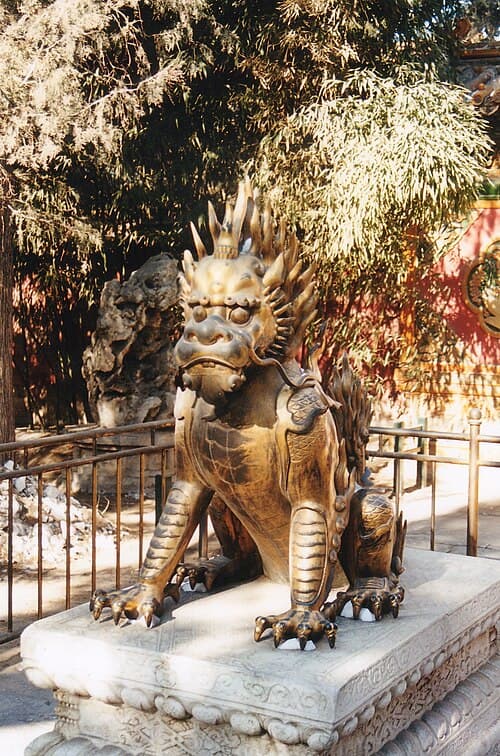
South Korea
The Haetae is Korea's mythological guardian lion that eats fire and prevents disaster, symbolizing justice, protection, and the fierce defense of those under its care.

Japan
Koinobori — carp-shaped wind streamers — are flown on Children's Day in Japan as a wish for children's strength, perseverance, and the courage to leap over life's obstacles.

