

143
Protection
📜
Pujok (Korean Talisman)
South Korea
Pujok are Korean shamanistic talismans made from yellow paper with red ink inscriptions, used for protection against evil spirits, illness, and misfortune in homes and on the body.
4.4Learn more →


The Korean Dokkaebi is a mischievous but fundamentally good-natured goblin who rewards honesty and punishes greed, serving as both a protective house spirit and a moral guardian.
The Dokkaebi (도깨비) is one of Korean folklore's most beloved supernatural beings — a creature utterly unlike the Western goblin tradition it superficially resembles. Korean Dokkaebi are not malevolent demons but morally complex spirits who emerged from inanimate objects infused with human blood or energy: an old broom, a discarded club, a forgotten farming tool. This origin makes Dokkaebi fundamentally domestic creatures, born from human household life and maintaining a deep connection to the rhythms and ethics of the families they haunt.
The Dokkaebi's moral orientation is precise and consistent across the folk tradition: they reward honesty, generosity, and genuine effort, and they punish dishonesty, laziness, and greed. A merchant who gives correct measures will be blessed by the Dokkaebi who watches his shop; one who short-changes customers will find his goods mysteriously destroyed or his profits vanishing overnight. This makes the Dokkaebi one of the few supernatural beings who functions explicitly as an ethical auditor — a divine quality-control inspector for human virtue.
Visually, the Dokkaebi is typically depicted as a large, club-wielding figure with wild hair, a fierce expression, and a spotted or striped body — but with a roguish smile that undercuts any genuine menace. The club (dokkaebi bangmangi) has its own legendary power: everything it strikes is transformed, doubled, or made to dance. Popular Dokkaebi imagery appears on Korean building tiles from the Goryeo period onward as roof-end protectors (maroo jangshik), performing a function similar to Japanese onigawara demon-face tiles.
The rewards of honest living and genuine effort, the punishment of greed and deception, the protection of a household by its resident ethical guardian spirit, and the good-natured power of the ordinary made magical.
Keep a Dokkaebi figure or image near the entrance of a home or business as a guardian who screens visitors for honest intentions. A Dokkaebi figurine in the kitchen or work area is traditionally associated with rewarding hard work. Treat the Dokkaebi as a household member — speak kindly of honest dealings and admit mistakes openly, as the Dokkaebi notices both.
The Korean Netflix drama 'Goblin' (Dokkaebi, 2016) featuring a 939-year-old goblin was watched by over 15 million viewers in South Korea and became one of the highest-rated Korean dramas ever, sparking a major revival of interest in Dokkaebi folklore and a sharp increase in Dokkaebi-themed charms and merchandise.
No — Dokkaebi are fundamentally morally positive beings who use rough methods to enforce good outcomes. They are mischievous and sometimes frightening but not malevolent. Their purpose is to maintain ethical order in the household and community. The key difference from Western demons: Dokkaebi can be reasoned with and respond to honesty.
While they are often compared as both club-wielding supernatural beings, the Dokkaebi and Oni are distinct. The Japanese Oni is fundamentally a demon requiring subduing or propitiation. The Korean Dokkaebi is a morally complex being born from human-touched objects who acts as an ethical guardian. The Dokkaebi is more neighbor than monster.
Yes — in Korean folk tradition, Dokkaebi are considered safe and even beneficial presences for children, as they actively protect and reward honest, hardworking young people. Children's books and toys featuring Dokkaebi are extremely common in Korea. The Dokkaebi's playful side makes them particularly appealing to children.
South Korea
Pujok are Korean shamanistic talismans made from yellow paper with red ink inscriptions, used for protection against evil spirits, illness, and misfortune in homes and on the body.
South Korea
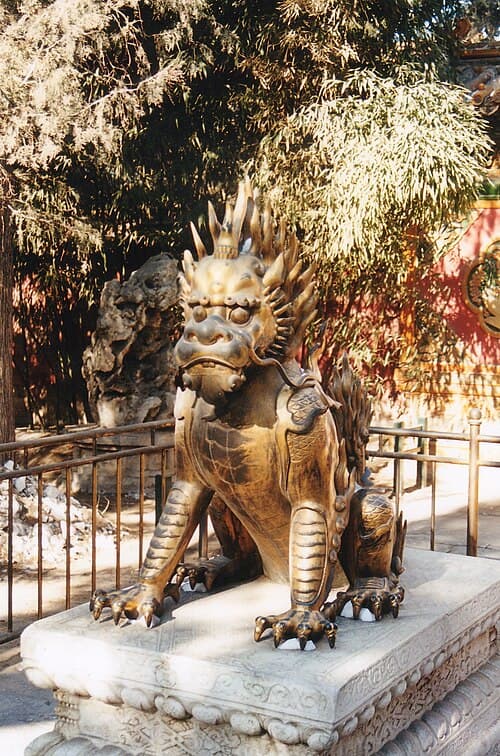
The Haetae is Korea's mythological guardian lion that eats fire and prevents disaster, symbolizing justice, protection, and the fierce defense of those under its care.

South Korea
The three-legged crow of the sun is an ancient East Asian solar symbol representing the divine energy of achievement, the connection between heaven and earth, and the unstoppable power of solar vitality.

South Korea
The Rose of Sharon, Korea's national flower, symbolizes the Korean people's resilience, eternal renewal, and the indomitable spirit that blooms continuously despite adversity.

