

142
General
👹
Korean Dokkaebi
South Korea
The Korean Dokkaebi is a mischievous but fundamentally good-natured goblin who rewards honesty and punishes greed, serving as both a protective house spirit and a moral guardian.
4.3Learn more →


The Rose of Sharon, Korea's national flower, symbolizes the Korean people's resilience, eternal renewal, and the indomitable spirit that blooms continuously despite adversity.
The Mugunghwa (무궁화, Hibiscus syriacus), the Rose of Sharon, is South Korea's national flower — chosen as the national symbol not for rare beauty but for the specific quality most admired in Korean cultural tradition: indomitable perseverance. The name itself means 'eternal bloom that does not wither' (mu = nothing, gung = exhaustion, hwa = flower) — a flower that cannot be worn down. During the summer months, the Mugunghwa produces successive generations of flowers, replacing each fallen blossom with a new one immediately, so that the plant appears to bloom continuously and inexhaustibly from June through October.
This quality of continuous regeneration through loss made the Mugunghwa the perfect emblem for the Korean people during the Japanese colonial period (1910–1945), when the flower served as a covert symbol of national identity when direct expressions of Korean culture were suppressed. The flower's defiant continuous blooming was read as a statement about Korean civilizational persistence: no matter how many individual expressions of Korean identity were suppressed, the culture itself would immediately regenerate and bloom again. The national anthem (Aegukga) includes the line 'until the Mugunghwa and three thousand li of rivers and mountains are covered in glory' — using the flower as a direct metaphor for the nation itself.
As a luck charm, the Mugunghwa represents the specific blessings of resilience, the refusal to accept permanent defeat, and the abundance that comes from continuous renewal. It is particularly appropriate for those recovering from setbacks, beginning again after loss, or facing extended periods of difficulty — its symbolism promises not a sudden reversal of fortune but the steady, continuous regeneration that outlasts any adversity.
Indomitable resilience, the endless renewal of effort and hope, the specific Korean spirit of perseverance through the longest adversity, and the beauty of a life that blooms continuously rather than brilliantly once.
Keep pressed or dried Mugunghwa blossoms in a personal journal, wallet, or prayer space as a reminder of resilience. Plant Mugunghwa in a garden as a living luck charm that renews itself each summer. Give Mugunghwa-themed gifts (handkerchiefs, porcelain, art) to Koreans as expressions of respect for their cultural heritage. The color — typically lavender-pink with a deep red center — is itself considered uplifting.
South Korea plants Mugunghwa trees along the entire perimeter of the Presidential Blue House (Cheong Wa Dae) grounds — approximately 1,500 trees creating a living national emblem that must be precisely maintained by a dedicated horticulture team as part of official presidential estate management.
They are parallel traditions — both nations chose flowers as national emblems representing cultural values. But the values are opposite: the cherry blossom (sakura) celebrates brief, perfect beauty and the noble acceptance of impermanence. The Mugunghwa celebrates persistent, imperfect blooming and the refusal to be permanently defeated. The contrast reflects a meaningful difference in each culture's self-understanding.
Yes. Hibiscus syriacus is widely cultivated as an ornamental shrub throughout temperate climates worldwide. It is sold in garden centers globally under the common name Rose of Sharon. Korean diaspora communities often plant it in home gardens as a connection to cultural heritage. It grows well in USDA zones 5–9.
Yes. The flowers, bark, and roots of Hibiscus syriacus are used in Korean traditional medicine (hanyak) for treating skin conditions, digestive issues, and inflammation. The flowers can be used fresh in salads or dried for tea. This practical utility reinforced the plant's status as broadly beneficial and worthy of national reverence.
South Korea
The Korean Dokkaebi is a mischievous but fundamentally good-natured goblin who rewards honesty and punishes greed, serving as both a protective house spirit and a moral guardian.

South Korea
Pujok are Korean shamanistic talismans made from yellow paper with red ink inscriptions, used for protection against evil spirits, illness, and misfortune in homes and on the body.
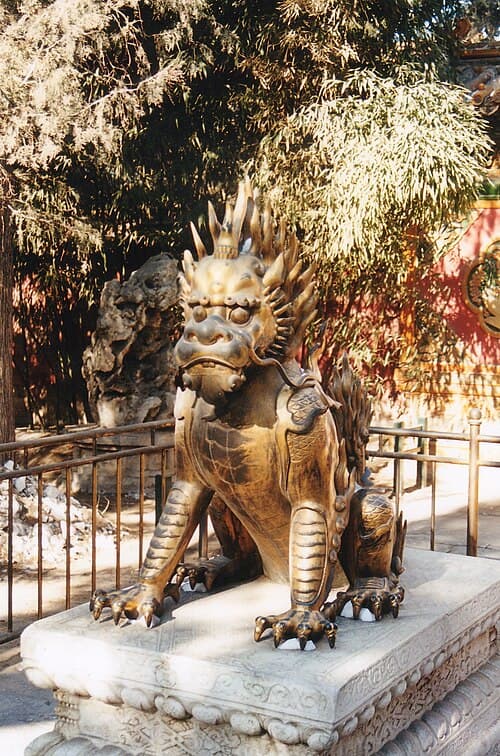
South Korea
The Haetae is Korea's mythological guardian lion that eats fire and prevents disaster, symbolizing justice, protection, and the fierce defense of those under its care.

South Korea
The three-legged crow of the sun is an ancient East Asian solar symbol representing the divine energy of achievement, the connection between heaven and earth, and the unstoppable power of solar vitality.

