
24
Wealth
🐸
Money Frog (Jin Chan)
China
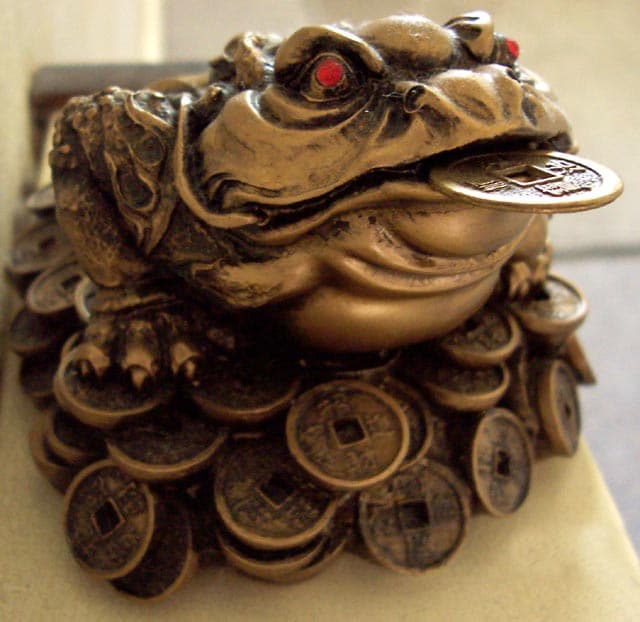
The three-legged toad sitting on coins with a coin in its mouth is one of feng shui's most potent wealth activators, said to attract money and prevent it from leaving.
4.6Learn more →

An ancient Chinese mythological creature, the three-legged toad of the moon is a powerful feng shui wealth symbol believed to attract money and protect against financial loss.
The Three-Legged Toad (Chan Chu) is one of China's oldest mythological creatures, rooted in ancient astronomy and the symbolism of the moon. In ancient Chinese cosmology, the moon was home to a three-legged toad — a notion that arose from interpreting the shadows visible on the moon's surface as the silhouette of a toad. This lunar association connected the creature to cycles of abundance and renewal, since the moon governs tides, farming seasons, and the rhythmic flow of time and fortune.
The feng shui wealth toad is closely related to but distinct from the Money Frog (Jin Chan) discussed elsewhere, though the terms are often used interchangeably in popular culture. In classical texts, Chan Chu is specifically the lunar toad who occasionally descends to earth to bring exceptional fortune to those worthy of receiving it. The figurine version, typically depicted with a coin in its mouth sitting on a bed of coins, captures this moment of earthly visitation — the celestial toad pausing in your home to dispense its lunar blessings before returning to the sky.
The three legs rather than four represent the odd numbers associated with heaven (yin numbers being even, yang numbers being odd in Chinese numerology). Three is also the number of completeness in many Chinese philosophical systems: heaven, earth, and humanity; past, present, and future. A toad standing on three legs is therefore a creature that bridges all realms simultaneously, drawing fortune from multiple dimensions. The red gems that serve as eyes in most modern figurines represent the fire element that activates the charm's wealth-generating power.
The Three-Legged Toad traces its origins to China, where it has been revered for generations as a powerful symbol of prosperity and abundance. Historical records and oral traditions suggest that early versions of this charm appeared centuries ago, when communities in China first began attributing supernatural qualities to objects drawn from their natural and spiritual environment.
Over time, the Three-Legged Toad evolved from a regional folk object into a widely recognized talisman. Traders, travelers, and migrants carried it across borders, introducing it to new cultures that often adopted and adapted it to fit their own belief systems. Today it is found in china, taiwan, vietnam and beyond, each culture adding its own layer of meaning and ritual to the charm's enduring legacy.
In its homeland of China, the Three-Legged Toad occupies a revered place in both daily life and ceremonial practice. It is not merely decorative — it is woven into the fabric of cultural identity, appearing in celebrations, rites of passage, and household traditions that have been passed down through generations.
Beyond China, the Three-Legged Toad has gained recognition in china, taiwan, vietnam and other regions, where it is valued for its symbolic connection to financial prosperity. Scholars of material culture and anthropologists note that charms like the Three-Legged Toad serve a dual psychological function: they provide a tangible focus for hope and intention, and they connect their owners to a living cultural tradition that transcends individual experience.
To get the most from your Three-Legged Toad, keep it in a place where you will see it daily — on a desk, nightstand, or near your front entrance. Physical proximity reinforces the intention behind the charm and serves as a regular reminder of your goals.
Traditional practice recommends handling the charm with clean hands and respectful intention. Many practitioners in China advise setting a clear purpose when you first acquire the charm: hold it, state your wish or goal silently or aloud, and then place it in its chosen position. Periodically cleansing the charm — by passing it through incense smoke, placing it under moonlight, or simply wiping it with a clean cloth — is believed to refresh its energy.
If the charm is meant to be worn (as jewelry or a carried token), keep it close to your body throughout the day. If it is a household object, place it in the area of your home most associated with its purpose — for example, near a workspace for success charms, or by the bed for love and health charms.
Lunar wealth cycles, the drawing down of celestial fortune into earthly life, the completeness of heaven-earth-human alignment, and protection of accumulated financial gains.
Place the Three-Legged Toad diagonally across from the front entrance, on the floor or a low shelf, with the coin in its mouth pointing inward. Some practitioners rotate between placing nine toads throughout the home on alternating days. The toad should not be placed in direct sunlight, which is considered to neutralize its lunar energy. Clean monthly with a soft damp cloth.
The ancient Chinese expression 'rare as Chan Chu visiting the earth' (Chan Chu coming to earth) was used to describe extraordinary windfalls and unexpected good fortune — equivalent to the English 'once in a blue moon' but with specifically financial implications.
In practice and popular usage they are treated as the same charm. In classical Chinese mythology, Chan Chu is specifically a lunar deity while Jin Chan is a reformed immortal. Modern figurines are sold interchangeably. Both are placed diagonally from the entrance and follow the same placement rules.
Inward — toward the interior of the room, not facing the door. This represents wealth coming into the home and being retained rather than flowing out. If the figurine has no coin, it is considered less effective for wealth but still protective.
Yes, absolutely. The office desk or the wealth corner of an office (diagonally opposite the entrance) are excellent placements. In a professional setting, placing one near the cash register or point of sale is particularly common and considered highly effective.
The Three-Legged Toad originates from China, where it has been used as a wealth charm for centuries. Its influence has since spread to china, taiwan, vietnam and many other regions worldwide.
Place the Three-Legged Toad diagonally across from the front entrance, on the floor or a low shelf, with the coin in its mouth pointing inward. Some practitioners rotate between placing nine toads throughout the home on alternating days. The toad should not be placed in direct sunlight, which is considered to neutralize its lunar energy. Clean monthly with a soft damp cloth. For best results, set a clear intention when you first acquire the charm and keep it in a prominent, respectful location.
Yes, giving a Three-Legged Toad as a gift is considered a generous and meaningful gesture in most traditions. In China, gifted charms are often believed to carry even stronger energy than those purchased for oneself, because they come with the goodwill and intention of the giver.
Many practitioners recommend periodically cleansing your Three-Legged Toad to refresh its energy. Common methods include passing it through incense smoke, placing it in moonlight overnight, rinsing it under clean water (if the material allows), or simply wiping it down with a clean cloth while setting a fresh intention.
While the Three-Legged Toad originated in the cultural traditions of China, it is not exclusive to any single religion. It has been adopted and adapted by people of many faiths and backgrounds, each bringing their own interpretation to its symbolism and use.
China
The three-legged toad sitting on coins with a coin in its mouth is one of feng shui's most potent wealth activators, said to attract money and prevent it from leaving.
China
The Golden Toad of Chinese folklore is a celestial wealth creature that appears under the full moon on auspicious nights, bringing extreme financial luck to those fortunate enough to witness it.
China
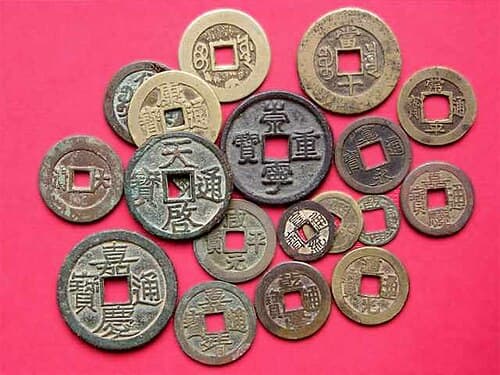
Ancient Chinese coins with square holes, tied in groups of three with red string, are powerful feng shui wealth activators connecting the circular heavens with the square earth.

China
The Laughing Buddha — the round, joyful, sack-carrying monk — is China's most beloved symbol of happiness, wealth, and the simple abundance that comes from contentment.

