
5
Protection
🖐️
Hamsa Hand
Middle East
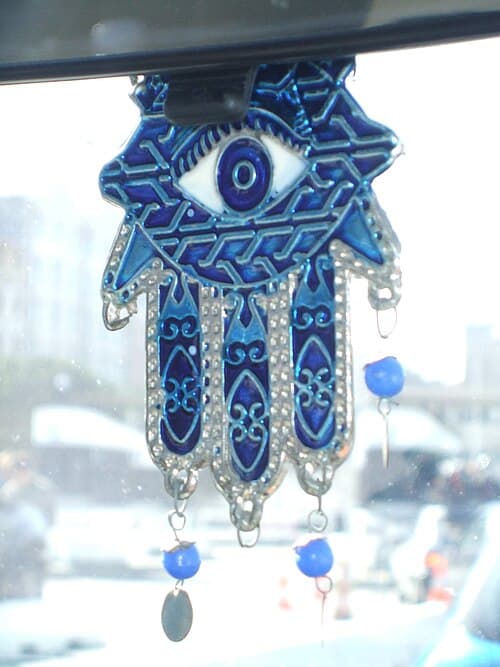
An open palm amulet warding off the evil eye across Middle Eastern and North African cultures.
4.9Learn more →

A brass door knocker shaped as the Hand of Fatima, protecting Tunisian homes at the threshold between public and private worlds.
The Tunisian Hand of Fatima door knocker is among the most eloquent architectural protective charms in the Islamic world — a functional object made sacred through form. Cast in brass, iron, or silver-plated metal, these door knockers take the shape of the khamsa (five-fingered hand), with the knocker itself suspended from the palm and producing a knocking sound when a visitor announces their presence. The genius of the design is that every knock is simultaneously a request for entry and an act of seeking protection — the hand protects the household from what's outside while simultaneously announcing what's outside to the household within.
In Tunisia's medina cities — Tunis, Sfax, Kairouan, Bizerte — the great wooden doors of traditional townhouses are among the finest examples of Islamic decorative woodworking in the world, and the door knocker is their crowning jewelry. Social customs around these doors carry their own protocols: in some traditional households, different knockers for men and women would produce different sounds, signaling to occupants who was at the door before it was opened, preserving feminine privacy. A single elegant hand knocker instead sent the occupants to the door to visually identify their visitor.
The Tunisian hand knocker has become an internationally beloved design object, widely reproduced and sold globally as a home decor item. But in its original context it is a complete philosophical statement: the threshold of a home is the most vulnerable and sacred boundary, and placing the Hand of Fatima there ensures that blessing enters with every welcomed guest and danger is turned away with every unwanted intrusion.
Protection of the household threshold, the filtering of welcome from unwelcome, and the blessing of hospitality — ensuring that what enters the home brings good and what wishes the home harm is refused entry.
Mount on an exterior door as both functional knocker and protective amulet. Hang a miniature version on an interior wall as a decorative protective charm for the household. Gift to someone moving into a new home as a blessing of protection and hospitality at their new threshold.
The blue color of many Tunisian doors — especially famous in Sidi Bou Said — is not merely aesthetic. Blue doors were traditionally colored to ward off evil spirits and the evil eye from entering the home, making the door itself a protective amulet in addition to any knocker or ornament upon it.
The blue doors of Sidi Bou Said and many medina cities are colored with a specific cobalt blue that was historically believed to repel insects (due to the natural properties of the indigo-based pigments) and evil spirits. The color has become so iconic it is now legally protected in Sidi Bou Said as part of the town's heritage.
Some traditional Tunisian townhouses did have two door knockers producing different sounds — a thin ring knocker for women visitors and a larger, heavier ball knocker for men. This allowed household members, particularly women, to know whether a male or female visitor was at the door before opening it, preserving privacy and observing social customs.
Modern apartment living has reduced the tradition, but in traditional riad and townhouse renovations across Tunisian medinas, installing a traditional door knocker remains a point of pride. The tradition is experiencing something of a revival as medina properties are restored and their owners seek to honor the architectural heritage.
Middle East
An open palm amulet warding off the evil eye across Middle Eastern and North African cultures.
Middle East / North Africa
The sacred open palm named for the Prophet Muhammad's daughter, a cornerstone of Islamic protective symbolism.

Tunisia
The lucky Tunisian fish amulet, a pre-Islamic fertility and abundance symbol still widely used across the country.

