

242
Success
🦌
Igbo Ikenga Figure
Nigeria
Horned Igbo personal shrine figure representing the right hand of achievement and personal destiny.
4.7Learn more →


Igbo women's body painting tradition encoding protection, beauty, and status in temporary living art.
Uli is the traditional body and wall painting tradition of Igbo women in southeastern Nigeria, particularly in Anambra and Imo states. Using dye extracted from the uli plant (Laportea aestuans) or from other natural pigments, Igbo women painted elaborate designs on their bodies — particularly on the torso, neck, arms, and legs — for important ceremonies including marriages, title-taking events, and festivals honoring deities. The designs, rendered in freehand by skilled practitioners in sinuous, flowing lines, combined curvilinear and geometric elements in compositions of great elegance. Each design element had a name and often a specific protective or aspirational meaning.
The uli tradition represents one of Africa's most sophisticated temporary art forms — its ephemeral nature was intrinsic to its meaning. The body painting was done fresh for each ceremony, lasting only a few days before fading, then renewed or redesigned for the next occasion. This temporality tied the art form to the specific moment of celebration, making it a living, breathing practice rather than a permanent fixture. The painter (typically a woman skilled in uli work) would spend hours creating the design, and the process itself — the patient, focused attention applied to another person's body — was a form of blessing and care.
Uli design principles profoundly influenced Nigerian modernist art in the 20th century. Artists at the Nsukka School of Art (University of Nigeria, Nsukka) — including Uche Okeke, who coined the term 'natural synthesis' — studied uli patterns and incorporated them into canvas paintings, sculptures, and graphic design. This synthesis of traditional uli with contemporary media created a distinctly Nigerian modernism. Today, uli-inspired designs appear in contemporary Nigerian fashion, textile design, and fine art, keeping the tradition alive in new forms.
Protective beauty as a form of spiritual armor, the blessing inherent in the process of careful, skilled attention applied to the body, celebration of significant life moments through living art, and the Igbo aesthetic principle of beauty as wellbeing.
Commission or learn to apply henna or natural plant-based temporary designs in uli-inspired patterns for important ceremonies — weddings, graduations, or personal celebration rituals. Use uli-pattern prints or textiles in clothing and home decor to carry the aesthetic and protective intentions of the tradition. Study the specific design elements and their meanings to choose patterns with personal resonance.
The Nsukka art movement's use of uli design in fine art was part of a broader pan-African effort in the 1960s-70s to assert African aesthetic values against dominant Western modernism. The movement produced several internationally recognized artists and established that indigenous African design traditions were not mere craft but sophisticated visual philosophical systems worthy of serious fine art exploration — a point that continues to resonate in contemporary African art discourse.
Uli dye is extracted from the leaves and stem of Laportea aestuans (a nettle relative), which produces a dark blue-black stain. The leaves are crushed or macerated, and the juice applied directly to the skin. The stain lasts several days to a week. Contemporary practitioners sometimes use commercial henna or natural plant dyes as substitutes.
Uli was applied by skilled women practitioners who learned the art from their mothers and senior women in the community. Particularly skilled uli painters (uli designers) were recognized community artists who could be commissioned for important ceremonies. The act of painting another woman's body was a social bond and a form of blessing.
The traditional body painting form has declined significantly, though it appears at major cultural festivals and in academic and artistic contexts. Contemporary Nigerian artists keep the tradition alive through canvas and paper works using uli-derived patterns. Textile designers incorporate uli motifs in printed fabrics. Cultural organizations in Anambra and Imo states work to document and preserve the traditional practice.
Nigeria
Horned Igbo personal shrine figure representing the right hand of achievement and personal destiny.

Nigeria
Consecrated charm aligned with a specific Yoruba orisha, channeling divine power for the wearer's protection and purpose.
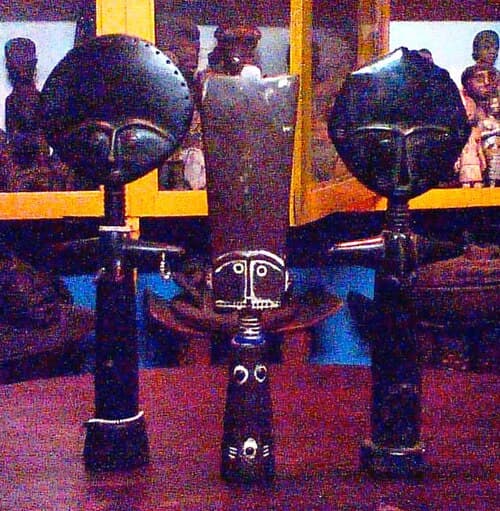
Ghana
The iconic Akan wooden fertility doll — carried by women hoping for children and by pregnant women blessing their unborn.

