

109
Love
♾️
Infinity Symbol
Ancient India / 17th-Century Europe
The infinity symbol — a horizontal figure eight — represents endless possibility, eternal love, and the boundless nature of the universe.
4.6Learn more →


The Yin Yang symbol represents the perfect balance of opposing forces — dark and light, feminine and masculine, rest and action — and is used globally as a talisman for harmony and well-being.
The Taijitu — known in the West as the Yin Yang symbol — originates from ancient Chinese Taoist philosophy, with its roots in cosmological observations recorded as early as the third century BCE. The symbol depicts two interlocking teardrops of black and white, each containing a small circle of the opposite color, expressing the fundamental Taoist teaching that all apparent opposites are in fact complementary, interdependent, and continuously transforming into each other.
Yin represents qualities associated with the moon, receptivity, softness, darkness, water, and femininity, while Yang embodies the sun, activity, strength, light, fire, and masculinity. The small circle of each color within the other half is crucial — it signifies that nothing is purely one thing: within darkness is a seed of light, and within light is a seed of darkness. This nuanced view of reality resonates far beyond China, aligning with concepts in Indian Tantra, Western alchemy, and modern physics.
As a lucky charm and wellness talisman, the Yin Yang is used globally to restore balance in times of stress, illness, or conflict. Feng shui practitioners place Yin Yang symbols in homes and offices to harmonize energy flows. Athletes wear them to balance aggression with recovery. Couples display them to acknowledge that their differences create a stronger whole.
Harmony, balance of opposites, complementary forces, wholeness, and the cycle of transformation.
Place a Yin Yang symbol in the center of your home or workspace to harmonize the energy of the entire space. Wear it as a pendant when you feel pulled in conflicting directions and need to find your center. During meditation, contemplate the symbol and the area of your life where you seek greater balance.
The Yin Yang symbol inspired the modern concept of complementarity in physics — Niels Bohr, one of the founders of quantum mechanics, was so moved by the Taijitu that he incorporated it into his personal coat of arms when he was knighted in Denmark.
It originates in Taoist philosophy, which is both a religion and a philosophical system. Today it is used widely as a secular symbol of balance and is not considered exclusively religious in most Western contexts.
When worn with respect and genuine appreciation for its meaning rather than purely as a fashion item, most practitioners consider it acceptable for anyone to use. Learning about Taoist philosophy deepens the charm's meaning and shows respect for its origins.
There is no strict rule for jewelry. In feng shui placement, traditional guidelines vary by compass direction and room function. For personal wear, place it whichever way feels balanced and visually harmonious to you.
Ancient India / 17th-Century Europe
The infinity symbol — a horizontal figure eight — represents endless possibility, eternal love, and the boundless nature of the universe.
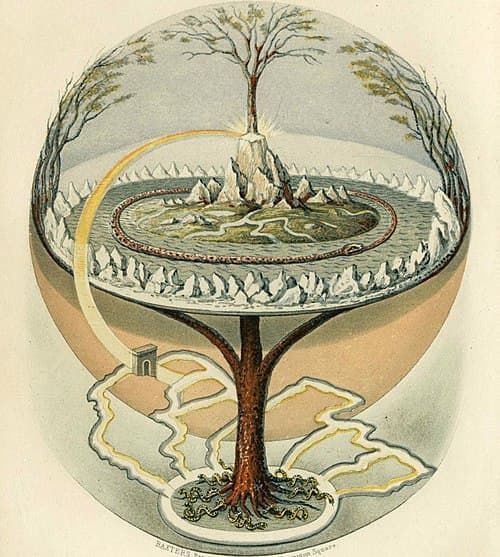
Ancient Mesopotamia / Multiple traditions
The Tree of Life is a universal symbol found in nearly every major world culture, representing the interconnection of all life, ancestral roots, and the continuous cycle of growth and renewal.

India
The eight-spoked wheel represents the Buddha's Noble Eightfold Path and the turning of cosmic law, one of the most universal Buddhist symbols.

