

27
Wealth
💛
Citrine Crystal
Brazil
The golden abundance crystal, known as the Merchant's Stone, carried to attract wealth, success, and the warm energy of solar prosperity.
4.8Learn more →

Your workspace shapes your financial destiny more than you might think. Learn how to apply ancient feng shui principles and the right lucky charms to transform your home office into a magnet for opportunity and prosperity.
The rise of remote work has turned millions of bedrooms, spare rooms, and kitchen corners into places of professional endeavour. But according to the ancient Chinese art of feng shui — the practice of arranging your environment to optimise the flow of vital energy, or chi — not all workspaces are created equal. The placement of your desk, the objects you keep around you, and the symbols you choose to display can have a profound effect on your professional success and financial wellbeing.
Here is a comprehensive guide to using feng shui lucky charms to transform your home office into a true prosperity hub.
Before placing any charm, you need to understand the bagua, feng shui's energy map. When applied to a room, the bagua divides the space into nine zones, each governing a different area of life:
To apply the bagua to your office, stand at the entrance door and use a compass to identify the directions. The southeast corner is your primary wealth zone and deserves the most attention.
Place a citrine crystal cluster in the southeast corner of your desk or office. Its warm golden colour resonates with the frequency of abundance, and unlike most crystals, citrine never needs energetic cleansing — it transforms negative energy rather than absorbing it. A citrine cluster placed near your computer or main work surface is said to infuse every task you complete with wealth-attracting energy.
Pro tip: Combine citrine with a small bowl of water (a feng shui wealth-activator) in the southeast corner for amplified effect.
Few feng shui tools are as beginner-friendly as lucky bamboo. A living plant, it generates fresh, active chi and, when placed in the wealth corner, continuously refreshes the prosperity energy of the space.
The number of stalks matters:
Keep lucky bamboo in clean water (change it every two weeks) and ensure it receives indirect light.
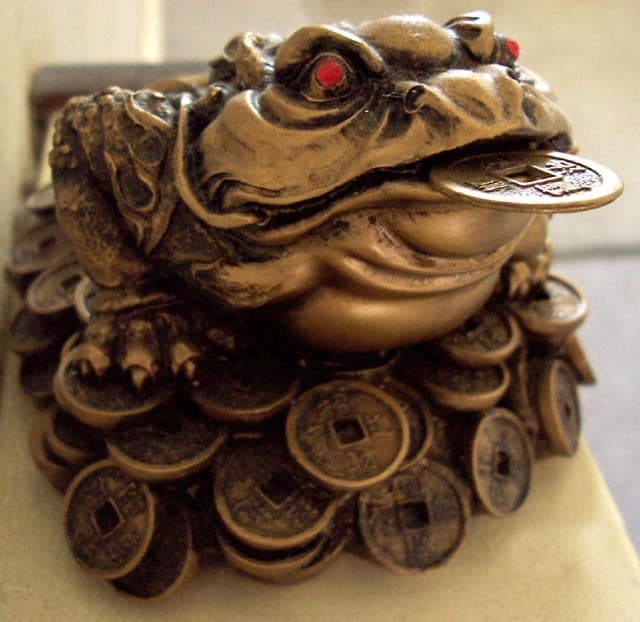
Place a three-legged Money Frog (Jin Chan) in the southeast corner of your office, facing inward (away from the door or windows). This mythical creature is the dedicated guardian of financial flow in feng shui and is said to prevent money from leaving the space while actively drawing more in.
Avoid placing the Money Frog in the bathroom, kitchen, or bedroom — it belongs in living spaces and workplaces where financial activity occurs.
A Laughing Buddha figurine on your desk or on a shelf at eye level or above infuses the workspace with the energy of contentment and abundance. The Laughing Buddha holding a gold ingot or a sack of treasure is specifically linked to financial gain.
Position him so he faces the main entrance of the room, greeting all who enter with his infectious joy.
An elephant figurine with its trunk raised upward, placed near the entrance to your office or on your desk, is said to bring wisdom, stability, and the strength to overcome professional obstacles. In Hindu and Buddhist traditions, the elephant (in its divine form as Ganesha) is specifically invoked before new business ventures.
Pair a small elephant with your most important work-related objects — your planner, your pitch deck, or your financial goals list — to anchor their success in powerful symbolic energy.
Before placing any charm, your desk must be in the command position. This means:
The command position is considered the most important feng shui principle for professional success because it puts you in the energetically dominant position in the room — aware of what enters the space, supported from behind, and positioned to act decisively.
Colours for wealth in feng shui:
Materials to favour:
Feng shui is as much about removing what blocks energy as it is about adding what activates it. In your home office:
When setting up or refreshing your feng shui workspace, try this simple ritual:
1. Clear the entire space of clutter, then clean all surfaces 2. Open a window briefly to allow stagnant energy to leave 3. Light a sage bundle or palo santo and walk the perimeter of the room clockwise, allowing the smoke to reach the corners 4. Place your chosen charms with clear intentions, speaking or writing what you desire to create in this space 5. Thank the space for supporting your prosperity
Repeat this ritual at each new moon to keep the energy of your home office fresh and aligned with your financial goals.
Feng shui and lucky charms are not substitutes for hard work, clear goals, and consistent action. But they are powerful environmental cues that keep your mind focused on your intentions throughout the working day. Every time you see your citrine crystal catch the light, glance at your Laughing Buddha, or notice your lucky bamboo flourishing, you are reminded of what you are working toward.
In that sense, the most powerful feng shui tool in your home office is you — oriented, energised, and fully aligned with the abundance you are creating.
Brazil
The golden abundance crystal, known as the Merchant's Stone, carried to attract wealth, success, and the warm energy of solar prosperity.

China
Lucky Bamboo is a feng shui staple believed to bring good fortune, prosperity, and positive energy when placed in the home or office.
China
The three-legged toad sitting on coins with a coin in its mouth is one of feng shui's most potent wealth activators, said to attract money and prevent it from leaving.

China
The Laughing Buddha — the round, joyful, sack-carrying monk — is China's most beloved symbol of happiness, wealth, and the simple abundance that comes from contentment.

Japan
The koi fish symbolizes perseverance, ambition, and transformation — the legendary carp that swam upstream and leaped the Dragon Gate to become a dragon.
Behind the mysticism lies a massive commercial machine. From Murano glass evil eyes to mass-produced Maneki-neko, the global lucky charm industry generates over $30 billion annually. Here is how the business of luck really works.
Are lucky charms mere superstition, or is there real psychology — and perhaps even neuroscience — behind why they work? The answer may surprise you.
Long before paper currency, coins were not just currency — they were sacred objects imbued with divine power. Explore how ancient civilisations from China to Rome turned money itself into the world's most practical lucky charm.

