

363
Health
🎀
Romanian Mărțișor
Romania
Romania's beloved spring charm — a red and white cord worn from March 1st to welcome new beginnings and health.
4.7Learn more →

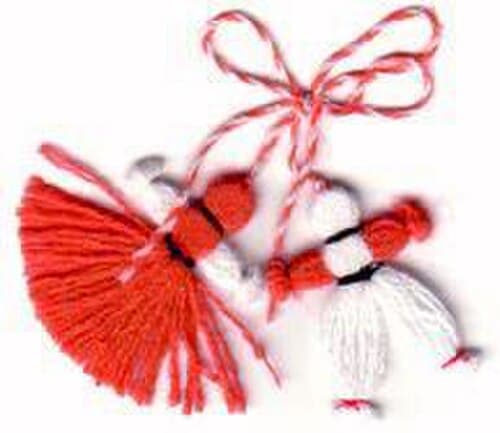
Bulgaria's red and white spring charm worn from March 1st to celebrate winter's end and invite health and happiness.
The Bulgarian Martenitsa is the Bulgarian version of the broader Balkanic spring cord tradition, and it is Bulgaria's most beloved annual folk custom. On March 1st — Baba Marta's Day — Bulgarians exchange martenitsi: small red and white ornaments made of twisted wool or thread, typically featuring Pizho (male, in white) and Penda (female, in red) — small woolen figures or simply a cord twisted in the two colors. They are worn on the wrist or pinned to clothing until the wearer sees the first stork or blossoming tree of spring.
The custom's legend involves Khan Asparuh, the medieval Bulgarian ruler who received the news of his sister's safe escape while a red-stained cord was sent as a message — the red of blood and hope combined with the white of the bird's message. More ancient roots trace to Thracian spring rituals predating Bulgarian ethnogenesis. Whatever the origin, the martenitsa has been continuous for at least 1,300 years.
When spring's sign appears, the martenitsa is tied to a blooming branch or placed under a stone — the health and happiness wished for in the charm transfers to the tree as an offering to nature. Looking under the stone a week later supposedly reveals the wisher's fortune: a worm means good health, an ant means busy activity ahead, a green plant means flourishing ahead.
Spring renewal, health at winter's end, the partnership of feminine and masculine principles in balance, the wish for happiness through a complete new season of life.
Pin or tie a Martenitsa to your left wrist on March 1st while making a health wish. Wear it until you see the first stork of spring or the first blossoming fruit tree. Then tie it to the blooming branch with gratitude, releasing your winter's accumulated wishes into spring's growth.
UNESCO recognized the Martenitsa tradition (along with Romanian Mărțișor, Macedonian Martinki, and Moldovan Mărțișor) as Intangible Cultural Heritage in 2017. The four countries filed a joint nomination, acknowledging the tradition's shared pre-national Balkan roots while celebrating each country's distinct expression of it.
Pizho is the white male figure and Penda is the red female figure in the most traditional martenitsa form. Together they represent the balance of opposing energies — winter and spring, death and life, male and female — that makes the charm complete.
Making and giving martenitsi is the most meaningful expression of the tradition. Handmade ones carry your love and intention most powerfully. Give them on March 1st morning before anything else for full luck transfer.
In urban settings, any blossoming flower, blooming tree in a park, or even a potted spring flower qualifies as the season's first sign. Some Bulgarians simply remove the martenitsa on March 22nd (the equinox) if no natural sign appears.
Romania
Romania's beloved spring charm — a red and white cord worn from March 1st to welcome new beginnings and health.

Bulgaria
The Rosa Damascena of Bulgaria's Rose Valley — the world's finest rose oil and a symbol of beauty, healing love, and fragrant abundance.

North Macedonia
North Macedonia's vibrant red poppy — a symbol of the fertile Vardar Valley, summer joy, and the resilience of beauty on difficult terrain.

