

72
General
☸️
Dharma Wheel
India
The eight-spoked wheel represents the Buddha's Noble Eightfold Path and the turning of cosmic law, one of the most universal Buddhist symbols.
4.7Learn more →

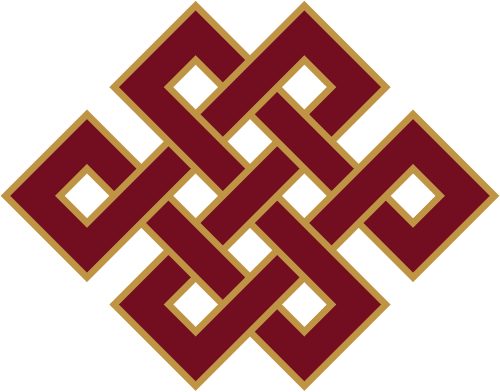
The Endless Knot (Shrivatsa) is one of the Eight Auspicious Symbols of Buddhism, representing the interconnectedness of all phenomena, infinite compassion, and the timeless wisdom of the Buddha.
The Endless Knot — a geometric design of interlocked loops with no beginning and no end — is one of the Eight Auspicious Symbols (Ashtamangala) of Tibetan Buddhism, shared also in Jain iconography and early Hindu art. It appears on the sole of the Buddha's foot in some artistic traditions, in the center of the Eight Auspicious Symbols arrangement, and in the complex geometric decorations of Tibetan thangka paintings, Buddhist temples, and ceremonial objects.
The primary meanings attributed to the Endless Knot center on the nature of interdependence — the Buddhist teaching that all phenomena arise in dependence on other phenomena, with nothing existing in isolation. The knot's interlocking loops graphically demonstrate that pulling one loop affects all others, just as every action, thought, and being is connected to every other. It also represents the union of wisdom and compassion — the two wings of the bird of enlightenment — which must both be cultivated simultaneously and which support each other.
As a lucky charm, the Endless Knot is given as a symbol of long life (because the pattern has no end), eternal love (because the connection never breaks), and good fortune (because its complexity represents the infinite possibilities of interdependent arising). It appears on Tibetan good luck cards, engraved on jewelry, woven into cloth, and carved into building facades.
Interdependence of all things, infinite compassion, the union of wisdom and method, long life, eternal connection, and the complex web of causality.
Wear an Endless Knot pendant to remind yourself of your connections to all beings and to cultivate a sense of interdependence in your actions. Give one as a symbol of everlasting friendship or love whose connection can never be unraveled. Place an Endless Knot image in your meditation space to contemplate the nature of interdependence.
The Endless Knot appears in ancient Roman, Celtic, and Chinese art as well as Indian and Tibetan traditions — the pattern is so fundamental to human pattern-making that it was independently invented across cultures long before any cultural exchange could have spread it.
While it is most prominently associated with Tibetan Buddhism, the Endless Knot appears in ancient Indian, Roman, Celtic, and Chinese traditions as well. It has been independently generated across cultures as a universal geometric meditation on infinity.
Yes. Its unbreakable interlocking structure makes it an excellent symbol for enduring love and friendship. It is often given at weddings and as anniversary gifts in Asian cultures.
Both are interlacing patterns with no clear beginning or end, but they developed in separate cultural contexts. Celtic knots originated in early medieval European illuminated manuscripts. The Endless Knot originates in ancient Indian and Tibetan Buddhist iconography and has specific auspicious religious significance.
India
The eight-spoked wheel represents the Buddha's Noble Eightfold Path and the turning of cosmic law, one of the most universal Buddhist symbols.

Ancient India
Buddhist prayer beads (mala) are used across all Buddhist traditions as a tool for counting mantra repetitions and sustaining meditative focus, while serving as a protective and calming talisman.
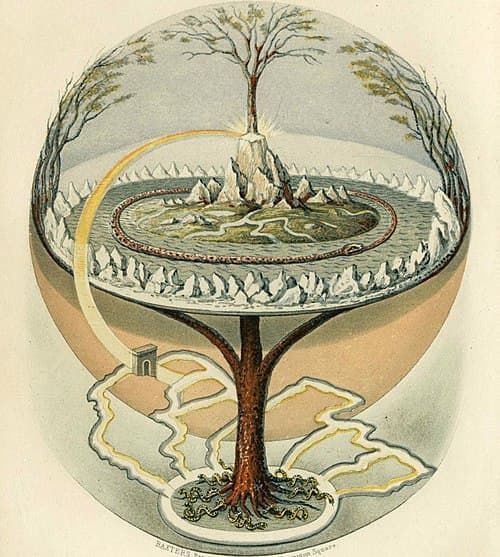
Ancient Mesopotamia / Multiple traditions
The Tree of Life is a universal symbol found in nearly every major world culture, representing the interconnection of all life, ancestral roots, and the continuous cycle of growth and renewal.

