

472
Protection
🧿
South Asian Evil Eye
India
The blue-and-white eye amulet protects against the malicious gaze of envy, widely used across South Asian communities.
4.6Learn more →

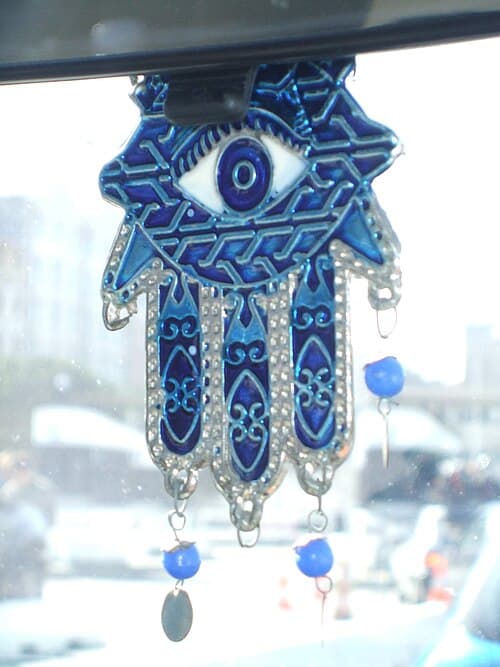
The open palm amulet protects against the evil eye and channels divine blessing, appearing across Hindu, Muslim, and Jewish traditions throughout South Asia.
The Hamsa hand (from the Arabic and Hebrew word for 'five,' referring to the five fingers) is a palm-shaped amulet used for protection against the evil eye, with an eye depicted in the center of the palm that sees and deflects malicious gazes before they reach the bearer. In South Asia, the Hamsa is used across Hindu, Muslim, and Jewish communities (particularly among Indian Jews, Bene Israel, and Cochini Jews), a remarkable example of a single protective symbol functioning across three major Abrahamic and Dharmic traditions simultaneously.
In Hindu tradition, the Hamsa hand is associated with the gesture of abhaya mudra — the open-palmed gesture made by deities signifying 'fear not.' This gesture, made by Shiva, Vishnu, the Buddha, and countless other divine figures in sculpture and painting, communicates divine protection to devotees. The Hamsa amulet takes this divine gesture and makes it portable, allowing the wearer to carry the deity's protective gesture with them continuously. The eye in the center of the palm replaces or supplements the eye-based protective function of the standard nazar bead.
In Muslim South Asian culture (Pakistan, Bangladesh, and Muslim communities in India), the Hamsa appears both as the generic protective hand and in its specifically Islamic form as the 'Hand of Fatima' (Khamsa), associated with the Prophet Muhammad's daughter Fatima Zahra, whose five key virtues are represented by the five fingers. This dual association makes the Hamsa one of the most cross-culturally versatile protective amulets in existence, comfortable across religious boundaries in a way that strictly religious symbols rarely achieve.
Divine protection through the open-palm gesture of fearlessness, deflection of the evil eye, the blessings of divine feminine power, and transcultural protection.
Hang a Hamsa in the home with the palm facing downward to actively repel negative energies and evil eye. Wear as a pendant or bracelet for personal protection. Place a large decorative Hamsa at the main entrance as both decoration and protection. The hand can face either direction — downward for protective deflection, upward for attracting blessings.
The Hamsa is one of only a handful of sacred symbols used comfortably across Jewish, Christian, Muslim, and Hindu traditions in the same geographic region (South Asia) without significant theological controversy — a testament to its ancient, pre-religious origins as a simple protective gesture that all traditions could interpret within their own frameworks.
Both orientations are used. A downward-facing Hamsa (fingers pointing down) is the more common protective form, actively repelling evil and negative energies. An upward-facing Hamsa (fingers pointing up, resembling a raised hand in greeting) invites good luck and blessings. Many people use downward-facing for doorway protection and upward-facing for jewelry.
Yes — the Hamsa's cross-cultural and cross-religious acceptance makes it particularly appropriate for those who prefer symbols that transcend specific religious frameworks. It functions purely as a protective symbol, and its efficacy in folk tradition is not tied to the bearer's specific religious practice. Many secular South Asians use it comfortably.
'Khamsa' is the Arabic pronunciation of the word for five, used specifically in Islamic North African and Middle Eastern contexts, often called the Hand of Fatima. 'Hamsa' is the Hebrew pronunciation of the same word, used in Israeli and Jewish tradition, often called the Hand of Miriam. In South Asia, both terms appear, along with the Sanskrit concept of abhaya mudra. All refer to essentially the same protective palm symbol.
India
The blue-and-white eye amulet protects against the malicious gaze of envy, widely used across South Asian communities.
India
The nazar battu is India's traditional evil eye repellent, a black effigy or symbol that absorbs jealous glances and protects its bearer.

India
The decorative forehead dot marks the ajna chakra, protecting the wearer and concentrating intuitive power.

India
The primordial sound of the universe, Om is the most sacred symbol in Hinduism, Buddhism, and Jainism.

