

473
Protection
🧿
Indian Evil Eye (Nazar Battu)
India
The nazar battu is India's traditional evil eye repellent, a black effigy or symbol that absorbs jealous glances and protects its bearer.
4.7Learn more →

The blue-and-white eye amulet protects against the malicious gaze of envy, widely used across South Asian communities.
The evil eye protective amulet in its blue glass or enamel circular form is found throughout South Asia as well as across the Mediterranean, Middle East, and Central Asia — evidence of the shared ancient silk road cultures that distributed this protective symbol across a vast swath of the world's population. In South Asian usage, the evil eye charm is most commonly called 'nazar' (from the Arabic and Urdu for 'sight' or 'gaze') and is used specifically to deflect the nazar (evil eye) cast by jealous or over-admiring glances.
The blue color of the most widely recognized evil eye charm is specifically associated with the sky and divine protection in many Middle Eastern and Mediterranean traditions that reached South Asia through trade contact. The eye itself, drawn on the amulet, functions according to the principle of sympathetic magic: an eye stares back at the evil eye, making it aware that it has been seen, which neutralizes its power. The combination of confrontational gaze and protective color creates a complete defensive system in a single small object that can be hung anywhere — on a baby's cradle, above a doorway, on a car's rear-view mirror, or worn as jewelry.
Modern design culture has made the blue evil eye one of the most globally recognized symbols, and South Asian diaspora communities worldwide display it as both a cultural identifier and a practical protective tool. The charm's ubiquity in Indian jewelry markets, Pakistani shops, Sri Lankan homes, and Bangladeshi households attests to its deep integration into the daily protective practices of this entire region, regardless of the religious background (Hindu, Muslim, Buddhist, or Christian) of the user.
Active protection against the envious or over-admiring gaze of others, the neutralization of jealous thoughts directed toward the bearer, and a visible statement of one's awareness of psychic threats.
Hang a blue evil eye charm at the entrance of your home, in your car, or above your child's sleeping area. Wear as a bracelet or pendant for personal protection. For children, attach a small evil eye bead to clothing or the cradle. Replace the charm if it cracks or breaks — a broken charm has absorbed a significant negative energy and has fulfilled its purpose.
Blue glass evil eye beads (nazar boncuğu) are manufactured primarily in Turkey, but distributed worldwide. Turkey produces hundreds of millions of these beads annually, making the Turkish glass bead industry one of the largest producers of a single amulet form in the world. South Asian markets import them by the ton from Turkish producers.
No — nazar belief crosses all religious communities in South Asia. Hindu, Muslim, Sikh, Buddhist, and Christian South Asians all maintain versions of evil eye belief and protection practices. This universality suggests the belief predates the major religious traditions in the region and represents a fundamental layer of folk spirituality common to all.
In most South Asian traditions, the person casting the nazar is not harmed — they may be entirely unaware of doing it. However, some traditions hold that a person whose gaze is considered particularly powerful (drishti-doshis) may inadvertently cause themselves discomfort when their own evil eye reflects back at them from strong protective amulets.
Multiple methods are used simultaneously: applying a kohl (kajal) dot behind the ear or on the foot, tying a black thread on the wrist, hanging a nazar bead above the cradle, and performing the nazar utarna ritual weekly. The combination of multiple methods is considered more effective than any single approach, as different methods address different avenues of the evil eye's entry.
India
The nazar battu is India's traditional evil eye repellent, a black effigy or symbol that absorbs jealous glances and protects its bearer.

India
The decorative forehead dot marks the ajna chakra, protecting the wearer and concentrating intuitive power.
India
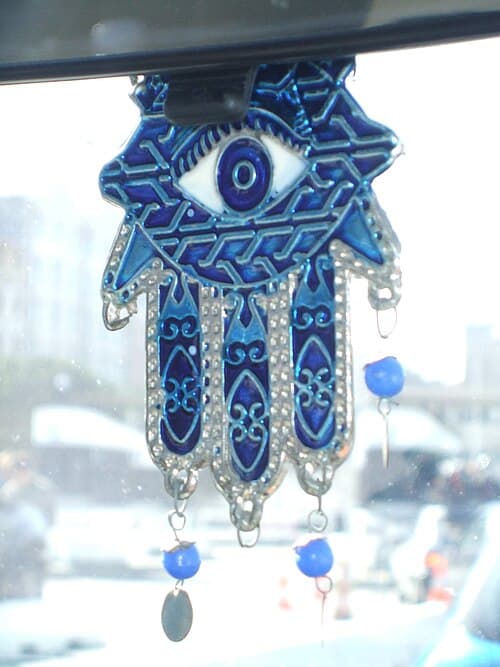
The open palm amulet protects against the evil eye and channels divine blessing, appearing across Hindu, Muslim, and Jewish traditions throughout South Asia.

India
Turmeric root is a sacred healing spice used as a talisman for purification, protection, and auspicious new beginnings.

