

76
General
☸️
Nepalese Prayer Wheel
Nepal
A spinning cylinder filled with mantras generates merit and blessings with each rotation, making every turn a complete prayer.
4.7Learn more →

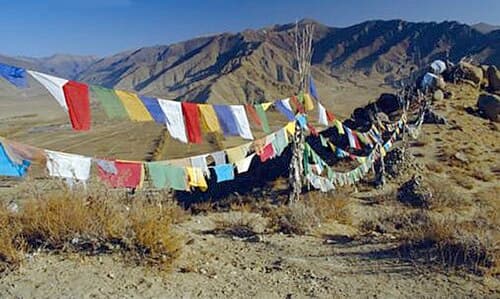
Colorful rectangular flags inscribed with mantras and prayers send blessings to all beings as the wind carries their words across the world.
Tibetan-Nepalese prayer flags (Lung ta in Tibetan, meaning 'wind horse') are rectangular cloths printed with mantras, sacred images, and prayers, strung on lines to be moved by the wind. The fundamental principle is the same as the prayer wheel: as the wind moves through the flag, it picks up the prayers and mantras printed on them and carries them to all beings in all directions. Unlike personal prayer, which benefits primarily the person praying, prayer flags are an act of universal compassion — their blessings are offered to every living being touched by the wind that passes through them.
Prayer flags come in five colors, each representing one of the five elements: blue (sky/space), white (water/air), red (fire), green (wood/water), and yellow (earth). The correct arrangement of colors from left to right is always blue, white, red, green, yellow. The central image on most prayer flags is the Wind Horse (Lung ta) — a horse carrying a flaming wish-fulfilling jewel on its back, surrounded by the four animals of the four cardinal directions (garuda, dragon, tiger, snow lion). The Wind Horse represents the vital energy of the individual that, when properly activated, carries prayers swiftly to their fulfillment.
Prayer flags fade and wear out over time, which is considered correct and desirable — as the flags age and their colors are washed into the sky by rain and their fibers are carried on the wind, the prayers within them are gradually released into the world. A flag that has become so old it is tattered has fulfilled its entire purpose and should be replaced with fresh flags, with the old ones burned respectfully (never simply discarded) so their prayers complete their journey through fire.
Universal compassion expressed through the offering of prayers for all beings, the five elements in perfect balance, and the vital energy (Lung ta) of the practitioner propelling their aspirations into reality.
Hang prayer flags in a high place with good wind exposure: rooftops, mountain passes, between trees in a garden. The line of flags should run east to west. Hang new flags on auspicious days — Losar (Tibetan New Year), full moon days, or the waxing half of the lunar month. When flags become tattered, burn them respectfully and replace with fresh ones.
During the 1953 first ascent of Everest, Sir Edmund Hillary and Tenzing Norgay left prayer flags at the summit — a tradition that all subsequent Everest climbers have continued. Tens of thousands of prayer flag sets now flutter at the base camps and high camps of Everest, making the world's highest mountain also one of the world's densest concentrations of prayers.
Yes, though interior flags cannot receive wind and thus release their prayers less actively than outdoor flags. Indoor prayer flags are still considered a positive presence that purifies the space through their sacred imagery and inscriptions. For full efficacy, exterior placement with good air movement is preferred. Some practitioners hang indoor flags near open windows or ceiling fans.
Traditional prayer flags are inscribed in Tibetan script with Sanskrit mantras. The sacred syllables are considered to carry intrinsic power independent of the reader's understanding — a property called 'mantra power' that operates through sound resonance rather than semantic meaning. English-translation prayer flags are available but are considered less traditionally potent.
Prayer flags are used widely by non-Buddhists who appreciate their beauty and the principle of sending good wishes outward into the world. The Dalai Lama has encouraged their universal use as symbols of compassion. The flags' prayers being offered 'for the benefit of all beings' is inherently inclusive — there is no tradition requiring the person hanging flags to be Buddhist.
Nepal
A spinning cylinder filled with mantras generates merit and blessings with each rotation, making every turn a complete prayer.

Nepal
Metal bowls that produce healing resonant tones when struck or rimmed are used for meditation, sound healing, and space purification.
Nepal
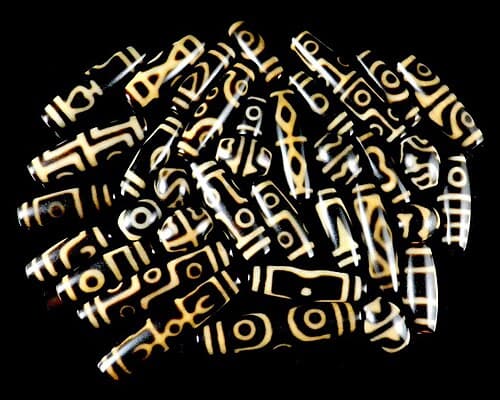
Mysterious ancient beads with eye-like patterns are among the most powerful and expensive amulets in Tibetan Buddhist tradition.

India
The eight-spoked wheel represents the Buddha's Noble Eightfold Path and the turning of cosmic law, one of the most universal Buddhist symbols.

