
75
General
🏳️
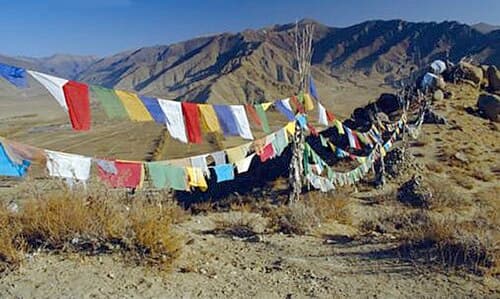
Nepalese Prayer Flags
Nepal
Colorful rectangular flags inscribed with mantras and prayers send blessings to all beings as the wind carries their words across the world.
4.7Learn more →


A spinning cylinder filled with mantras generates merit and blessings with each rotation, making every turn a complete prayer.
The prayer wheel (Tibetan: mani chos 'khor; Nepali: mani chakra) is a cylindrical device filled with tightly rolled paper or metal sheets inscribed with mantras — most commonly Om Mani Padme Hum, the mantra of Avalokiteshvara, the Bodhisattva of compassion. Each rotation of the wheel is considered equivalent to verbally reciting all the prayers contained within it once. A single prayer wheel may contain millions of mantra repetitions printed in tiny script, meaning a single spin generates the merit of millions of prayers — making the device an extraordinary efficiency mechanism for the accumulation of spiritual merit.
The theological basis for the prayer wheel's efficacy in Tibetan Buddhism lies in the understanding that the power of a mantra is not dependent on the speaker's conscious awareness of its meaning — the sound vibration itself creates the spiritual effect. Just as wind blowing through prayer flags inscribed with mantras is considered to spread the mantras' blessings across the landscape, a prayer wheel turning in a person's hand continuously radiates the blessings of its contained mantras in all directions. This understanding makes the prayer wheel one of the most practical and compassionate inventions in world religion: even while walking, working, or resting, the practitioner generates merit for all beings.
Prayer wheels come in sizes ranging from small hand-held versions to enormous fixed wheels at monastery entrances that take two hands and a full body rotation to spin, to water-powered prayer wheels at river banks that spin continuously day and night without human intervention. In Nepal and Tibet, passing a row of prayer wheels and spinning each one with the right hand as you walk by is one of the most common acts of daily devotional practice — a mobile prayer that takes no time away from other activities.
Continuous generation of merit and compassion for all beings, the democratization of spiritual practice, and the practical expression of Mahayana Buddhism's commitment to the liberation of every living creature.
Hold the prayer wheel in your right hand and spin it clockwise (the same direction as the mantras are written). The spinning should be smooth and continuous. Recite Om Mani Padme Hum aloud or mentally while spinning for enhanced effect. Walk clockwise around temples and stupas spinning the wheel. Keep the wheel clean and treat it as a sacred object.
The largest prayer wheel in the world is located in Gyantse, Tibet, and stands over 11 meters tall. Some large prayer wheels installed at monasteries and pilgrim sites contain not just paper scrolls of mantras but also Buddha statues, sacred relics, and thousands of prayer flags compressed inside — essentially a portable stupa.
The wheel generates its full merit only when spinning — a stationary prayer wheel is spiritually inert, analogous to a prayer book that remains unopened. However, the act of keeping and maintaining a prayer wheel with respectful intention is itself considered meritorious. The combination of proper storage, regular use, and respectful care generates the fullest benefit.
Electric prayer wheels are widely used in modern Tibetan Buddhist practice and are considered fully valid by most teachers. Solar-powered prayer wheels that spin continuously are installed at many stupas and temples. The Dalai Lama has endorsed electronic prayer wheels, arguing that the source of electricity (ultimately the sun or wind) is natural and the spinning is genuine.
At minimum, the Om Mani Padme Hum mantra written millions of times. More elaborate wheels contain additional Buddhist texts: the Prajnaparamita Sutra, Vajrasattva mantras, and other dharanis. Sacred substances like relics, healing herbs, and blessed grains may be included. The quality of the printed text (correct script, proper materials) matters more than quantity of material.
Nepal
Colorful rectangular flags inscribed with mantras and prayers send blessings to all beings as the wind carries their words across the world.

India
A string of 108 prayer beads used for mantra repetition, mala beads align the practitioner's energy with divine intention through meditative counting.

India
The eight-spoked wheel represents the Buddha's Noble Eightfold Path and the turning of cosmic law, one of the most universal Buddhist symbols.

India
A leaf from the sacred Bodhi tree, site of the Buddha's enlightenment, is a tangible connection to the moment of history's most celebrated awakening.

